

Summary of the situation
As the leading winter resort in the Balkans, Bansko has long competed with low prices against the giants in France, Austria and Switzerland. However, the announced pricing strategy for the new season — with a seasonal lift pass price of 1700 BGN (approximately €869) — suggests a confident, and perhaps aggressive, repositioning of market value. This report explores the central economic question: Is this price justified for the 2025/2026 ski season in Bansko?
1. Macroeconomic and currency context: 2025/2026
Pricing decisions for the 2025/2026 season cannot be analyzed in a vacuum. They are the result of a unique combination of monetary policy, regional inflation, and strategic profitability management by the resort operator., Yulen AD.
1.1 Convergence with the Eurozone
Bulgaria will officially adopt the euro on January 1, 2026. This historic transition places the winter season in a unique „borderline“ state. The season begins in December 2025 with the Bulgarian lev (BGN) and switches to the euro at the height of winter.
- 🔵 Fixed rate: The exchange rate is locked at 1.95583 BGN per euro. This ensures theoretical stability.
- 🔵 Psychological impact: For international tourists, the transition makes payments easier. For Bulgarians, however, the concern is related to "Euroflation" - the rounding up of prices.
- 🔵 Operational transparency: After the introduction of the euro, prices for the 2025/2026 ski season in Bansko will be directly comparable to those in Italy and Austria, removing the "veil of cheap currency".
1.2 The narrative of the „Last Budget Season“
Industry analysts are characterizing the current period as the „end of an era.“ Expectations are that price convergence with Western Europe will accelerate, creating a „buy now“ urgency. The rate of increase in ski pass prices in Bansko is already outpacing many mature Alpine markets.
2. Anatomy of Prices: Ski Season in Bansko 2025/2026
To determine the justification, we need to look at the exact burden of costs on the consumer. Here's a breakdown of the official and projected prices.
| Category | Age | Price (BGN) | Price (€ approx.) | Notes |
|---|---|---|---|---|
| Adult | 19 – 64 years old. | 1,700 BGN. | €869.20 | Base rate for the season. |
| Students | 12 – 18.99 years. | 1,600 BGN. | €818.07 | Minimum discount (<6%). |
| Child | 7 – 11.99 years. | 900 BGN. | €460.16 | ~53% from the adult price. |
A critical look at family pricing: A glaring omission is the lack of a "Family Card". For a family of four (2 adults + 2 children over 12), the total price can reach 5,900 BGN (~€3,016). This erodes the rationale for families using “Family Flex” packages in the Alps.
2.2 Daily and short-term prices
The daily chart is expected to be around 110 BGN (€56), and the 6-day one – around 550 BGN (€280). At €56 per day, Bansko is positioned in the „Middle Class“, competing with the smaller Austrian resorts.
2.3 The „VIP“ Card: Monetizing Inefficiency
A unique feature is the VIP card for fast access to the gondola. Economically, this is an admission of infrastructure failure – the resort charges extra to solve the waiting problem it creates.
3. Comparative Market Analysis: The „Justification“ Test“
The central thesis of this report is based on benchmarking. What do you get for your money here compared to the competition?
In the Three Valleys (France) you pay ~€2.63 per km of track.
In Bansko you pay ~€11.58 per km of track.
Bansko is 4 times more expensive based on ski terrain.
Comparison with Andorra (Grandvalira) – The Direct Competitor
Andorra is the most relevant competitor. Here's how things look:
- Bansko Seasonal Card: ~€869 for 75 km of slopes.
- Grandvalira (Andorra) Seasonal Map: ~€855 for 308 km of slopes.
Verdict: Unjustified. Bansko is already more expensive than the largest resort in the Pyrenees, which offers many times more slopes and modern infrastructure.
The destructive alternatives: Magic Pass and Gudauri
The Swiss Magic Pass (€450 early bird) gives access to 80 resorts – half the price of Bansko. On the other hand, Gudauri (Georgia) is establishing itself as the "New Bansko" with a season price of just €230 and similar terrain, attracting budget tourists.
4. Consumer Attitudes and the Experience Gap
The price is only „high“ if the quality is not up to par.
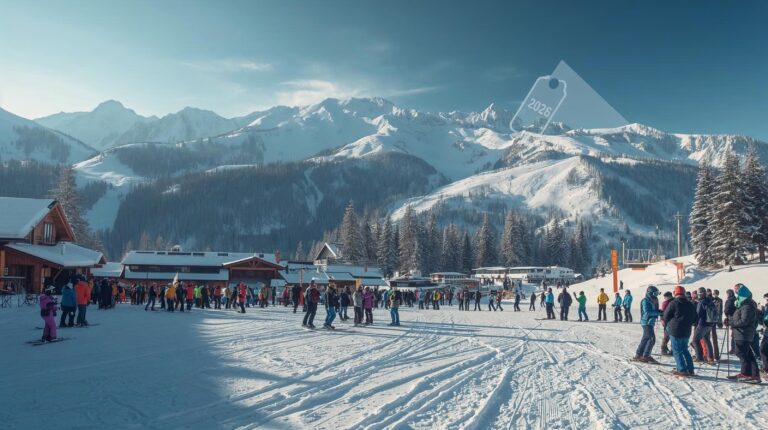
- The problem with the elevator: Queues of 1.5 to 2 hours are the norm. Many tourists pay extra for vans, which is a hidden "transport tax".
- Local attitudes: Bulgarians find prices to be exclusionary. The attitude towards people with disabilities is also a problem.
- Digital nomads: For them, the price is justified as a "lifestyle subscription" since they can ride during the week without queues.
5. Total Vacation Value (TVV): The Lifeline
If the lift pass for the 2025/2026 ski season in Bansko is overpriced, why is the resort full? The answer is in hotels and food.
Bansko subsidizes the expensive lift with cheap extras. A 4-star hotel with a spa can cost €60-€80 per night, while in the Alps it is €300+. For a 7-day holiday, a family saves €1,500 – €2,000 on accommodation. This massive saving makes the lift pass surcharge irrelevant in the overall budget.
6. Conclusions and Verdict
Is the price for the 2025/2026 ski season in Bansko worth it? The answer depends on who you are:
For the Sport Skier: NO
If you are looking for miles of slopes and fast lifts, Bansko is not economically viable. Choose Andorra or France (Isola 2000).
For the Holiday Tourist: YES
Due to the low prices of hotels, food and nightlife, the total cost of the vacation remains 30-40% lower than in the Alps.
Future risk: Bansko is walking on thin ice. With prices in the west and infrastructure in the east, the resort risks falling into the „middle-income trap“ after the adoption of the euro. Without a solution to the gondola problem, competition from Georgia and Andorra will become increasingly fierce.
 English (UK)