


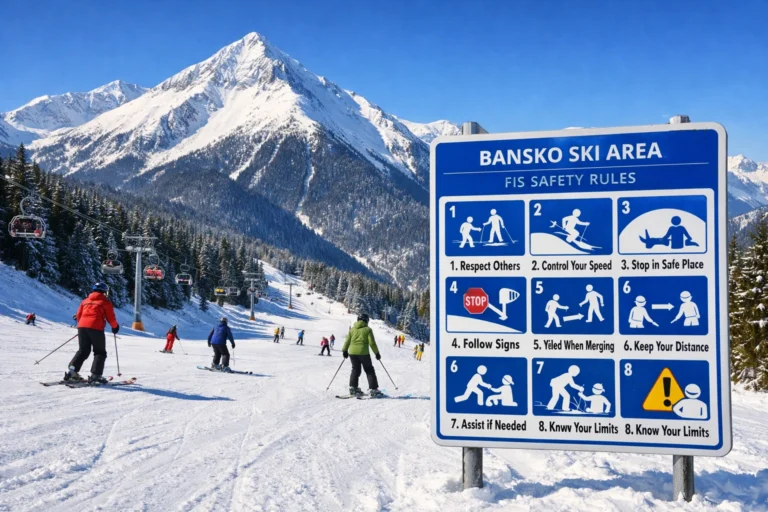
In this detailed guide, we will look at the official ski slope safety rules, established by the International Ski Federation (FIS). These ten gold standards are not just recommendations – they are the foundation of safety in winter resorts around the world and ensure that every skier and snowboarder returns home safe and sound.
Why are FIS rules mandatory in Bansko?
Many tourists approach skiing as pure fun, but legally speaking, the piste is a shared responsibility zone. The FIS rules are used by police, ski patrol and insurance companies to determine fault in collisions and accidents. In ski area Bansko the ski patrol strictly monitors their compliance and has the authority to revoke lift passes in case of gross violations.
The 10 golden rules for ski slope safety
1. Respect for others
Every participant in the movement on the slope must behave in such a way as not to endanger or harm others. This is the first and most important principle. Aggressive riding, “splitting” at speed near beginners or groups of children is absolutely unacceptable. Remember that there are people with different skill levels on the track.
2. Speed and riding style control
Your speed should be adjusted to your personal abilities, the terrain, the snow conditions and the traffic density. You should always be in full control. In Bansko, especially in sections like Banderitsa or Shiligarnika, conditions can change in hours – from powder to ice.
3. Trajectory Selection (Advantage)
The skier moving behind (higher up the slope) bears full responsibility for choosing his trajectory. He must ride in a way that does not endanger people in front of him. The skier in front always has the advantage., because he doesn't see what's happening behind him.
4. Safe overtaking
You can overtake from the left or right, above or below, but on one condition: always leave enough space for the overtaking vehicle. He must have room for any voluntary or involuntary movement (for example, a sudden swerve or turn).
5. Entering the track and leaving
Before you enter the slope or start after a break, you must look up and down the slope. Make sure you are not crossing the path of someone who is already moving at high speed. This is when most T-bone collisions occur.
6. Stopping the runway
Unless absolutely necessary, avoid stopping in tight spots or areas with limited visibility. If you fall, you must clear the area as quickly as possible. Always stop at the edge of the track, not in the center of the track.
7. Ascent and descent on foot
If you have to move on foot (for example, if you lose a ski or your equipment is damaged), be sure to do so at the very end of the slope. Deep steps in the groomed snow create dangerous bumps that can lead to falls for passing skiers.
8. Compliance with signs and markings
The information signs in the ski area are not decoration. The difficulty marking is key:
| Color | Difficulty | Suitable for |
|---|---|---|
| Green / Blue | Easy / Beginners | Children and first steps |
| Red | Intermediate / Advanced | Experienced skiers |
| Black | Expert | Professionals |
9. Providing assistance
In the event of an accident, every skier is obliged to come to the rescue. Mark the spot by driving crossed skis into the snow just above the injured person to warn others. Immediately call the Mountain Rescue Service (MRS) on 1470 (for all mobile operators).
10. Identification
Every participant or witness to an accident, regardless of whether they are at fault or not, is required to provide their personal data. This is crucial in insurance events or legal disputes.
Expert tips for skiing in Bansko
As a destination with a high elevation gain, Bansko also requires additional preparation beyond FIS rules:
- Wind check: Always check the wind speed before going up to the "Plateau". Strong gusts can cause the upper lifts to close.
- Equipment and helmet: Although FIS does not list it as rule #11, helmets are mandatory. Modern technologies (like MIPS) save lives.
- Mountain insurance: Make sure you have active insurance. Rescue operations in hard-to-reach areas off-piste can be extremely expensive.
- Alcohol: „Après-ski fun is great, but only after you've taken off your skis. Alcohol slows down your reactions and is responsible for 30% of the accidents at the end of the day on the "Ski Path".
Are you ready for the slopes under Todorka?
Awareness is the first step to safety. Check real-time weather and traffic conditions.

 English (UK)