


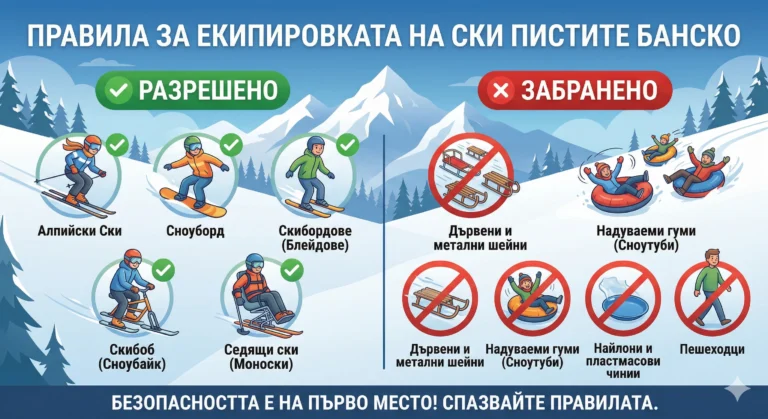
In this detailed guide, we will look at all the types of equipment you can legally use to conquer the mountain, as well as those you should leave for special areas or off-piste.
Classic equipment: What are we used to on the track?
These are the standard means of transportation on the snow. The entire infrastructure of the resort – from the chairlifts to the ski lifts – was designed primarily for them.
Alpine Skis
This is the absolute classic. Two skis with hard plastic boots that are securely attached to the bindings. Alpine skis are the most popular choice of all. ski slopes Bansko. They offer excellent control, speed and stability. There are different subcategories – for slalom, giant slalom, all-mountain (for all terrains) and freeride.
Snowboard
A wide board on which one stands sideways (with the left or right foot forward). Snowboarding experienced a boom in the 90s and is today an indispensable part of winter culture. The shoes are softer and more comfortable than ski shoes, and the feeling is closer to surfing and skateboarding.
Skiboards / Blades (Snowblades / Skiboards)
They are very short skis, usually between 70 and 100 cm long. They are ridden without poles. The blades are extremely maneuverable, easy for beginners to learn and allow for fun tricks on the piste. They are fully permitted and are often used as a transition to standard skis.
Telemark Skis
Telemark is an old technique that is coming back into fashion. In these skis, the heel of the boot is free (not attached to the automatic). The descent requires a specific technique of rhythmic squatting with each turn. Elegant, beautiful and completely legal on the piste.
Exotic Appliances: What was that strange thing?
We come to the most interesting part. Tourists often notice equipment that looks like a hybrid of different sports. Here are the permitted alternatives that you can find around Pirin:
Skibob (Skibob / Snowbike)
This is exactly that interesting device that is a bicycle frame, but instead of tires, it has two skis – one in front (for turning) and one in the back. A person sits on a seat, holds a handlebar and necessarily wears two additional very short mini-skis on their feet for balance and braking. The skibob is extremely gentle on the knees and joints, which makes it a favorite of people with previous injuries. It is allowed on the slopes, and getting on the lift is done in a specific but easy way.
Snowscoot
Imagine a BMX bike or a large scooter designed for snow. It has a wide board with edges, divided into two parts, and a handlebar for steering. You stand upright on it. Snowscooting is becoming increasingly popular in Bansko because of the adrenaline it offers and the possibility of extreme turns.
Sit-ski / Monoski (Sit-ski)
This is a specialized, high-tech equipment for adaptive skiing, designed primarily for people with physical disabilities or paralysis of the lower limbs. It is an ergonomic seat mounted on a sturdy shock absorber, which in turn is attached to a wide ski. The skier uses short poles with small skis on top for balancing. Bansko offers conditions for adaptive skiers and this equipment is welcome on the slopes.
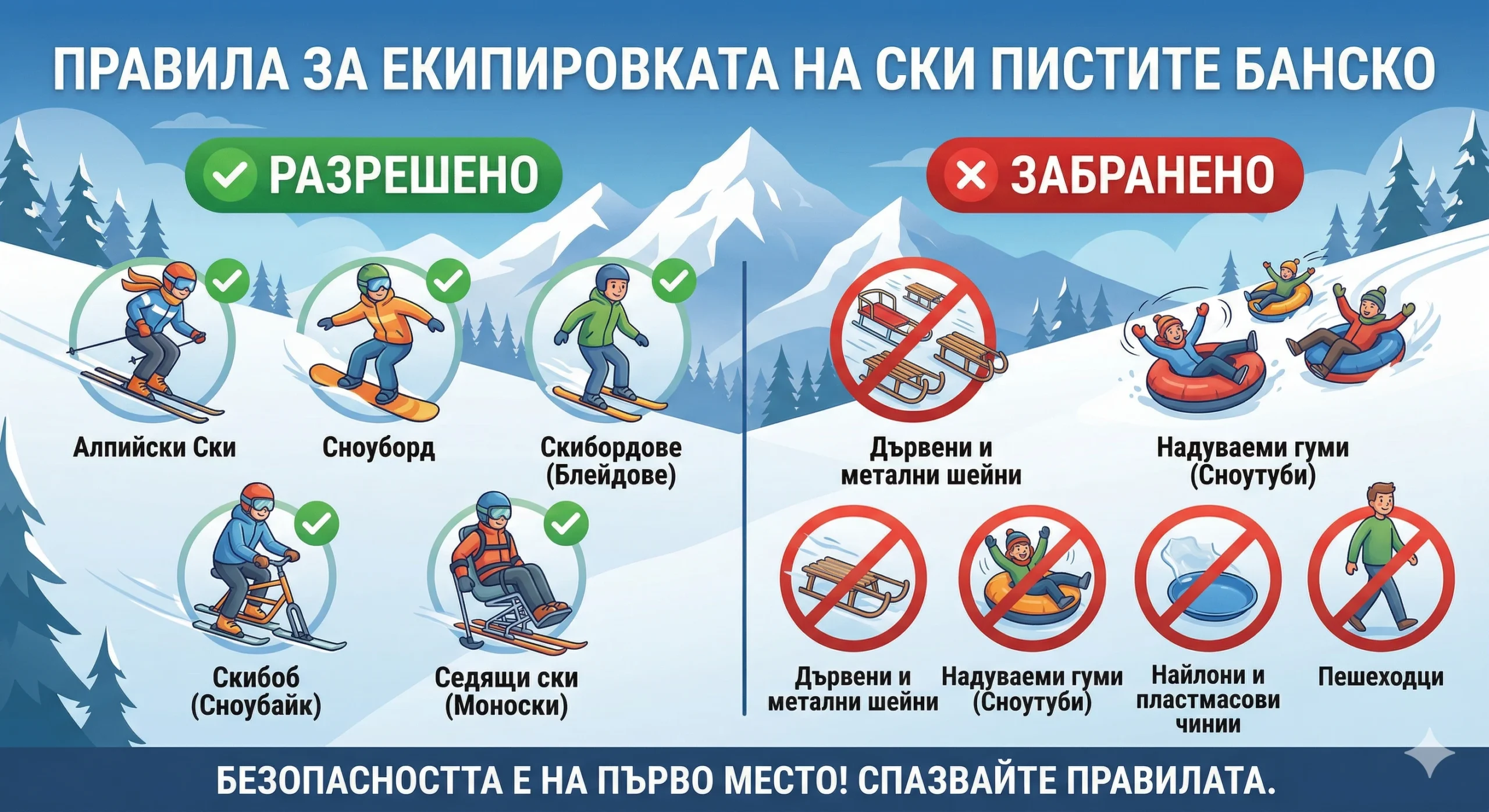
This infographic clearly illustrates which types of equipment are allowed (skis, snowboards, skibobs, monoskis) and which are prohibited (sleds, snowtubing, nylons, pedestrians) on the official ski slopes in Bansko.
ABSORBERS STRICTLY PROHIBITED
Marked ski slopes are high-risk areas. People travel on them at an average speed of 40-60 km/h. Any vehicle that does not have edges and a reliable braking system poses a deadly danger. Here's what definitely not to use there:
- Sleds (all types): Whether they are wooden, metal, plastic or “hammer” type with a steering wheel. Sleds do not have brakes that work on packed or icy snow, and they cannot make sharp maneuvers. Sledding down a ski slope is prohibited! There are designated meadows and specialized areas in the lower parts for them.
- Inflatable tires (Snowtubes): Snowtubing is fantastic fun, but the tires are completely uncontrollable and spin chaotically. They are only ridden in specially built chutes (such as those found on Banderishka meadow).
- Nylons, sacks and “plates”: The use of improvised skating materials is unthinkable on the territory of the official ski area.
- Pedestrians without equipment: Walking in the middle of the piste is extremely dangerous. Skiers do not expect static obstacles, and pedestrians' shoes destroy the integrity of the piste, creating holes that can cause injuries to skiers.
The FIS Golden Rules
Whether you are on skis, snowboarding or skibob, once you are on the slopes, you are required to follow the rules of the International Ski Federation. The most important of these are: The skier in front always has the advantage! The one descending behind or above him is obliged to choose a trajectory that avoids a collision. Always adjust your speed to your skills, visibility, the weather and traffic on the runway.
By following these guidelines, you guarantee both your health and the peace of mind of all other guests in the mountain.
 English (UK)