


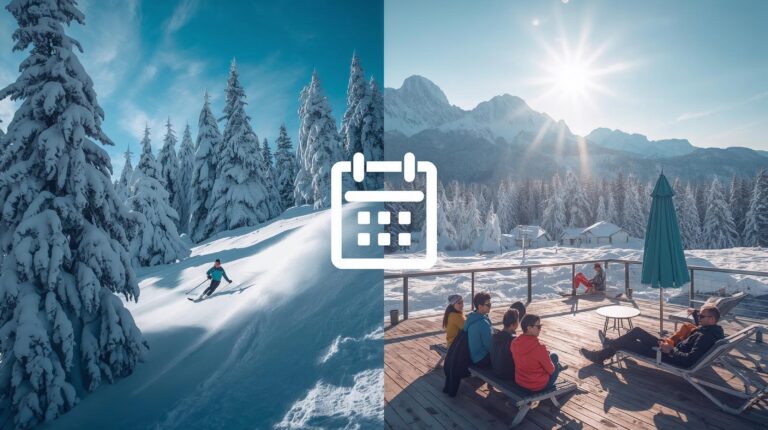
Bansko is the most popular winter resort in the Balkans and this is no coincidence – the unique microclimate of the Pirin Mountains provides one of the longest ski seasons in Eastern Europe (from mid-December to mid-April). To properly understand snow conditions, however, It is necessary to distinguish between the situation in the city itself (925 m above sea level).in.) and the one in the high mountains (up to 2600 m above sea level).in.).
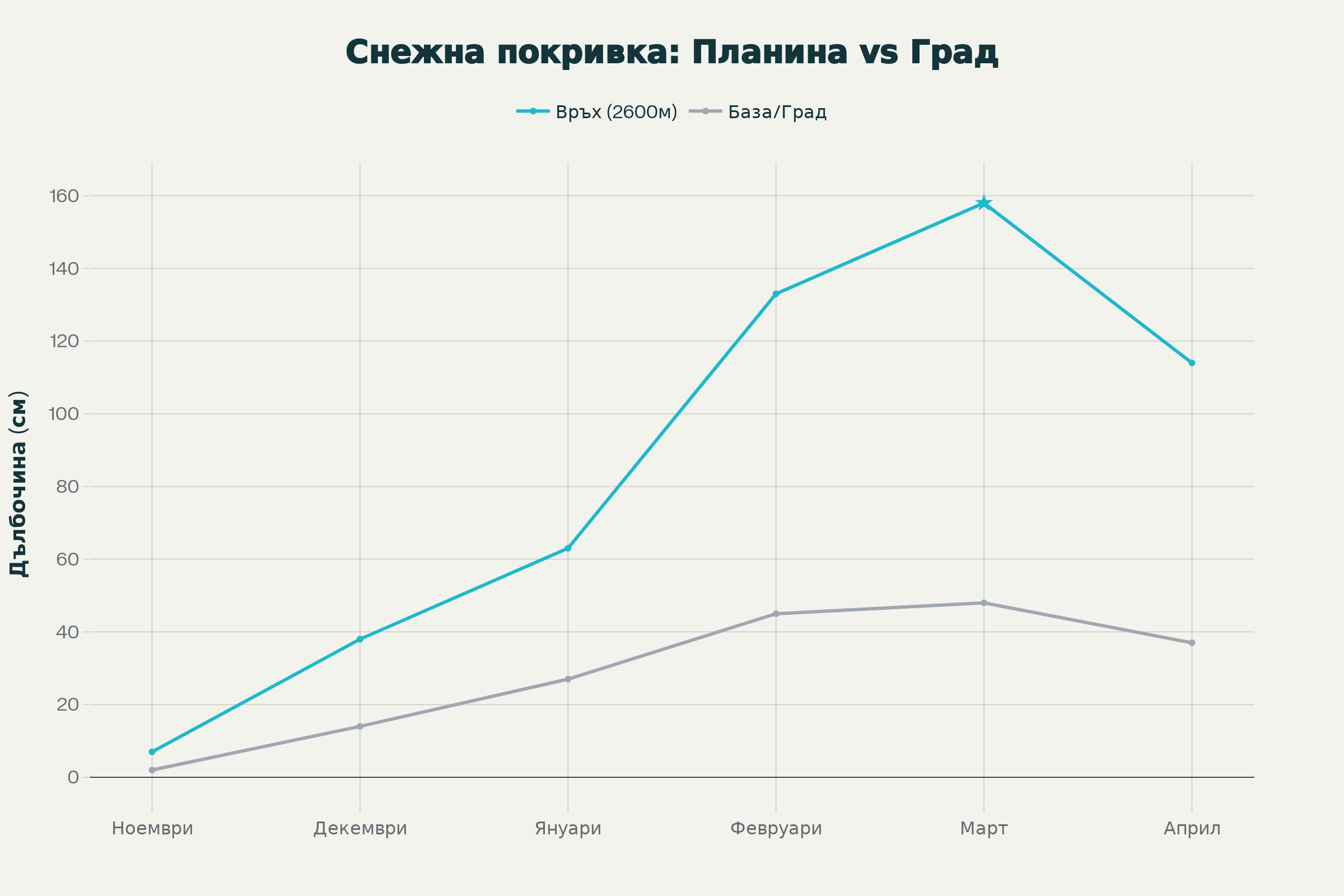
A statistical graph illustrating the difference in snow accumulation between the highlands of the ski area and the city, with a clear peak in snow cover in March.
Graphic: How much snow is there in reality?
One of the most common misconceptions is to judge the conditions of the slopes by the presence of snow in front of the hotel. The graph below clearly illustrates the drastic difference between the low and high zones:
Snow Cover Comparison: Peak vs. City (in cm)
Detailed analysis of snowfall by month
???? November: Preparation
-
In the city: It is usually dry or rainy.
-
In the mountains: The first snowfalls begin to "whiten" the peaks. Temperatures enough snow falls to start the snow cannons (over 230 in number), which create the so-called.called. „"pad" or artificial base.
❄️ December: Opening of the season
-
Snow: Average 13 cm of new snow for the month.
-
Conditions: The season usually opens around the middle of the month. The slopes of "Shiligarnika" and "Platoto" are open, but the snow cover is still relatively thin (about 40–60 cm at the top).
-
Risk: Before Christmas, the lower parts often rely mainly on technical (artificial) snow.
????️ January: The real winter
-
Snow: This is the coldest month with the most frequent precipitation (average 22 cm of new snow).
-
Conditions: The safest month for skiing. Temperatures are permanently below zero, which keeps the snow dry and fluffy ("powder" type).
-
Tablecloth: At the top it reaches 60–80 cm.
✨ February: The Golden Month
-
Snow: Heavy rainfall, which accumulate serious cover.
-
Conditions: The combination of accumulated old snow and frequent new precipitation makes February the wettest month. All tracks, including the ski road to the city, usually operate at full capacity.
-
Tablecloth: It reaches an average of 130 cm at the top.
☀️ March: Snow Peak
-
The surprise: Contrary to expectations, March is the month with the thickest snow cover. in the high mountain.
-
Statistics: Historical data shows an average tip thickness of 158 cm (reaching up to 240 cm in strong years).
-
Conditions: This is the weather the ideal conditions for freeride – long sunny days after heavy snowfalls. It may already be spring in the city, but it's deep winter up there.
???? April: Spring Skiing
-
-
Snow: Precipitation is decreasing, but the base is thick enough (over 100 cm at the top), to last until the end of the season.
-
Conditions: In the morning the tracks are hard, and in the afternoon the snow softens and becomes "snowy". The lower parts of the resort may be closed, but the area above Banderitsa Polyana remains excellent for skiing.
-
The role of artificial snow
Bansko has one of the most modern technical snowmaking systems in Europe. Over 80% from the tracks are covered by snow cannons.
-
Why is it important? Even in "snowless" years, the system guarantees, that the main tracks ("Tomba", „"Shiligarnika", „"Kolara") will work. Technical snow is denser and more resistant to melting, which extends the season by at least a month.
Table: Snow cover reliability
| Month | Reliability (Top) | Reliability (City) | Snow type |
| December | Medium | Low | Artificial + Natural |
| January | High | Medium | Powder |
| February | Very high | High | Treaded and deep |
| March | Very high | Low | Deep / Spring |
| April | High | None | Hard / Soft |

 English (UK)