


Snow cover Bansko: City vs. Mountain
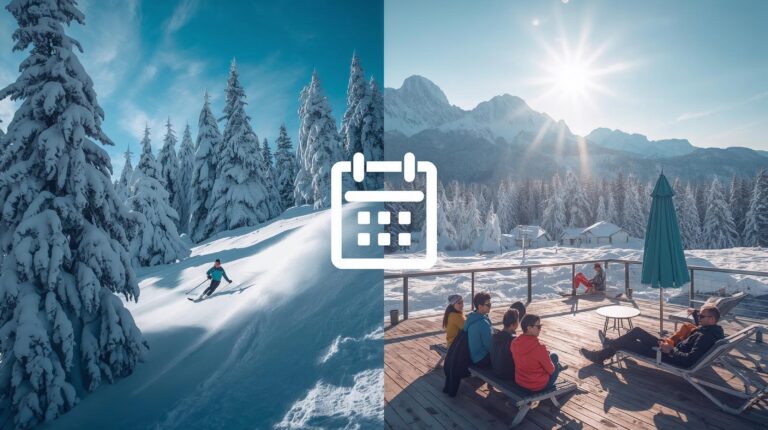
Many tourists are misled when they see green meadows in the city in January or February. However, statistics show that while it may be early spring down below, up above the “The plateau” or “Banderitsa” the conditions are for “deep winter.
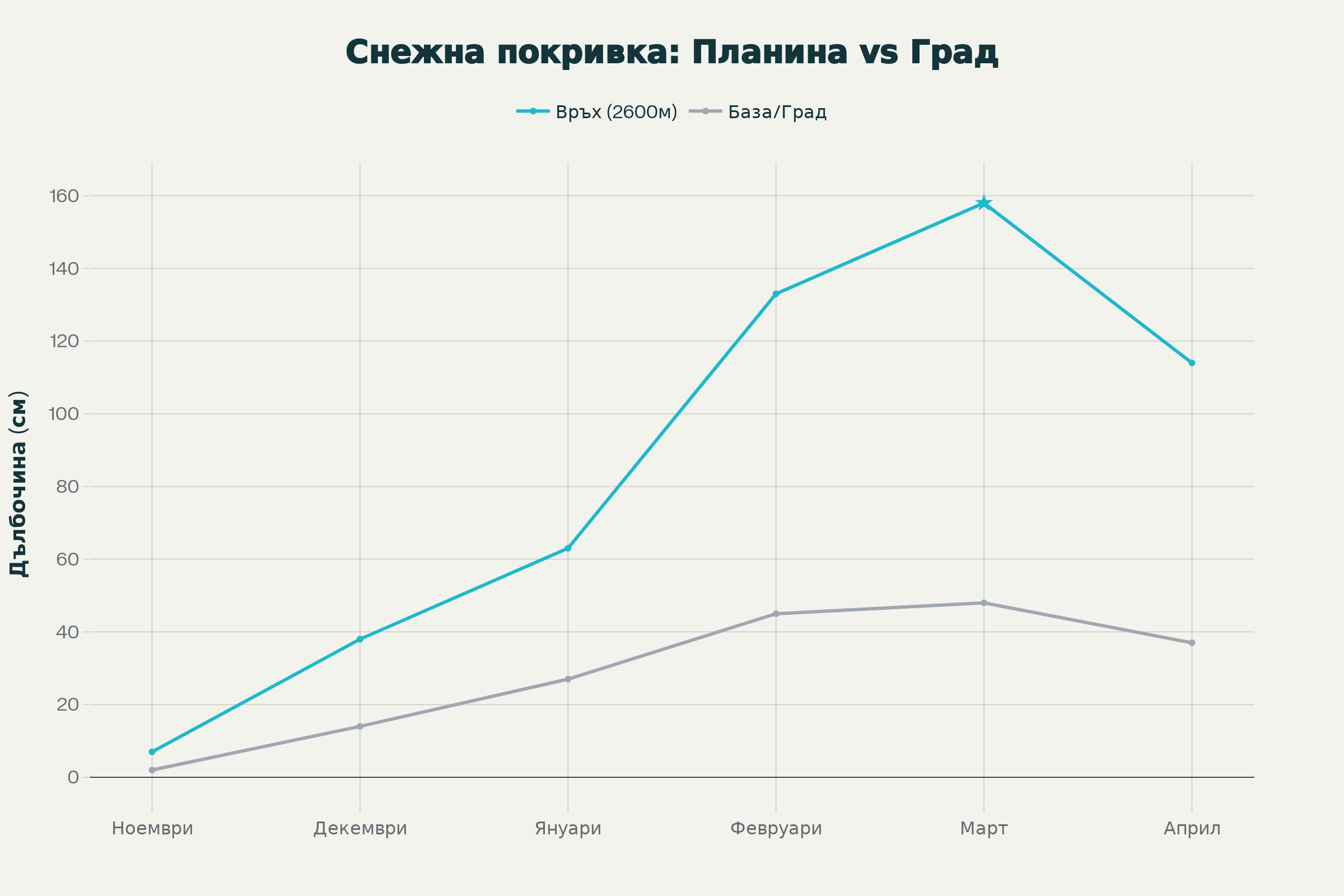
Statistical graph of snow accumulation between the city and the highlands ski area (November – April).
Monthly analysis of ski conditions in Pirin
November: The foundation of the season
In November, nature begins its preparations. Although natural snow in Bansko at this time is rare below 2000 meters, the low temperatures allow the powerful arsenal of over 230 snow cannons to work at full speed. The technical snow created during this month serves as the so-called “base” – an extremely dense base that guarantees the survival of the slopes in case of possible warming later in the season.
December: The official start
The season officially opens around mid-December. The average snowfall is around 13 cm, but the focus here is on grooming the slopes.
- Ski area: The main arteries work like "“The Shiligarnika”" and "Banderitsa.
- Snow cover: At the top it varies between 40 and 60 cm.
- Tip: An ideal period for budget skiing before the Christmas madness.
January: The Kingdom of Powder
January is the coldest month and offers the best quality snow – dry, fluffy and fast. The snow cover in Bansko on the higher parts is already stable, often exceeding 80 cm. This is the time of the “powder” days that attract freeriders from all over Europe. Temperatures rarely rise above zero, which keeps the snow in perfect condition throughout the day.
February: The Gold Standard for Skiing
If you are looking for maximum security, February is your month. The snow cover reaches an average of 130 cm at an altitude of 2600 m. All 75 km of slopes are open, and the ski road to the city (the longest in Bulgaria) is in its best shape. February combines stable weather with heavy snowfall, making it the busiest, but also the most satisfying month for skiing.
March: The Snow Peak and the Spring Sun
A little-known fact is that the thickest snow cover in Bansko is measured in March. Statistics show average levels of 158 cm at the peak, with strong years reaching an impressive 240 cm.
March offers a unique combination of long, sunny days with high afternoon temperatures alternating with intense spring storms bringing meters of new snow. It's a paradise for lovers of terraces and suntans, combined with excellent skiing in the morning hours.
Why is technical snow important?
Bansko has one of the most modern artificial snowmaking systems in the world. Over 80% of the ski area is secured. Technical snow is more resistant to temperature fluctuations because it has a higher density. Thanks to it, the ski season in Pirin manages to last until mid-April, even when spring is in full swing in the lowlands.
Summary snow reliability statistics
| Month | Reliability (Top) | Snow type | Running tracks |
|---|---|---|---|
| December | Medium | Technical + New | 40-60% |
| January | High | Dry powder | 90-100% |
| February | Maximum | Treaded / Hard | 100% |
| March | Maximum | Deep / Firn | 90-100% |
| April | Good (High Zone) | Springy / Soft | 50-70% |
Freeride and safety in Pirin
Pirin is an alpine mountain and its slopes offer some of the best conditions for off-piste skiing. Despite the heavy snow cover in Bansko, safety should be a priority. Always check the bulletin of the Mountain Rescue Service (MSS) for avalanche danger, especially in the areas of the “Ulei” below Todorka Peak. If you are not an experienced mountaineer, it is highly recommended to hire a local guide for freeride adventures.
Conclusion
The snow conditions in Bansko are the result of a perfect symbiosis between nature and technology. Even in drier years, the combination of high altitude and heavy snowfall guarantees your vacation. If you are aiming for the best snow, aim for the period from mid-January to mid-March.
 English (UK)