

But how is such a massive and responsible facility maintained? How is it possible for miles of thick steel to be joined together in an endless and flawlessly smooth circle, without a single weld? In this article, we'll dive deep into the technology, engineering history, and uncompromising safety checks.
Anatomy of Security: What is a rope made of?
The gondola's steel cable is not just a simple piece of cast metal. It is an extremely complex, dynamic structure designed to withstand colossal stress, bending, and extreme weather conditions. The cable is made up of hundreds of high-strength steel strands, precisely twisted into individual bundles (technically called "strands").
- Synthetic core: At the very center of the rope is often a special elastic core (polymer or synthetic). Its role is twofold – it maintains the round shape of the rope as it passes through the huge rollers and at the same time acts as a sponge, retaining special lubricants that constantly protect the internal steel strands from corrosion.
- Impressive dimensions: The Bansko lift route is about 6.3 kilometers in one direction. This means that the rope has a total length of over 12.6 kilometers, closed in a continuous circle.
- Diameter and weight: Its thickness is over 50 millimeters, and its total weight amounts to tens of tons. That is why such powerful electric motors are needed in the stations to overcome the inertia of this enormous mass.
Braiding: The Secret of the "Infinite" Circle
One of the most common and logical questions tourists ask is: „"Where is the weld on the rope?"“. The answer is as simple as it is ingenious – there is no welding. Using an electric or oxy-fuel welder would heat and change the structure of the steel, making it brittle and creating an extremely weak and dangerous spot on the track.
Instead, an ancient but refined manual method called splicing. The ends of the multi-kilometer rope are joined by hand by a narrow circle of highly qualified international specialists. They literally untangle the steel strands at both ends for tens of meters and then weave them into each other. The friction and geometry of the braided section make it just as strong as any other part of the rope, and the connection point is practically invisible to the untrained eye.
Inspections and Maintenance: How is steel inspected?
The safety of the Bansko lift rope is subject to daily, monthly and annual control according to the highest European standards. The inspection systems are so advanced that they reduce the possibility of human error to absolute zero.
Magnetic flaw detection (MRT)
Visual inspection by mechanics is important, but not enough, as the internal threads are not visible. That is why Magnetic Resonance Inspection is used. A special high-tech device is mounted so that it surrounds the rope. As it moves slowly, the device scans it with a powerful magnetic field. This method allows engineers to „see“ the core of the metal. If the computer detects even one microscopic broken thread deep inside the bundle, the system sounds an alarm immediately.
Hydraulic tension and temperature amplitudes
The laws of physics dictate that steel expands in the heat of the summer and contracts dramatically in the freezing temperatures of the winter. On a scale of 12 kilometers, this means differences in length of several meters. To prevent the rope from sagging dangerously close to the ground or breaking from overtension, huge hydraulic pistons are installed in the stations. These systems compensate for the length in real time, maintaining a constant and precise tension, regardless of whether it is +30 or -20 degrees outside.
Service life and replacement
Despite their strength, steel ropes have a strictly defined service life. After a certain number of thousands of operating hours or when material fatigue is detected by flaw detection, the rope is completely replaced with a brand new one. This is a colossal logistical operation that is planned for months and is usually carried out during major maintenance outside the active tourist seasons.
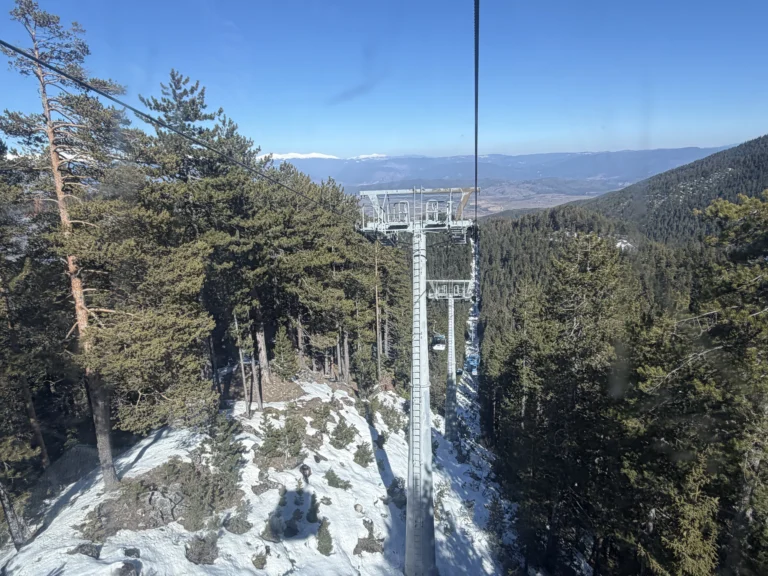
Investments in top-class steel ropes from leading Swiss and Austrian manufacturers ensure that ski area Bansko remains one of the safest destinations in Europe. The next time you look at the thick metal thread above you through the glass of the gondola, you will know that it is the fruit of over a century of engineering evolution and continuous care.
Do you want to learn everything else about the facility, prices and access?
 English (UK)