

Geopolitical and economic framework of winter tourism in a regional context
In 2017, Bansko is at a critical stage in its development, functioning both as a leading sports center in the Balkans and as a clashing ground for radically opposing visions of the future of mountain tourism in Bulgaria. The city, located at the strategic crossroads of Pirin, Rila and Rhodope Mountains, this year not only hosts world events, but also becomes a litmus test for the ability of state institutions and the local community to balance economic growth and environmental sustainability. The analysis of this period requires a deep understanding of the mechanisms by which sports prestige influences the investment environment and how infrastructure deficits can become a political catalyst.
Key point: The decade leading up to 2017 was marked by an aggressive expansion of the bed base, which was not followed by the corresponding development of the transport and sports infrastructure in the mountains. This imbalance reached its peak in 2017.
When two main factors come to the fore: the international success of Bulgarian snowboarding and the administrative attempt for a radical change in the management of protected areas. These two processes are inextricably linked, as the sporting success is used as the main argument to legitimize the further expansion of the ski area.
Global trends in winter sports and the positioning of Bansko
To understand the significance of 2017 for Bansko, it is necessary to consider the broader strategy of the International Ski Federation (FIS). During this period, the federation places a strong emphasis on generating financial value through centralization of media rights and digital transformation. Bansko, as the host of the World Cup, becomes part of this global ecosystem, which requires not only perfect slopes, but also high technological security for television broadcasting and audience engagement.
| FIS Media Influence Index | Growth compared to previous season |
|---|---|
| Broadcast Time | +17% |
| Cumulative Audience | +84% |
| Total Media Impact | +88% |
Data illustrating the global context of media growth in winter sports.
Although the data in the table reflects broader trends, it clearly shows why destinations like Bansko are striving for a presence on the FIS calendar. The higher cumulative audience directly translates into higher brand recognition for the resort, which is vital for attracting foreign tourists in competition with alpine destinations.
The 2017 Snowboard World Cup – a highlight in sports history
In February 2017, Bansko became the epicenter of world snowboarding. Hosting the World Cup in the parallel giant slalom (PGS) disciplines was not just a technical event, but a strategic demonstration of organizational capabilities. This period was marked by the „phenomenon Radoslav Yankov“, whose presence as one of the leading competitors in the world completely changed the dynamics of local interest in the sport.
Technical parameters and sports results
The competition in Bansko is distinguished by an extremely high level of preparation of the course. The parallel giant slalom discipline requires perfectly symmetrical courses that guarantee equality of both competitors. The choice of Bansko to host such an event is a recognition of the quality of the slopes in the ski area, maintained by the concessionaire.
The men's standings on February 3, 2017 show an extremely close battle, in which the Bulgarian representative Radoslav Yankov took the prestigious second place, trailing only Sylvain Dufour.
| Rank | Bib | FIS code | Competitor | Country | Points |
|---|---|---|---|---|---|
| 1 | 12 | 1560730 | DUFOUR Sylvain | FRA | 1000 |
| 2 | 1 | 1094969 | YANKOV Radoslav | BUL | 800 |
| 3 | 20 | 9200092 | BAUMEISTER Stefan | GER | 600 |
| 4 | 8 | 1054984 | KARL Benjamin | AUT | 500 |
| 5 | 13 | 9320091 | LEE Sang-ho | KOR | 450 |
The women's competition is also world-class, with the race dominated by representatives of the traditional Alpine nations of Switzerland and Austria. Patricia Kummer solidifies her status as the leader, which brings additional prestige to the event in the eyes of the international media.
| Rank | Bib | FIS code | Competitor | Country | Points |
|---|---|---|---|---|---|
| 1 | 8 | 7519960 | KUMMER Patrizia | SUI | 1000 |
| 2 | 12 | 1746485 | DUJMOVITS Julia | AUT | 800 |
| 3 | 29 | 515102 | JENNY Ladina | SUI | 600 |
| 4 | 15 | 1004920 | RIEGLER Claudia | AUT | 500 |
Socio-economic impact of the sporting event
Hosting the World Cup generates a significant short-term economic boost for local businesses. The hotel base reaches maximum occupancy, and the restaurant sector reports record turnover. But the more important strategic effect is the long-term branding. Bansko is positioned in the minds of the global consumer as a destination that is „tested and approved“ by professional athletes.
The analysis of media influence from 2017 shows that disciplines such as snowboarding are extremely popular in markets such as Germany (49% of media influence for parallel events) and Austria (16%). These are precisely the main target markets for Bulgarian winter tourism. Through the success of the competition in 2017, Bansko managed to reach these audiences in a way that traditional advertising could not achieve.
Part Three: The Infrastructure Node and Capacity Constraints
Despite the sporting successes, 2017 exposed one of the resort’s biggest problems – the cramped space at the gondola lift’s starting station. While the ski slopes have a relatively high capacity, the existing cable car’s ability to transport tourists from the town to the ski area is woefully inadequate. This leads to hours-long waits, which is starting to undermine Bansko’s image as a modern resort.
The problem with the second cable car line
The issue of a second gondola line became a major political topic in 2017. Supporters of the project, including the local municipality and the sports federation, argue that without a new facility, the resort will lose its competitiveness. On the other hand, environmental organizations warn of irreversible damage to Pirin's biodiversity.
This polarization led to one of the most controversial decisions of the Bulgarian government in a decade. On December 28, 2017, the Council of Ministers adopted Decision No. 821, which introduced changes to the Management Plan of Pirin National Park.
Legal analysis of Decision No. 821 of the Council of Ministers
The December 2017 decision is disguised as a technical amendment, but its implications are far-reaching. The essence of the change is to replace prohibition regimes with permits in certain areas of the park.
| Area according to the Management Plan | Previous state | After Decision No. 821 |
|---|---|---|
| Sustainable Use Zone (IIa) | Prohibition on construction of sports facilities | Construction with new lifts and tows permitted |
| Tourism Area (III) | Limited construction | Expanded scope of permitted activities |
Summary of changes to the Pirin National Park Management Plan initiated at the end of 2017.
The legal analysis of these changes indicates that the amendment opens up the possibility of construction and logging on an area equivalent to nearly 48% of the territory of the National Park. The main argument of the environmentalists is that the change was made without the mandatory environmental assessment, which violates both national legislation and European habitats directives. This administrative act provoked mass protests in Sofia and other major cities, which marked the end of 2017 and the beginning of 2018 with the spirit of civil discontent.
Part Four: Economic Dynamics and Real Estate Market
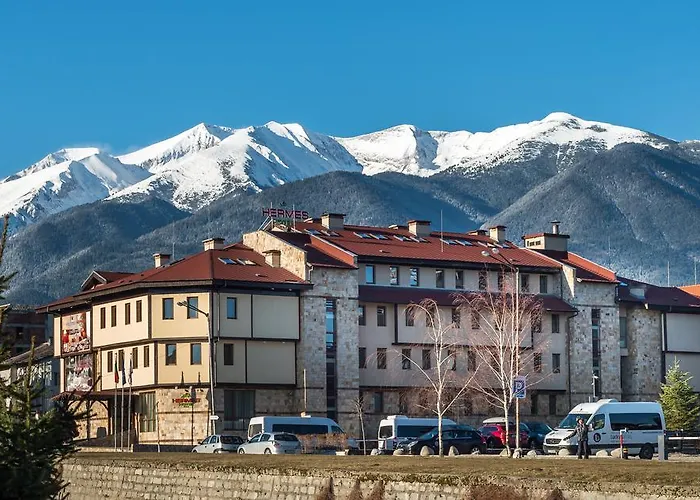
Hotel Hermes, Bansko
2017 marks the beginning of the "second breath" for the property market in Bansko after the long period of stagnation after 2008. While in previous years the market was flooded with resales at low prices by British and Irish investors, in 2017 there was stabilization and the emergence of a new type of buyer.
Price level analysis
Property prices in Bansko in 2017 are characterized by a high degree of differentiation depending on the proximity to the gondola lift. The average prices per square meter for the different types of apartments show interesting trends.
| Property type | Average total price (EUR) | Average price per sq m (EUR) |
|---|---|---|
| One-room apartment | 54,665 | 1,250 |
| Two-bedroom apartment | 80,875 | 1,250 |
| Three-room apartment | 120,000 | 1,218 |
| Multi-room apartment | 147,200 | 1,168 |
| Atelier / Studio | 46,380 | 1,027 |
It is important to note that in 2017 Bansko began to become an attractive destination not only for holiday recreation, but also for longer-term stays. This is the year in which the foundations of digital nomadism were laid in the city - a process that would later transform the local economy. The stabilization of prices around 1000-1200 euros per square meter for quality properties is a clear signal of the return of investment confidence, directly stimulated by the international prestige of the resort.
The impact of sports infrastructure on property prices
There is a direct correlation between the success of the World Cup and interest in real estate. Investors recognize Bansko as a place with a guaranteed winter season and growth potential, especially in light of the promises of a second gondola line. The decision of the Council of Ministers of December 28, 2017 was initially perceived by the real estate sector as a „green light“ for new investments, leading to a slight speculative increase in purchase inquiries just before the end of the year.
Part Five: Cultural Appearance and Social Development
No strategic analysis of Bansko would be complete without considering the city’s cultural capital. November 2017 saw the 24th edition of the Bansko Film Fest, the largest mountain film festival in the region. This event plays a critical role in positioning Bansko as a destination for year-round alternative tourism, away from the commercial ski model.
Bansko Film Festival 2017 – a triumph of the mountaineering spirit
The 2017 festival brings together the elite of mountaineering and extreme sports, presenting 80 films from over 40 countries. This event demonstrates that Bansko has a „soft power“ that can unite different perspectives on the mountain.
| Award | Movie | Director / Country |
|---|---|---|
| Grand prize | „"Champions in the Golden Valley"“ | Ben Sturgelewski (Afghanistan, Germany, USA) |
| Jury Award | „"Bushido - the choice"“ | Marcin Tomaszewski (Poland) |
| Best Screenplay | „"The Tribe Within"“ | Pavol Barabas (Slovakia) |
| Best Bulgarian Film | „"Under the Skin"“ | Petar Penev (Bulgaria) |
| Cultural value | „"The Future of Climbing"“ | Guillaume Broust (France) |
Of particular importance is the award for the film "Under the Skins", which tells the story of local Banska Dimitar (Mimo) Kehayov and the tradition of puppetry. It highlights the connection between the modern resort and its authentic folklore roots, which is a key element in the city's marketing strategy to attract high-paying Western tourists seeking off-piste experiences.
Social risks and division in the community
However, 2017 also left a bitter taste due to the growing division in the local community. While one part of the population, directly involved in tourism, unreservedly supports the expansion of the ski area, another part is beginning to experience the negative effects of excessive development – inflation of local services, overloading of the water supply system and loss of the city’s appearance. The protests of December 2017 brought this local conflict to the national level, putting Bansko at the center of a debate about what „sustainable development“ means.
Part Six: The FIS Strategy and Its Impact on Bansko
To understand Bansko’s long-term trajectory beyond 2017, one must look at the FIS’s strategic priorities, which were beginning to take shape at that time. The federation places an emphasis on sustainability, human rights and digitalization.
- Sustainability and environmental standards
In 2017, FIS is already actively developing its „Impact Programme“, which aims to reduce emissions and waste when hosting major competitions. For Bansko, this means that future households will be increasingly dependent on the ecological state of Pirin. The contradiction between Decision No. 821 and the FIS’s aspiration for environmental leadership creates a strategic risk for the resort – if it is perceived as a destination that destroys nature, it may lose the support of international sponsors and federations. - Digital transformation and a new type of audience
FIS has seen a huge growth in digital reach, with the reach increasing to 206 million users in subsequent cycles. In 2017, Bansko capitalized on this trend through Radoslav Yankov’s active social media presence, which helped to „rejuvenate“ interest in the resort. However, the lack of modern digital infrastructure in the town itself (public Wi-Fi zones, integrated ticketing platforms) remains a challenge that is only beginning to be addressed later.
Part Seven: Synthesis of Challenges and a Critical Look
Analyzing 2017 in its entirety, the conclusion is that Bansko has become a victim of its own success. The prestige of hosting World Cups and Junior World Championships (in later years, but with roots in the successes of 2017) places demands that the existing physical and legal infrastructure has difficulty meeting.
Major controversies of 2017
- Sport vs. Ecology: The success of the snowboarding trail is proof of professionalism, but the administrative act to expand the area is perceived as a threat to the natural heritage.
- Economic Growth vs. Urban Environment: The stabilization of the real estate market brings capital, but the continued waiting in lines for the lift compromises the quality of the tourism product.
- Global Visibility vs. Local Discontent: „The Bansko Film Fest shows the cosmopolitan face of the city, while the protests in late December reveal a deep distrust of the way strategic decisions are made for the region.
Conclusion and strategic perspectives
2017 is a year of paradoxes for Bansko. On the one hand, the city triumphs on the world sports stage, thanks to Radoslav Yankov and the perfect organization of the Snowboard World Cup. On the other hand, the institutional attempt to solve the infrastructure problems through Decision No. 821 of the Council of Ministers of December 28, 2017 opens a deep social wound and calls into question the long-term legitimacy of the resort's development model.
The lessons of 2017 are clear: sporting prestige is a powerful driver, but it cannot replace transparent and sustainable planning. The property market shows signs of maturity, and cultural events such as the film festival offer a path to diversification. The future of Bansko after this watershed year depends on the ability of stakeholders to find a consensus that will protect the mountain without stopping the development of sports. 2017 proved that Bansko is no longer just a small town in Pirin, but a significant factor in global winter tourism, whose decisions have repercussions far beyond the borders of Bulgaria.

 English (UK)