


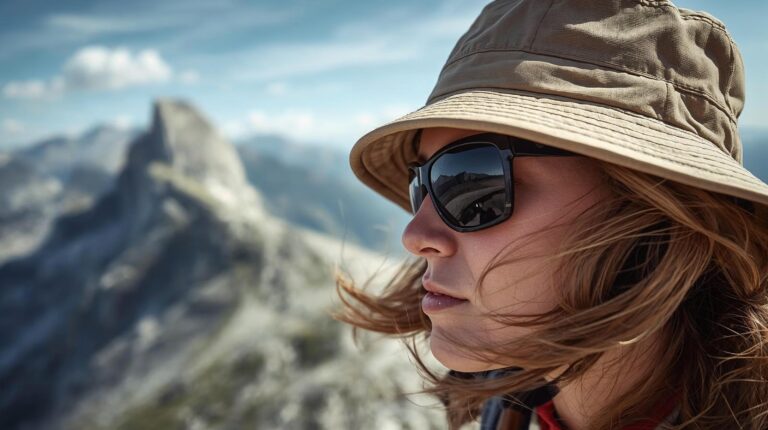
1. The hat in Pirin: If there is no connection, don't take it!
Let's start with the biggest problem in our region - the wind. At an altitude of 2900 meters, the air currents are powerful and often come from below and up (thermals), which literally "tear" hats off our heads.
Rule #1 for Pirin:
Never wear a hat without Chin strap or a tightening mechanism (cord with a stopper). If your favorite hat doesn't have one, either sew a tie on it yourself, or leave it for walks in the park.
Which model is best?
- Bucket Hat: This is a favorite. The brim keeps your ears and neck from burning, and the tie ensures the hat will stay with you even in a storm. Look for models with a stiffer brim at the front so it doesn't fall in your eyes when the wind blows.
- Desert Cap: This is a baseball cap with a long piece of fabric at the back that covers the neck. It is excellent against sunburn, but in strong winds the “curtain” at the back flaps very loudly and makes a lot of noise. Look for a model where the fabric can be tucked in with a button.
- Multifunctional towel (Buff): The most windproof option. It fits snugly on the head and has nothing to “catch” the wind. The disadvantage is that there is no visor and the sun burns in your eyes, so it must be worn in combination with sunglasses.
2. Glasses: Shield against radiation and wind
The altitude of Pirin means that UV radiation is 40% stronger, than the sea. Add to that the white marble cliffs and snowfields in “Kazan” that reflect the light like a mirror, and you get a recipe for “snow blindness” (even in July).
Why is form more important than brand?
City glasses (aviator-style or with thin frames) are dangerous in the mountains. They leave large gaps on the sides.
In Pirin you need glasses that:
- Are curved around the face (Wrap-around): To block light coming from the side.
- Protect from wind: Strong winds dry out the eyes and make them watery. Good mountain goggles act as a mask and stop the flow of air to the pupils.
Table: Protection categories (VLT)
| Category | Description | Application in Pirin |
|---|---|---|
| Category 2 | Medium dark | Only for the forest or cloudy days. Not enough for the peaks. |
| Category 3 | Dark (8-18% light) | The universal choice. Perfect for summer and sunny weather. |
| Category 4 | Very dark (3-8%) | For winter Pirin, glaciers and mountaineering. *Warning: Driving is prohibited! |
3. Sunscreen and the “hidden” places
The wind in Pirin is a subtle “anesthetic”. It cools the skin and you don’t feel the burning sensation until it’s too late. In the evening you go home to Bansko with a face as red as a tomato and fever.
- SPF 50+ is a must: Don't compromise with lower factors.
- Apply 20 minutes before leaving: The cream should absorb before you start sweating.
- Weak points: Most often they burn:
- The tips of the ears (if you are wearing a hat without a brim).
- The back of the neck.
- Calves (very painful when wearing shoes).
- Under the nose (from the reflection).
Lips: Victim of the wind
Lips lack melanin and sebaceous glands. The combination of wind and sun leads to painful cracking and cold sores. A regular balm won't do the trick – you need one with UV protection (SPF 30) and a greasy texture that creates a film against the wind.
4. The Alternative: UV-Protective Clothing (Sun Hoodies)
More and more mountaineers in Pirin are replacing the cream with clothes. The so-called “Sun Hoodies” are thin, breathable long-sleeved shirts with a hood that have a built-in UPF 50 factor.
This is the safest protection – the cream rubs off, but the shirt protects permanently. The hood is designed to be worn under a helmet or hat and protects the neck and ears perfectly, without having to smear yourself with sticky cream.
Final recommendation
When packing for Pirin, do the “Wind Test”: Grab your hat and wave it vigorously. If it falls out of your hand or the brim bends completely, it’s not for you. Invest in a hat with a brim and goggles (Cat 3) so you can enjoy the views, not squint.

 English (UK)