

If you ask a young person in Sofia today what we celebrate on December 25th, they will answer "Christmas." But if we turn the tape back to the weather back or listen to the conversations of the old people in Southwestern Bulgaria – in the stone houses of Bansko, Razlog and the villages at the foot of Pirin – we will hear another word. A word that weighs like a stone and warms like fire: Bozic (or in the old written tradition – Christmas).
In the following lines, we will examine the deep meaning of this name and the rituals that accompany it in the western Bulgarian lands.
1. What does "Christmas" mean? Etymology and hidden meaning
The Word „"Christmas"“ has an ancient pan-Slavic root. Morphologically, it is composed of the root "God" and the diminutive suffix "-ich" (as "hero" becomes "yunačich" in folk songs, or "king" becomes "kralevich"). The literal translation is „"Little God"“, "Son of God" or "Infant.".
While the name Christmas (derived from the Roman calendar) marks the beginning of the new calendar year, Bozic personifies the holiday itself. For the old Bulgarians, the holiday was not just a date on the calendar, but Personality. In folk beliefs, Božić is the newborn Sun.
On the longest night of the year (the winter solstice), the ancients believed that the sky opens. The old sun has exhausted its strength and is „dying“. The world is facing the threat of eternal darkness. And it is then, in the womb of the night, that the „Young God“ (Božić) is born. He is the new sun, who from the next day will begin to grow „like a millet grain“ to bring life back to the earth.
In Serbia, Croatia and Montenegro the word Christmas is still the official name for Christmas. In Bulgaria it has been replaced by "Christmas" and "Christmas", but has remained preserved in the songs and memory of the people of Western Bulgaria.
2. The Great Battle in the Hearth: The Old vs. the Young God
In the Bansko and Southwest regions, the central event of the holiday is not the exchange of gifts, but the drama that plays out in the hearth. This is the ritual with Christmas Eve.
According to old beliefs, the Young God (Christmas) cannot come until the Old God (symbol of the outgoing year) has left.
The Ritual of Cutting Down
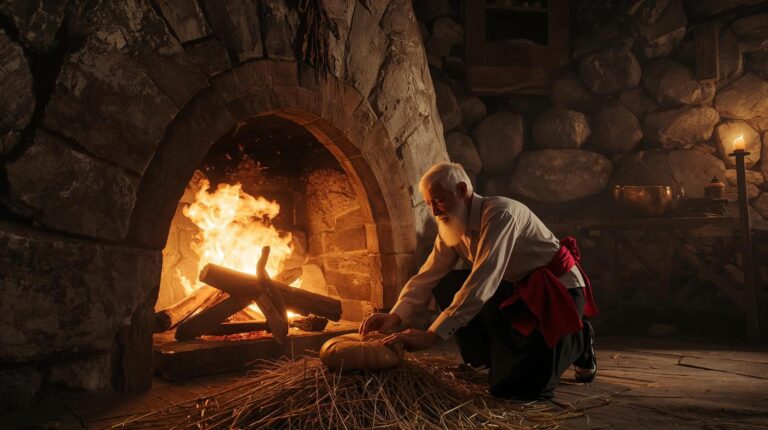
In the patriarchal families of Bansko, preparations for Božić began early in the morning on Christmas Eve. The owner of the house, dressed in new clothes, went to the forest. He had to choose a strong, pedigree tree - most often an oak (blagun) or a pear, which was called "Badnik".
Felling was not just logging. The tree had to be kept from falling to the ground, lest it be „tainted“ with death. It was carried on the right shoulder. When the owner entered the house, he would say the sacred words:
„"Do you praise the Young God?"“
And the family answered:
„"We celebrate, we celebrate, you are welcome!"“
The sacrifice in the fire
The most important moment is the placing of the Yule log in the fire. In folk mythology, the tree is the embodiment of the Old God. By burning it, he is sacrificed. The heat and light that the tree gives off while burning are actually the substance of the newborn Božić.
| Ritual element | Action in the Pirin region | Symbolism |
|---|---|---|
| Smelling | Drilling a hole, pouring oil, wine and incense | Consecration of the tree; its transformation into a sacred object (sacrifice). |
| Burning | It must burn all night. | The death of the old year and the birth of the new solar power. |
| Ash | Don't throw it away, keep it for medicine. | A magical substance for fertility and health all year round. |
3. The Table for the "Young God": Bread as an Icon
At the Christmas Eve table (which in some Western dialects is called "Little Christmas"), the main place is occupied by ritual bread. In Bansko it is called „"Goddess"“, "Christmas Eve" or "Vechernik".
This is not an ordinary bread. On it, the world of the Bulgarian is sculpted from dough – the sheepfold, the field, the plow, the house and, of course, a cross. Since in the past, icons were an expensive pleasure and not every home had one, the bread played the role of a temporary icon. By breaking and eating the bread, the family partakes of the body of Božić.
- Tradition from Bansko: The table is placed on the ground on straw. The straw symbolizes not only the manger of Christ, but also the earth that is to bear the wheat.
- The ritual with the firewood: The oldest man incenses the table with the plowshare - a combination of Christian incense and agricultural labor - to sanctify the food and invite the ancestors to dinner.
4. The Christmas Carolers: The Army of Christmas
When night falls and the Christmas tree is already burning, the carol singers appear. In southwestern Bulgaria, their songs are some of the most archaic preserved in the Balkans.
Unlike today's notions of cheerful songs, in the past, caroling was a serious male rite. It was believed that on Christmas night the border between the worlds was thin and evil forces (karakonjuli, vampires) roamed outside. The carolers were a kind of "army" of the Young God. With their heavy footsteps, the ringing of the geysers and their loud voices, they were supposed to put the world in order, drive away chaos and make room for a new beginning.
In songs from Bansko and Razlog, the refrain is often found:
„"It's knocking, it's knocking, Young God..."“
or
„"We sing to you, Young God!"“
Here, Božić is not just a baby in a cradle. In songs, he is often described as a hero riding his horse, or as a golden sun shining on his mother's forehead. This is evidence of the superimposition of proto-Bulgarian and Slavic sun cults on the Christian narrative.
5. Why is Christmas important today?
The difference between "Christmas" and "Christmas Eve" is the difference between form and content. Christmas is the time, the cycle, the celebration, the general framework. Bozic is the essence, the spirit, the sacred presence in the home.
In the regions of Western Bulgaria and especially in Bansko, where ancestral memory is extremely strong, the memory of Božić is a memory of the time when man and nature breathed in one rhythm. The use of the word Bozic today it is an act of cultural preservation. It reminds us that the center of the holiday is not the gifts or the rich table, but the hope that after every darkness, light is born – the Young God is born.
So, if an old man from Banska Bystrica greets you with the words:
„"Merry Christmas!"“,
Know that he wishes you something much more than a happy holiday. He wishes you the power of the new sun and the warmth of eternal fire.

 English (UK)