


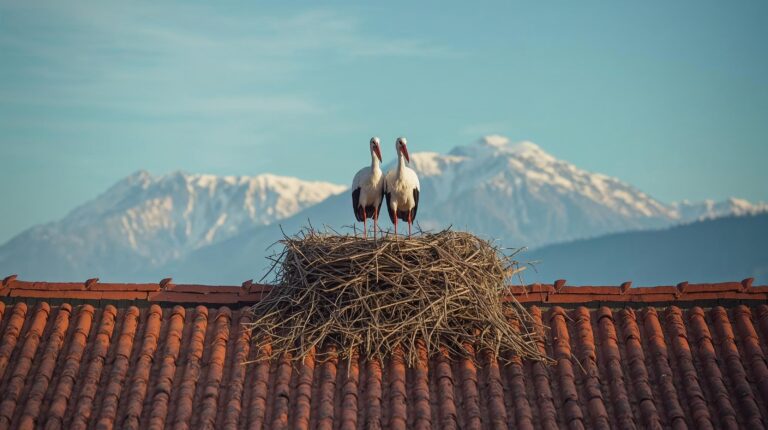
The stork capital under Pirin: Why is the village of Banya a phenomenon?
When we talk about the Bansko and Razlog region, most people immediately imagine ski slopes and majestic mountain peaks. However, just 5 kilometers from the winter resort lies a natural wonder that turns the small village of Banya into a unique spot on the European map. The village is known not only as a spa destination, but also as one of the largest centers of the white stork in Bulgaria.
The Record: Banya Village in Numbers
In recent years, Banya has established itself as a true record-breaker. If in 2017 ornithologists and local residents counted 34 nests – which in itself was an impressive achievement – today the trend is definitely upward.
The most recent data shows 51 occupied stork nests within the village. This ranks Banya in first place in Bulgaria, the title being contested only by the village of Rupite (Petrich municipality), where the number of nests is similar. The arithmetic of nature here is remarkable: each nest is inhabited by two parents and an average of 2 to 3 young. This means that in the summer the stork population exceeds 150 birds. Locals often joke that during the summer season the village's population officially increases by 150 residents, who bring good luck and do not pay taxes.
Why here? The secret of the "Stork Village"„
What makes these majestic birds choose the small village of Razlog over all other places? The answer is a combination of geography, biology, and the local environment.
1. Abundance of water ("The Mineral Oasis") Banya is famous for its 75 mineral springs – this is nearly a third of all springs in the Razlog Valley. For storks, this is vital. They prefer wetlands, marshy meadows and riverbanks, where they find food (frogs, reptiles, insects). Even when it is dry elsewhere, the warm mineral waters in Banya keep the ecosystem moist and rich in life.
2. The perfect hunting ground Located at an altitude of 801 m, the village is surrounded by open spaces – meadows and pastures with low vegetation. Storks avoid tall grasses and forests, as they hunt by walking on the ground. The plain around Banya is their perfect source of food.
3. Harmony with people In Banya, the birds nest almost exclusively on human structures – electricity poles, house chimneys, roofs of public buildings and even the domes of churches. The traditional rural architecture and the tolerance of the local people who guard the nests create a safe environment for raising their offspring.
Local folklore: "Good energy"„ Of course, it's not all biology. Older residents have their own explanation: storks are extremely sensitive and choose places "charged with good energy." The fact that more and more birds arrive every year is taken as confirmation of the village's positive charge.
The Stork Calendar: What and when to observe?
If you are planning a walk around the area, here is how the life cycle of the feathered inhabitants goes:
-
Arrival (End of February – Beginning of March): The males appear first, to start nesting after the winter. Their appearance often coincides with Baba Marta. Legend has it that when you see the first stork, you should take off your martenitsa.
-
New Life (April – May): Females lay between 3 and 5 eggs in April. The most exciting moment is the second half of May, when the young hatch. At first they are invisible from the ground, but the parents are constantly running around to bring food.
-
Flying School (July): The young storks are now almost as big as their parents. In July they begin to make their first, hesitant attempts to fly over the rooftops of Banya.
-
The Great Journey (August – September): At the end of August, the birds gather in huge flocks in the fields between Banya, Bansko and Razlog, preparing for migration. By mid-September, the nests are deserted until the following spring.
Are there storks in Bansko?
This is a question that many guests of the city ask. While Banya is the „capital“, the situation in the town of Bansko is a little different. The town is located at a higher altitude (925 m) and is significantly more densely built up. The lack of immediate wetlands and the city noise make the center unattractive for nesting.
However, on the outskirts of Bansko (towards the industrial zone and the road to Razlog) single nests are sometimes found. However, the best view remains in the fields between the two settlements, where the birds from Banya often fly over for food.





 English (UK)