


Did you know that?
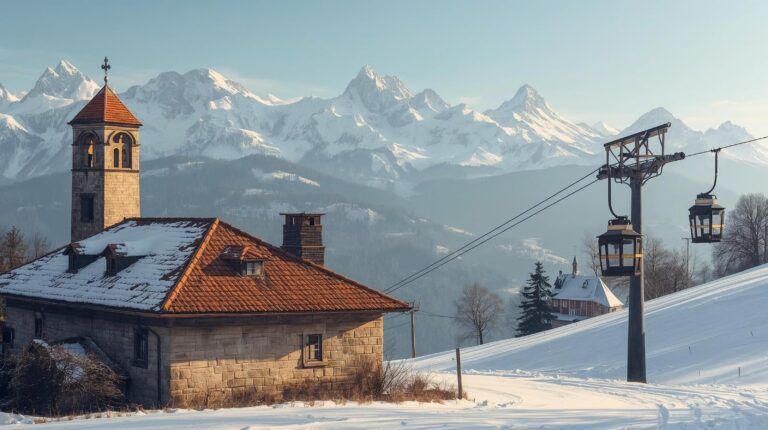
Before the construction of the lift, the only way to access the high ski slopes was via a narrow mountain road, serviced by hundreds of minibuses daily – a logistical challenge that seems almost unthinkable today.
Archaeological foundation and medieval development
The roots of human presence in the area are deeply rooted in antiquity. Archaeological research has revealed layers from the early Roman Empire, dating back to 100 BC. On the outskirts of the present-day city, residential structures have been identified that served a population engaged in mining and animal husbandry. The strategic location of the Razlog Valley along the Mesta River has turned the region into a natural corridor between the Aegean coast and the interior of the Balkans.
During the Middle Ages, the settlement strengthened its position by building defensive structures. The ruins of the fortresses in the areas of Yulen and Starogradishte testify to a well-organized system for protecting the passes. This period laid the foundations of the local identity, which would later become the backbone of the Bulgarian Enlightenment.
Timeline of key historical events
| Period | Significance and events | Key sites |
|---|---|---|
| 100 BC. | Roman rule and mining | Residential buildings on the outskirts |
| 9th – 10th century. | Medieval fortification | Yulen Fortress„ |
| 18th – 19th century. | Bulgarian Renaissance | Commercial houses and schools |
| 1835. | Religious emancipation | Church of the Holy Trinity„ |
| 2003. | Modern ski tourism | Cable car (Gondola) |
The Spirit of the Renaissance: Cultural and Economic Rise
The 18th and 19th centuries are emerging as the "golden age" for history of Bansko. The city became one of the most significant centers of the Bulgarian National Revival. This prosperity was not accidental – it was based on the formation of a powerful merchant class. About 17 wealthy „Hadzhiy“ families developed large-scale trade networks reaching as far as Vienna, Leipzig and Trieste. These merchants not only imported goods, but also brought European culture and educational ideas to their homeland.
Unlike many other regions in the Ottoman Empire, Bansko retained its distinctly Christian character and enjoyed broad administrative autonomy. This freedom gave rise to Bansko Art School, founded by Toma Vishanov-Molera. His icons bring secular and humanistic elements into the Orthodox tradition, which is revolutionary for the weather you are.
Paisii Hilendarski and Neofit Rilski: The Titans of Bansko
At the center of Bansko's identity stand two colossal figures. The first is Paisius of Hilendar, the author of "Slavic-Bulgarian History". Although disputes about his birthplace have continued for decades, modern research and folk memory firmly connect his roots with Bansko. Today, the Spiritual and Historical Center in the town has reconstructed his monastic cell, transporting visitors to 1762.
The second figure is Neophyte Rilski, the father of Bulgarian secular education. His birthplace, known as the "Benina House", is an architectural masterpiece. It reveals not only the way of life, but also the survival strategy of that time - with its thick stone walls and secret hiding places, including an underground tunnel leading to the Church of the Holy Trinity.
The beginning of alpine ambitions (1970s and 1980s)
Before the "big boom" after 2003, history of Bansko As a winter resort, it began timidly during socialism. In 1979, the town was declared a "unique settlement of international importance for cultural tourism". The first ski lifts were installed in the areas of "Shiligarnika" and "Chalin Valog".
At that time, ski tourism was an activity for enthusiasts. Transporting skiers to Banderishka meadow was carried out by minibuses and buses on a narrow, steep and often icy road. Waiting in lines for transport was part of the experience, which, however, limited the resort's capacity to a few thousand people per day.
The Van Era vs. the Gondola Era
Until 2003, access to the mountain was entirely dependent on weather conditions on the road. Frequent traffic jams and a lack of parking spaces were the main obstacles to development. The launch of the 8-seater gondola changed this overnight, increasing capacity to 2,000 people per hour and turning the 25-minute journey into a panoramic attraction.
The 2001 Concession and the Conflict with UNESCO
The key moment for the modern development of Bansko came in December 2001, when the Bulgarian government granted a concession for the ski area to the company "Yulen" AD. This decision marked the beginning of the largest investment in winter tourism in Eastern Europe.
However, this process does not go smoothly. Pirin National Park„ is a UNESCO World Heritage Site. The expansion of the ski area has sparked international debates about the ecological balance. In the period 2001-2004, UNESCO set strict management requirements that still define the boundaries between tourism development and nature conservation today.
Conclusion: One legacy, two worlds
The history of Bansko is a tale of incredible transformation. The town has managed to preserve its cobblestone streets, taverns and Bulgarian Revival spirit, while building a world-class infrastructure. Today, when you board the Gondola, you are not just going skiing – you are passing through centuries of history, gathered in a small but majestic mountain valley.
The article was prepared by the Bansko Cultural Heritage editorial team. If you are planning a visit, be sure to check out our guides to the museums in the old town.
 English (UK)