


How technology, physics and 400 machines are defeating climate change in Pirin
Technical analysis and reporting
Imagine a perfect morning in Bansko. The time is 8:25. You are at Banderishka meadow, the skis are fastened, and in front of you is the perfectly groomed ribbed surface of the Tomba slope. The air is crystal clear, the sun is peeking out from behind the peaks. Everything seems like a perfect gift from nature.
The truth, however, is a little different. What you are standing on is not just a natural phenomenon. It is an industrial product. It is the result of a silent but high-tech war that is fought every night on the slopes of Pirin. This is a story about the „Winter Factory“ – the complex engineering system of Bansko, which turns water and air into white gold, and without which modern tourism in Bulgaria would be impossible.
In this article, we'll take a look behind the scenes of the ski area to find out how one of the most powerful artificial snow systems in Eastern Europe works, what the price of white slopes is, and why "snow guns" are the most important insurance against global warming.
Part I: Why is nature no longer enough?
To understand the scale of the technology in Bansko, we must first look at the map. The resort is located in a unique, but also treacherous, geographical position. It is located in the northern embrace of the Pirin Mountains, but at the same time it is only about 150 km from the shores of the Aegean Sea.
This proximity is a double-edged sword. When Mediterranean cyclones bring moisture, the mountain receives heavy snowfall. But often, especially in January and February, warm air masses invade from the south. Temperatures can jump from -10°C to +5°C in a matter of hours.
This is where the „Snow Arsenal“ comes into play. From a modest 55 machines in 2005, the system now numbers nearly 400 snow blowers, covering 90% from the slopes. This isn't just an extra; it's the resort's life support system.
Part II: The Arsenal – Guns, Chains and Refrigerators
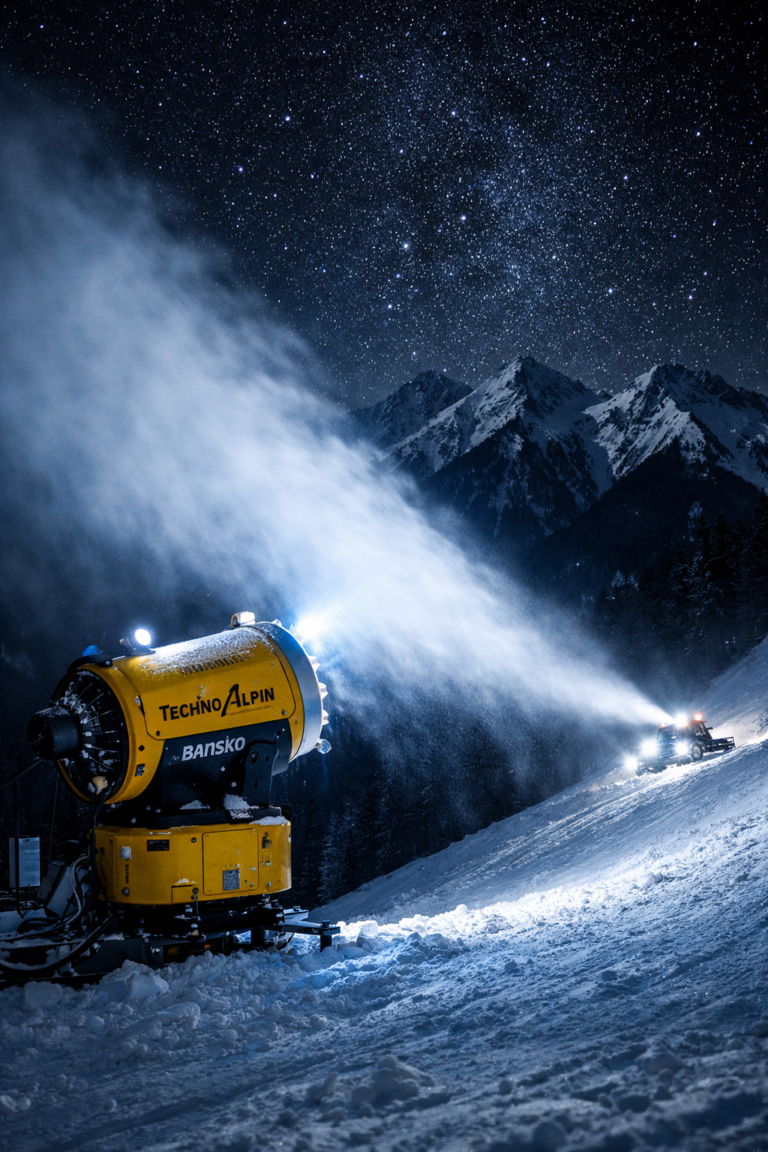
When you ski, you probably pass them without thinking – those yellow machines by the slopes. But if you look closely, you will see that they are not the same. Bansko has a diverse technological park, mainly supplied by the Italian giant TechnoAlpin. Each machine has its own tactical role.
1. The „Heavy Artillery“: Fan Guns
These are the most recognizable machines (models such as the TF10 and TR8) that resemble jet aircraft engines.
- How they work: At their heart is a powerful fan driven by an electric motor. It creates a huge air stream. Around the muzzle is a ring of nozzles. Some (nucleators) inject a mixture of water and compressed air to create tiny ice crystals – „nuclei“. Other nozzles inject only water, which sticks to these nuclei and freezes as it flies through the air.
- Where are they: You will see them on wide slopes like "Platoto", "Shiligarnika" and "Tomba". They are powerful, noisy and can throw snow 50 meters away, covering huge areas.
2. "Silent Infantry": Snow Lances
On the narrower sections and along the "Ski Road", long aluminum tubes, up to 10 meters high, stick out. These are the chains.
- The advantage: They do not have a fan, which means they do not use electricity to spin a fan and are completely silent. They use the pressure of the water itself and compressed air supplied by a central compressor.
- Physics: Height is key here. By shooting water from 10 meters high, they give the drop more time to fall to the ground, ensuring better freezing. They are more sensitive to wind, so they are ideal for clearings sheltered by the forest.
3. The „Superweapon“: SnowFactory
There is something on Banderishka Polyana that looks like an ordinary shipping container. It is actually SnowFactory – the technological miracle that saves the start of the season.
- The magic: This is not a cannon. This is a giant industrial refrigerator. It freezes water inside heat exchangers under vacuum, creating dry ice, which is then blown out.
- Why is it important: This machine can make snow at +15°CEven if it's spring outside, SnowFactory works around the clock to provide the snow patch for the opening of the season in December and the area for the kids.
Part III: Alchemy of Cold – The Mystery of the Wet Bulb Thermometer
The biggest misconception is that in order to make snow, the temperature simply has to be below zero. The engineers in Bansko don't look at the ordinary thermometer. They look at „Wet Bulb Temperature.
Operating principle
Imagine you're getting out of the shower. Even if the air is warm, if your skin is wet, you feel cold. Why? Because the water evaporates and takes heat away from your body. The same thing happens with a water droplet shot out of a cannon:
- If the air is dry (low humidity), water evaporates intensively from the surface of the drop, cooling it drastically from the inside. This allows snow to be made even at air temperatures +1°C or +2°C.
- If the air is humid (fog, high cloud cover), evaporation stops. Then, for water to freeze, the outside temperature must be at least -2.5°C or lower.
Since Bansko often suffers from high humidity, the battle for every degree is fierce. The water that is fed to the cannons must be as cold as possible (just above 0°C). Therefore, the water stays in open reservoirs (such as the Belizmata dam) or is cooled in special towers before entering the pipes.
Part IV: The Digital Brain of the Mountain
In the past, „making snow“ meant teams of men with wrenches driving around all night on snowmobiles to turn cranes. Today, the mountain is computer-controlled.
The software ATASSpro is the brains of the operation. Each of the 400 guns is networked. It has its own weather station.
- Scenario: Imagine that at the Shiligarnika track the temperature drops to -4°C at 02:00 at night. The gun detects this and automatically turns on.
- Adaptation: If the temperature continues to drop to -10°C, the software automatically opens more nozzles, increasing the water flow to produce maximum snow. If it suddenly gets warm, the system stops the water to prevent the track from turning into wet snow.
Yulen operators monitor this dance of the machines from warm rooms or via tablets directly from the lift. This allows for something called „"Blitzkrieg Strategy"“ – using short windows of cold weather (sometimes only 3-4 hours) to cover critical areas.
Part V: The Circulatory System and the „72 Hour“ Rule“
The visible part is the cannons, but the real engineering marvel is beneath your feet. Kilometers of pipes made of high-strength cast iron and polyethylene carry water under enormous pressure (up to 100 bars).
A key upgrade of the Ski Path system was carried out in 2023. The goal was ambitious: Complete snow coverage of the 7-kilometer track in 72 hours. To achieve this, the new pumping stations push water at a flow rate of over 470 liters per second. To put it in perspective, that's enough to fill an Olympic-sized swimming pool in less than an hour and a half.
When the guns stop, it’s the turn of the „sculptors“ – the trampling machines (snow groomers). The artificial snow is much denser (500 kg/m³) than natural snow. It falls in huge piles called „whales“. The snow groomers have to break up these icy mountains and mill them finely to create that nice, hard base that allows Bansko to operate until mid-April, when the trees in the town below are already blooming.
Part VI: The Price of White Gold (Ecology and Economics)
Of course, the industrialization of nature has its price. The artificial snow system is a bone of contention between environmental organizations and businesses.
Critics (such as WWF) rightly point out that the system consumes enormous resources. Water is taken from the mountain rivers Banderitsa and Demyanitsa, which, although regulated, changes the hydrological cycle. The energy required for the pumps and compressors is colossal. The construction of pipelines in Pirin National Park (a UNESCO site) has always been accompanied by sharp disputes about soil erosion and interference with habitats.
On the other side is the economic reality. Without artificial snow, the season in Bansko would be 40% shorter. This would mean bankruptcies for hundreds of hotels, restaurants and ski lockers that provide the livelihood of the entire region. Artificial snow provides security - a guarantee to tour operators from London to Tel Aviv that the vacation will take place.
Conclusion: The future is hybrid
Bansko is a vivid example of how humanity is trying to adapt to a changing climate. The "winter factory" is not just a fad, but a necessity for the survival of winter sports in our latitude.
Technology is becoming more efficient – new guns use less electricity and make more snow. The water circulates in a closed cycle (from the spring melt it returns to the rivers). But despite the power of the 400 machines, Nature always has the last word.
The next time you go down Tomba and hear the distinctive creak of your edges in the deep snow, remember the invisible army of machines, sensors, and people who have worked all night to steal winter from the warm embrace of climate change. That's the magic of modern skiing - half nature, half science.
Technical report for the 2024/2025 season
| Parameter | Value / Detail |
|---|---|
| Number of snow generators | ~400 pieces (mixed type) |
| Percentage coverage | 90% from the cultivated areas |
| Main supplier | TechnoAlpin (Italy) |
| Basic models | TF10, TR8 (Fan), TL Series (Chains) |
| Special technologies | SnowFactory (for operation above 0°C), ATASSpro (software) |
| Water resource | Belizmata Dam, high mountain reservoirs |
| Pumping capacity | Over 470 l/s (after modernization) |
| Response time | 72 hours to fully cover the Ski Trail (7 km) |
*The article is based on a technical analysis of the infrastructure of ski area Bansko for the 2024/2025 season.
 English (UK)