

When it comes to Bansko, the story usually follows a familiar script: the majestic peaks of Pirin, world-class ski slopes, cozy taverns, and lately – the growing community of „digital nomads“ and foreigners who have chosen the city as their second home.
In this cosmopolitan mix of British, Russian, Israeli and Bulgarians from the interior of the country, one group remains almost invisible in public space, despite being an integral part of the city's daily life. This is the local Roma community.
Today we look away from the tourist glamour to examine a less frequently discussed, but important part of Bansko's reality.
The statistics: Who lives here?
According to the latest national census (2021), the population of Bansko municipality is 12,722 people. Of these, 593 people identify themselves as Roma.
This makes approximately 4.7% from the local population – a share comparable and even slightly higher than the national average (4.4%). In comparison, while foreign settlers are often the subject of reports and analyses due to their economic contribution and cultural color, the Roma community rarely comes into focus, unless it is a question of domestic or social problems.
Geography of the division
While the tourist flow is concentrated in the "upper" part of Bansko (the area around the Gondola Lift and the new hotels) and in the old center, the Roma community lives mainly in the periphery and lower part of the city.
These are the areas on the northern and eastern outskirts, often towards the industrial zone or the exit to the village of Banya. There, the streets are quieter, away from the hustle and bustle of the taverns, and the housing conditions vary from modest single-family houses to more densely populated buildings. This „invisible border“ between the tourist area and the residential quarters of the locals is the reason why many visitors are left with the impression that only hoteliers and ski instructors live in Bansko.
Invisible Labor: Contribution to the Resort
Bansko is a city that works at a fast pace. To operate a resort of this scale, a huge workforce is needed, which often remains „behind the scenes“. Although they face barriers in the labor market, a large part of the Roma in the region are employed in sectors critical to the maintenance of the city:
-
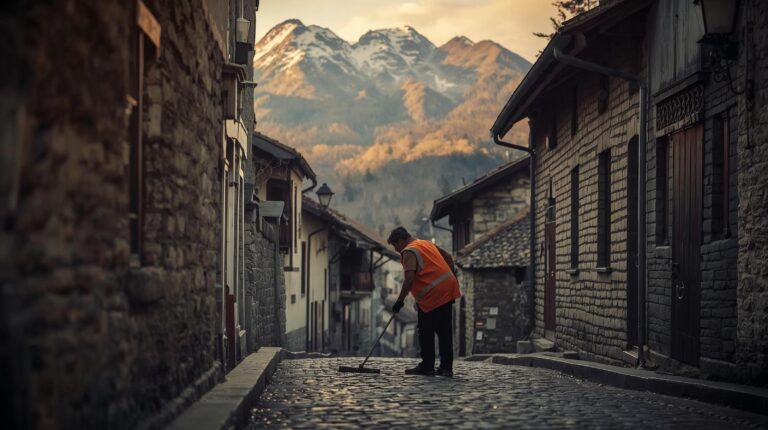
Cleanliness and landscaping: The early cleaning of the streets and alleys that tourists find welcoming every morning.
-
Construction: Hard physical labor in the construction and repair of the hotel base and road infrastructure.
-
Agriculture: In the Razlog Valley region, many families still rely on seasonal work in the fields (potato production and livestock farming).
This is the paradox of resort towns – the luxury at the forefront is often supported by the labor of people with the lowest incomes.
The contrast: Five stars versus no conditions
If you walk down the main streets of Bansko, you will see modern buildings and gated communities with controlled access. However, the reality for a part of the local population is radically different. On a national scale, the statistics are alarming and Bansko is not an isolated island from these trends:
-
Nearly 43.51% of the Roma in Bulgaria live in difficult living conditions.
-
76.9% live in overcrowded housing.
-
Over 80% are at risk of poverty and social exclusion.
In the context of Bansko, this contrast is even more stark. While thousands of guest apartments sit empty during the low season, many local families live in overcrowded homes, sometimes without adequate infrastructure. This dissonance between „Bansko for guests“ and „Bansko for the poor“ is a topic rarely discussed over a glass of wine in the center, but is an everyday occurrence for almost 5% of the municipality’s residents.
Education and future
The key to change is education. Data for Bulgaria show that only 9.51% of Roma complete secondary education, and less than 11% of Roma graduate from university. However, in a small town like Bansko, integration sometimes has better chances than in the large anonymous neighborhoods of the capital. Children often study in a mixed environment, but economic difficulties remain the main obstacle to a child continuing their development after the age of 16.
Why is this important for us and the city's guests?
Why should a tourist or digital nomad care about this topic? Because truly understanding a place requires seeing the full picture, not just the „tourist facade.“.
Bansko is a living organism. It is not just a setting for a ski vacation. People with different destinies, backgrounds and opportunities live here. The Roma community is here – with their families, struggles for a better life and hopes, just like everyone else. Knowing and understanding these realities is the first step towards a more mature and responsible attitude towards the places we visit and love.
Small gestures matter.
Many of the people who keep the streets clean early in the morning or take care of the infrastructure are part of this community. A smile, a greeting of "Good morning" or simply a respectful attitude towards the staff, which often goes unnoticed, is the smallest but most important step.
This is the way to overcome social barriers and show that we appreciate everyone's efforts. Let's give them a smile tomorrow morning when we meet them.
 English (UK)