


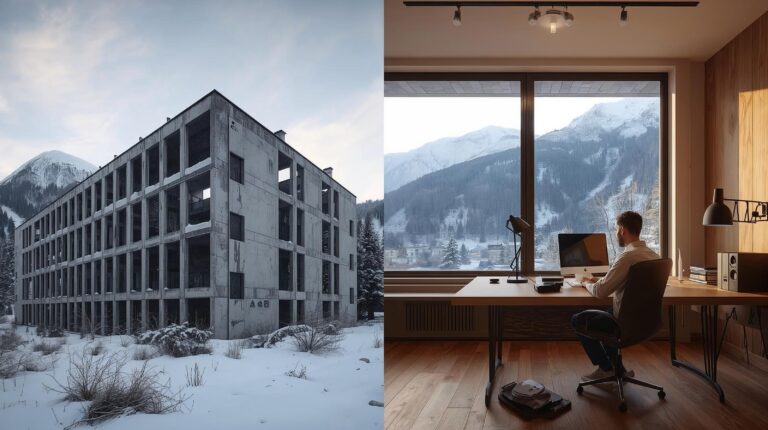
Summary: The real estate market in Bansko, Bulgaria, is currently at a decisive turning point, characterized by a deep mismatch between the building stock left behind by the speculative boom of the mid-2000s and the sophisticated requirements of the buyer in 2025. Although the town appears to be oversaturated with residential properties, detailed analysis reveals a “hollow” supply: a surplus of functionally outdated studios and small one-bedroom apartments that do not meet the needs of the new demographic of year-round, digital-savvy nomads и семейни купувачи. Този доклад оспорва преобладаващото пазарно мнение, че новото строителство трябва да бъде напълно спряно в полза на довършването на стари структури. Вместо това, той аргументира нуждата от нюансирана, двупосочна стратегия: агресивно преустройство и обединяване на съществуващи единици за създаване на семейни жилища, заедно с целенасочено, висококачествено ново строителство в периферни зони като Баня и Razlog, където липсва типологията на “алпийската хижа” (chalet).
The analysis confirms that the “missing properties” – specifically large-format three-room apartments (with 3 bedrooms), energy-efficient detached houses and homes optimized for working from home – represent a significant arbitrage opportunity. In addition, the investigation into the “unfinished” building stock (Act 14) reveals that while environmental and aesthetic arguments support their completion, legal and technical obstacles often make them less viable than new construction, necessitating a selective approach to their acquisition. By bridging the gap between the 2007 heritage and the functional requirements of 2025, investors and developers can unlock significant value in what remains one of the most undervalued mountain resort markets in Europe.
1. Macroeconomic context and market evolution (2007–2025)
За да се идентифицира какво “липсва” на пазара в Bansko днес, е от съществено значение първо да се деконструира икономическата и архитектурна ДНК на съществуващия инвентар. Настоящата застроена среда не е отражение на органичното търсене на жилища, а по-скоро вкаменелост на специфичен финансов продукт – “ваканционния имот за отдаване под наем” (buy-to-let), който доминираше ерата преди 2008 г. Търкането между това наследство и реалността на 2025 г. движи настоящия недостиг на предлагане.
1.1 The legacy of the 2007 boom: Structural mismatch
The period leading up to Bulgaria’s accession to the EU in 2007 was characterised by a “gold rush” mentality in the real estate sector in Bansko. Fuelled by easy credit and speculative capital – mainly from the UK and Ireland – developers prioritised return on investment over liveability. The architectural strategy was to maximise building density (Kint) to produce the highest number of saleable units per plot.
This era left behind a specific typology of housing: the “ski lodge”. These units, usually measuring between 35 and 50 square meters, were designed for transient occupancy – sleeping for seven to ten days a year at the height of the ski season. They are characterized by:
- Minimalist layouts: Липса на входни антрета за мокра ски екипировка, липса на складови площи и комбинирани зони за живеене и спане.
- Kitchenettes: Small, single-walled kitchen installations without ovens, dishwashers or adequate food preparation space, reflecting the assumption that occupants will eat exclusively outside.
- Inefficient heating: Relying on resistive electric convectors, which are cheap to install but too expensive to operate for long-term occupancy.
When the global financial crisis hit in 2008, this speculative bubble burst with catastrophic speed. Prices collapsed, and the outflow of capital left dozens of developments unfinished. These “skeletons,” stalled at the Act 14 (rough construction) stage, remain a blight on the landscape and a source of confusion for modern investors. More importantly, the completed stock from that era has aged poorly, often lacking the insulation and quality of construction needed for year-round living that will define the post-2020 market.
1.2 The market renaissance (2020–2025)
By 2025, Bansko is reinventing itself. No longer just a winter ski resort dependent on a three-month season, it has become a year-round destination, strongly driven by the digital nomad community and the “Nomad Fest” phenomenon. This shift has fundamentally changed the economics of property ownership in the region.
The “habitability” crisis: The influx of semi-permanent residents – nomads staying for 1–6 months, retirees and families engaged in “worldschooling” – has exposed the inadequacy of the stock since 2007. A family cannot live comfortably in a 40 sq m. studio with poor soundproofing and no oven. The market is now defined not by a lack of roofs, but by a lack of homes. The discrepancy between the existing “holiday” product and the necessary “residential” product is the central theme of this report.
1.3 Demographic change: Who is the buyer in 2025?
Understanding the “missing” properties requires profiling the new buyer, who is different from the investor from 2007.
- The digital nomad: It requires high-speed internet, ergonomic workspaces, and community. They are high-income earners, but often prefer high-quality rentals or turnkey purchases that do not require immediate renovation.
- The young family: Often Bulgarians or mixed nationalities, moving from Sofia or abroad to raise children in a cleaner environment. They prioritize schools, parks and, most importantly, separate bedrooms for parents and children – a feature that is almost absent in the studio-dominated offering.
- The Wellness Migrant: Attracted by the mineral springs of Banya and the clean air of Pirin, this demographic seeks luxury, privacy and integration with SPA services, driving the market in the peripheral villages.
2. “The Missing Properties”: Analysis of Typological Gaps
Your query specifically asks what is “worth building or renovating.” Based on a comprehensive review of current listings, forum discussions, and market reports, the following types of properties are functionally non-existent or in critical shortage relative to demand.
2.1 Three-room apartment of “residential class”
The Void: The most obvious gap in the Bansko market is the three-bedroom apartment (a four-bedroom by Bulgarian standards, or a three-bedroom with a large living room and study). During the boom, developers reasoned that three studios were easier to sell than one large apartment. Consequently, 3-bedroom units make up a statistically insignificant portion of the total inventory.
The requirement: Modern families and long-term residents require separation of functions. The “missing” product is a single-level apartment of 100–140 sq m, containing:
- Three separate bedrooms: One for the parents, one for children/guests and one for an office.
- Two full bathrooms: To ease morning traffic, a critical point of failure in 1-bathroom vacation homes.
- Utility room: Separate space for washing machine, dryer and boiler, removing these noisy appliances from the kitchen or bathroom.
- Separate entrance hall: A space with aggressively ample storage space for ski boots, jackets, and hiking gear, separating the “dirty” outdoor space from the clean living space.
Development viability: The creation of this typology is highly “beneficial” because it faces no competition. New projects that have offered larger areas have seen rapid realization, often selling out “on the green”. The shortage is so acute that buyers are increasingly forced to buy two adjacent apartments and attempt complex legal and structural mergers (discussed in Section 4).
2.2 Work-From-Home-Optimized Housing
The Void: While Bansko is advertised as a hub for digital nomads, the housing stock rarely reflects this. Most units lack dedicated workstations, forcing residents to work from dining tables or couches, which is unsustainable for long-term productivity.
The requirement: A “ready-to-use” apartment is a specific asset class. It differs from a standard apartment by:
- Acoustic insulation: Improved noise insulation between apartments and within the home to ensure video calls are not interrupted by neighbors or household noise – a common complaint in older buildings with thin brick partitions.
- Connectivity infrastructure: While fiber optic reaches the building, the internal wiring is often outdated. The “missing” property has Cat-6 or Cat-7 Ethernet cabling to every room, ensuring gigabit speeds without relying on unstable Wi-Fi signals.
- Ergonomic zoning: A layout that includes a dedicated “Zoom corner” or office niche with proper lighting and power, separated from relaxation areas.
2.3 Alpine-style eco-lodge (Detached houses)
The Void: Bansko is an alpine resort, but paradoxically it lacks the “chalet” typology common in the Alps. The housing stock is split between large apartment blocks and old, often dilapidated, country houses in the town centre. There is almost no supply of modern, energy-efficient detached houses with courtyards.
The requirement: Buyers looking for the “mountain dream” are looking for:
- Private green space: A garden or yard, essential for families with children or pets.
- Modern Aesthetics: Merging traditional materials (stone, wood) with modern forms (large windows, open plans), instead of the heavy, dark styles of the Renaissance period.
- Energy independence: Homes equipped with heat pumps and photovoltaic panels to mitigate rising energy costs.
Change location: Due to the scarcity of land and density in Bansko itself, this typology migrated to the periphery – specifically the area between Bansko and Banya, and the area of “Pirin Golf. Here, plots allow for horizontal development, and new gated community projects command prices significantly higher than downtown apartments, validating the demand.
2.4 Wellness home with mineral water
The Void: The village of Banya, just 5 km from Bansko, is located on a massive thermal ridge. Although there are hotels, there is a shortage of high-end private residences that utilize this resource.
The requirement: “The ”missing” property here is the luxury villa or apartment with direct access to mineral water.
- Mineral water pipe: Properties that have the rights to channel thermal water into private jacuzzis or pools are the ultimate luxury asset.
- Year-round appeal: Unlike ski-focused properties in Bansko, these wellness homes have a 12-month appeal, smoothing the rental yield curve and attracting a more affluent demographic.
3. The “skeletons” dilemma: Analysis of the unfinished inventory
The user mentions a strong opinion: “You can’t build new until the old unfinished ones are fixed.” This section analyzes the validity of this opinion from a technical, legal and economic perspective. This is the most complex aspect of the Bansko market.
3.1 The Landscape of the “Ghost Town”
Bansko is dotted with structures suspended at Act 14 (rough construction). These buildings, numbering dozens, have been exposed to the harsh mountain elements – freeze-thaw cycles, snow loads and UV radiation – for over 15 years. They represent a massive “sunk cost” and a visual scar on the city.
3.2 Technical Viability: Can they be saved?
The assumption that these buildings can simply be “finished” is technically wrong without a rigorous audit.
Evaluation protocol: Before any investment, a destructive audit is required: core drilling to test the depth of carbonation and exposing reinforcement to check for loss of section. In many cases, the cost of rehabilitating a degraded skeleton – by sandblasting reinforcement, applying corrosion inhibitors and patching concrete – approaches or exceeds the cost of demolition and new construction.
3.3 The Bureaucratic Swamp: From Act 14 to Act 16
Completing a skeleton is a legal minefield.
- Expired permits: Building permits in Bulgaria are valid for 5 years. If Act 15 (construction completion) is not reached within this window, the permit expires.
- The shock of the new codes upon re-verification: To restart construction, the developer must apply for a permit renewal or recertification. Crucially, this triggers compliance with current building codes (2025), not the 2007 codes.
- Energy efficiency: The 2025 codes require buildings to meet Energy Class A standards. A 2007 frame was probably designed for 5 cm of EPS insulation. Meeting the 2025 standards may require 10–15 cm of high-grade insulation, triple glazing, and complex HVAC systems that were never in the original budget or structural load calculations.
- Seismic standards: Seismic codes have also been tightened. A 2007 structure may need expensive strengthening (e.g., carbon fiber column wraps) to meet 2025 earthquake safety regulations.
3.4 Fragmentation of ownership
Perhaps the biggest hurdle is legal, not technical. Many of these unfinished buildings have units that were sold “green” to British, Irish or Russian buyers who have since disappeared, gone bankrupt or lost interest.
The Consolidation Nightmare: To complete a building, a developer usually needs 100% control. Tracking down 40 individual owners across Europe to buy them out or get their consent to restart construction is often impossible.
The niche of “distressed assets”: The only viable “skeletons” are those held by a single legal entity (e.g., a bank or the trustee of a bankrupt entrepreneur), where pure ownership can be acquired in a single transaction.
3.5 Conclusion about skeletons
Although the attitude is to fix up the old ones, the reality is that for many skeletons, demolition or abandonment is the only economic outcome. However, for the select few who are structurally sound and have clear ownership, their completion is highly “beneficial” because they occupy the best locations. The area around the Gondola is completely built out; the only way to get a new apartment next to the lift is to complete an old skeleton.
4. Construction and Renovation Strategy: What is useful?
Given the constraints on new construction (land shortage in prime areas) and the difficulties with scaffolding, a targeted strategy is needed.
4.1 Renovation Strategy: The Unification Project“
For individual investors and small entrepreneurs, the strategy with the highest return is Amalgamation.
The concept: Purchase of two adjacent studios in a completed building (Act 16).
Example: You buy two 40 sq m studios for €45,000 each (total €90,000).
Work: Demolition of the non-load-bearing partition wall. Reconfiguration of the space to create a spacious one-bedroom apartment of 80 sq m or a compact one-bedroom (with two bedrooms) with a large living area.
Value Arbitrage: Large, livable apartments are selling for a higher price per square meter than studios due to the scarcity. The combined entity creates a unique asset that stands out in a sea of generic listings.
Technical considerations:
- Wet rooms: Combining two bathrooms allows one to be converted into a utility room/storage room – a huge plus for long-term living.
- Kitchen upgrade: The kitchenette from one studio can be removed completely, allowing for a full-size L-shaped or island kitchen in the extended living area.
4.2 Technical retrofitting: Solving the energy crisis
“The ”useful” renovation should address the main pain point of life in Bansko: Heating costs.
The problem: Most apartments since 2007 use resistive electric convectors. With rising electricity prices, heating a poorly insulated apartment can cost €200–€300/month in winter.
The solution: Heat pumps:
- Air-Air (Hyperinverter air conditioners): The most cost-effective solution. High-efficiency modules (COP > 3.5) can reduce heating bills by 60–70% compared to “blowers”. They also provide cooling in the summer, which is increasingly needed.
- Pellet fireplaces: Although popular for their “cozy” warmth and lower fuel costs compared to inefficient electricity, they require physical labor (carrying bags) and storage space that is lacking in apartments. For the nomad market, automated heat pumps are superior.
- Insulation: Internal wall insulation (e.g. mineral wool behind plasterboard) is a viable solution for individual units where the building facade cannot be changed. It also provides the acoustic insulation needed by remote workers.
4.3 New Construction: “Suburbanization”
Since the “Ski Zone” is saturated, “useful” new construction is moving to the Rila-Pirin Valley (Razlog/Banya).
- Typology: Low density, gated communities of single-family homes.
- Construction method: Prefabricated energy-efficient homes or timber-frame construction are gaining momentum due to their speed and thermal performance.
- Cost vs. Value: Building a new house costs €600–€800/sq m (construction only). Sales prices for these units reach €1,800–€2,200/sq m, offering a healthy margin for developers who can secure the land.
5. Financial analysis and investment economics
5.1 Shipping cost comparison
To determine the most viable path, we compare the costs of delivering a “livable” 100 sq m property through three methods.
| Indicator | Strategy A: New construction (Periphery) | Strategy B: Skeleton Completion (Prime) | Strategy B: Unification (Renovation) |
|---|---|---|---|
| Acquisition price | €100–€150/sq m. (Land) | €200–€400/sq.m. (Structure) | €1,000–€1,200/sq m. (Existing properties) |
| Construction price | €800–€1,000/sq.m. | €500–€700/sq m. (Finishing) | €250–€400/sq m. (Renovation) |
| Regulatory risk | Medium (Permitting) | High (Revalidation) | Low (Internal Affairs) |
| Time to market | 18–24 Months | 12–18 Months | 3–6 Months |
| Total cost | ~€1,100/sq.m. | ~€1,000/sq.m. | ~€1,400/sq.m. |
| Selling price | €1,800+/sq.m. | €1,600+/sq.m. | €1,600+/sq.m. |
| Verdict | High margin, high effort | High risk, high reward | Lower margin, speed and security |
Analysis:
- New construction offers the best margin, but forces development to the periphery (Banya/Razlog).
- Consolidation is the most affordable strategy for smaller investors. Although the cost is higher (buying ready-made units), the risk is zero in terms of permits or structural integrity.
- Completing skeletons is mathematically appealing, but operationally dangerous due to the “unknowns” surrounding structural health and legal title.
5.2 Rental Yield and the “Nomad Premium”
The shift to digital nomads has changed the profitability equation.
- Traditional ski season: High volatility. 12 weeks of income, 40 weeks of emptiness. High depreciation.
- Nomadic rental (1-6 months): Lower price per night, but potential for 12-month occupancy.
- Profitability: A well-renovated, “ready to move in” apartment can bring in €450–€700/month year-round. This provides a stable 5–7% gross yield, outperforming the ski tourism cycle.
The trap of "“Maintenance fee“": A critical financial factor is the Maintenance Fee. In resort complexes it can be €12–€15/sq m/year. For a 100 sq m apartment this is €1,500/year in fixed costs that eat into profitability.
Strategic view: “Useful” buildings are those with low maintenance fees. Nomads prefer to pay for a separate coworking membership than a mandatory fee for a pool in the building that they may not use. Renovating units in residential buildings without expensive amenities (fees <€4/sq m) is a highly effective strategy for maximizing net income.
6. Bureaucratic and legal guide for investors
6.1 Explanation of the “Acts”
Navigating the stages of construction in Bulgaria is critical for anyone considering the “skeletons” path.
- Act 14 (Rough construction): The construction is complete. The building looks like a concrete skeleton. Ownership can be transferred, but the building is not habitable.
- Act 15 (Completed construction): The building is physically completed, but not yet certified for occupancy. Electricity and water may be connected, but often at “industrial” rates.
- Act 16 (Permit to Use): The final stamp of approval. The building is safe, legal, and utility bills are normalized (domestic electricity).
6.2 The Maintenance Fee Act
The Condominium Management Act (ZUES) regulates maintenance fees. However, disputes are common. Owners in complexes often find themselves locked into contracts with management companies that provide poor service.
Reform: Case law and changes allow owners to vote to change the management company more easily. Investors should prioritize buildings where the “General Assembly” of the condominium is active and functional, rather than controlled by the investor.
7. Conclusion: A roadmap for “useful” development
The market in Bansko has matured from a speculative playground into a functional residential ecosystem. The “missing” properties are not yet vacation rentals, but homes that respect the dignity of long-term living.
7.1 Strategic recommendations
- Stop the construction of studios: The market is saturated. Any new development with units under 50 sq m. contributes to the problem, not the solution.
- Focus on “Adaptive Reuse”: The most sustainable and “useful” route is to acquire run-down hotels or skeletons with Act 14 (where the legal title is clean) and radically re-configure the plans. Combining three hotel rooms into one apartment creates the spacious inventory the market craves, while removing a stain from the city.
- Embrace “Suburbanization”: For new construction, look to the lands between Bansko and Banya. This is the future “Beverly Hills” of the valley – low density, high luxury and a focus on wellness.
- Technological re-equipment: There is a massive business opportunity in simply renovating existing stock. A service that installs heat pumps, high-speed networks and acoustic insulation would have a waiting list of customers among the new expat community.
By answering the call for “missing” livable spaces, developers can align themselves with Bansko’s new reality: a place not just for skiing, but for living. The boom era of 2007 is over; the housing renaissance era of 2025 is just beginning.
8. Detailed applications: Data and technical specifications
8.1 Comparative analysis of heating systems for the climate in Bansko (Altitude 925m)
| System | Installation price | Current expenses | Comfort | Advantages | Disadvantages |
|---|---|---|---|---|---|
| Electric convector | Low (€500) | High (€200/month) | Low (Dry air) | Cheap installation | Expensive electricity, cold areas |
| Pellet fireplace | Medium (€1,500) | Medium (€80/month) | High (Radiant) | High power | Manual labor, space required |
| Heat pump (Air) | High (€3,000+) | Low (€60/month) | High (Air Conditioning) | Cooling on, automatic. | High initial price |
| Gas | High | Medium | Tall | Persistence | Lack of gasification |
* Note: The efficiency of heat pumps (COP) drops in extreme cold, but modern modules remain effective down to -15°C/-20°C, which covers 95% of winter nights in Bansko.
8.2 Construction Cost Breakdown (Average for 2025)
| Feather | Price per sq m. (New construction) |
|---|---|
| Rough construction (Construction) | €250–€300 |
| Roof and Facade (Insulation) | €100–€150 |
| Windows (Triple glazing) | €80–€100 |
| Plumbing and El. installations | €120–€150 |
| Finishing works (Floors/Walls) | €150–€200 |
| Total fixed costs | €700–€900 |
This table supports the thesis that new construction must target the luxury segment (sales >€1,500/sq m) to be viable.
8.3 Checklist of connectivity requirements for digital nomads
- Download speed: Min. 100 Mbps (Optics).
- Upload speed: Min. 30 Mbps (for video calls).
- Reservations: Dual connection with provider or 4G/5G backup.
- Hardware: Mesh Wi-Fi network covering all rooms and balconies.
- Power supply: UPS (Uninterruptible Power Supply) for the router in case of power surges.
 English (UK)