


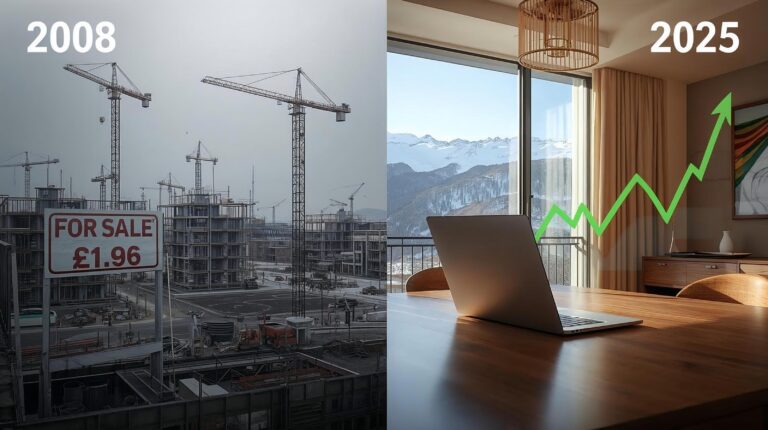
If there is an economics textbook looking for the perfect example of a market cycle, it simply needs to look to Bansko. Over the past two decades, the real estate market in our most popular winter resort has gone through everything: from unprecedented euphoria and unrealistic promises, through a brutal crash and years of stagnation, to today's unexpected but stable renaissance.
For investors who are following the processes from the side, the price chart in Bansko describes a classic „U-shaped“ curve. For the people who put their money there, it was either the biggest mistake (in 2008) or the deal of a lifetime (in 2015).
In this detailed analysis, we will look at the anatomy of the market – why prices collapsed, what raised them again, and whether today's levels of 1000+ euros per sq m are a new bubble or a sustainable reality.
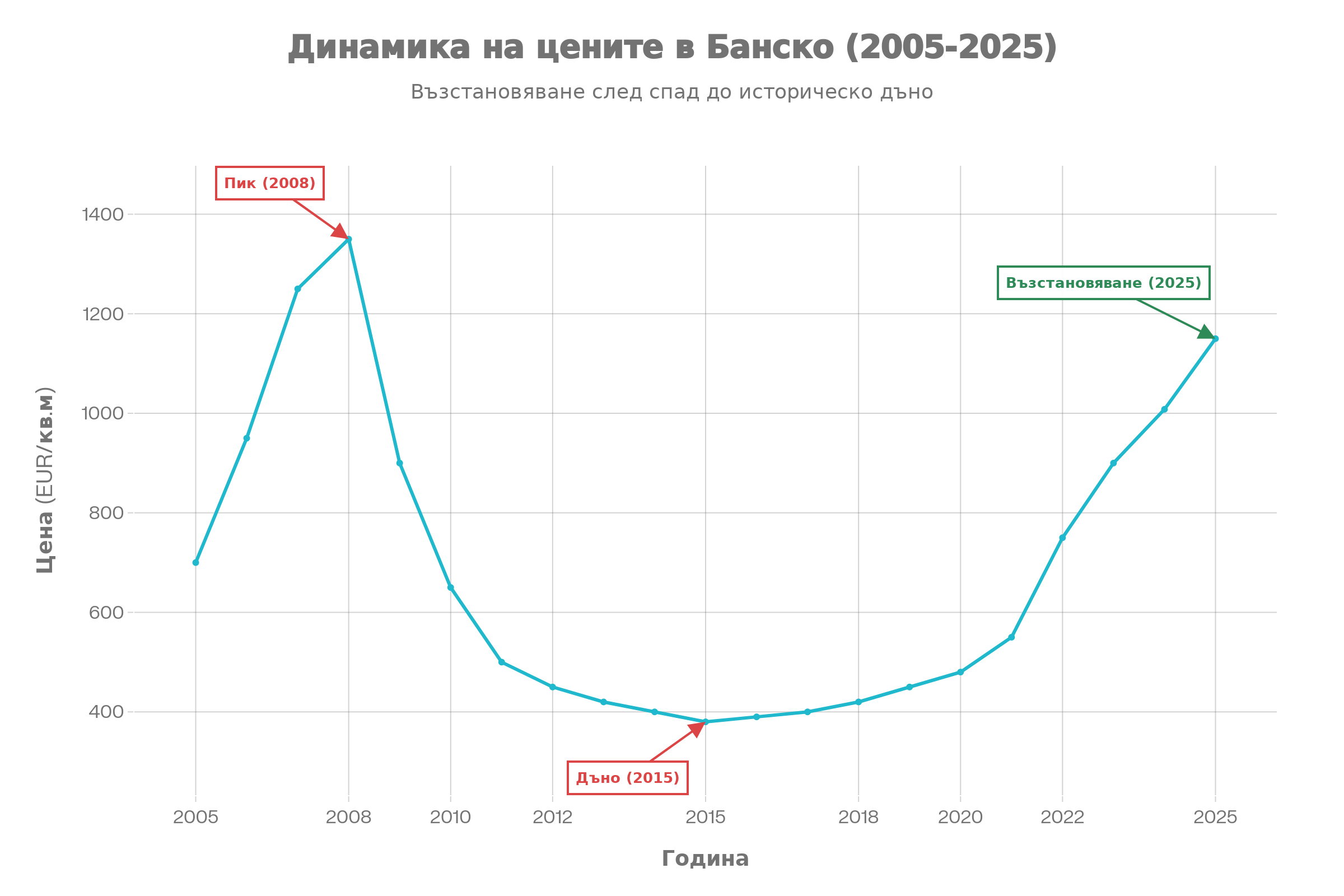
Visualization of market cycles in real estate in Bansko: from the peak of the bubble in 2008, through the bottom in 2015, to the current price recovery in 2025.
Era 1: The Gold Rush and the British Invasion (2005 – 2008)
To understand today's situation, we need to go back to the beginning of the millennium. Back then, Bansko was not just a town under Pirin, but El Dorado for foreign investors.
The marketing of dreams
Between 2004 and 2007, Bansko was aggressively advertised in Britain and Ireland as the „Alps of the Balkans,“ but at the price of a prefabricated house in Eastern Europe. British retirees and young speculators bought properties „off-plan,“ often relying solely on colorful brochures and computer visualizations, without ever setting foot in Bulgaria.
The peak of madness
Prices started at a reasonable 700 euros/sq m, but the hysteria quickly inflated the bubble. In late 2007 and early 2008, deals for luxury apartments near the cable car base station reached the then unthinkable 1300–1500 euros/sq m. There were more construction cranes than trees in the Gramadeto area, and every vacant plot of land was being turned into a spa complex. No one asked about the quality of the construction or the size of the maintenance fee. The important thing was to buy now.
Era 2: The Burst and the „Decade of the Buyer“ (2009 – 2018)
Then came 2008. The global financial crisis hit, and the British pound collapsed. Foreigners who had bought properties with loans or savings suddenly found themselves owners of assets they couldn't repay and that no one wanted to buy.
Freefall (2009–2011)
The bubble burst with a bang. Foreign investors launched a massive fire sale. The market was flooded with supply and there were no buyers. In just three years, prices had fallen by over 50%, returning to levels of around 500 euros/sq m. Many complexes remained unfinished – ghostly skeletons that for a long time reminded us of that era.
The Absolute Bottom (2014–2016)
If there was ever a time to buy, it was 2015. That's when the market hit rock bottom. Studios of 30-40 square meters were selling for 10,000-12,000 euros - a price lower than the cost of a mid-range car. The average price per square meter fell to a historic low of 380 euros.
During this period, the buyer profile changed completely. The English withdrew, and in their place came the Bulgarians – people from Sofia, Plovdiv and Varna, looking for a bargain holiday base for skiing and summer tourism. They were cautious, haggling for every euro and were particularly sensitive to the annual maintenance fee.
Era 3: The Renaissance and the New Normal (2020 – 2025)
When everyone predicted that Bansko would remain an undervalued property market forever, the unthinkable happened – the COVID-19 pandemic changed the rules of the game.
The effect of COVID-19 and digital nomads
Lockdowns made people realize that they did not want to be confined to concrete boxes in big cities. Bansko, with its clean air, nature and good connectivity, became a refuge. The phenomenon of coworking communities attracted hundreds of digital nomads, who not only rented, but also started buying. Housing in Bansko was no longer just a „ski vacation property“, but a „second home“ or even a primary residence for remote work.
Inflation as a catalyst
After 2022, high inflation forced people with free funds to seek salvation for their money in "hard assets." Properties in Bansko, although more expensive, were still significantly more affordable than those in Sofia or on the Black Sea coast.
The situation today (2024–2025)
By the beginning of 2025, average prices for quality properties will again reach levels of 1000–1200 euros/sq m, and premium properties on the first line to the lift will reach up to 1500 euros/sq m.
Paradoxically, nominally, prices have returned to their peak levels in 2008. The difference is that today inflation has "eaten" a large part of the value of money, so in real terms, properties are still more affordable than they were 20 years ago.
Statistical breakdown: Price movement
| Year | Average price (€/sq m) | Market condition |
| 2005 | ~700 | Beginning of the construction boom, optimism. |
| 2008 | 1350 (PIK) | A speculative bubble dominated by British. |
| 2011 | 500 | Sharp collapse (-60% of spades), panic. |
| 2015 | 380 (BOTTOM) | Oversupply, bank sales, best deals. |
| 2020 | 480 | A timid start to recovery, the start of the pandemic. |
| 2023 | 850 | Increased interest from Bulgarians, nomads and investors. |
| 2025 | 1100+ | Stable growth, deficit of quality new construction. |
Why is this growth different from the bubble in 2008?
Many skeptics ask: „"Isn't a new balloon inflating?"“. The analysis shows that the current situation is fundamentally different for three reasons:
-
Real use, not speculation: In 2008, properties were bought for quick resale. Today, they are bought for use – year-round living, remote work, or renting out on platforms like Airbnb and Booking.com.
-
Lack of overbuilding: Currently, Bansko is not building indiscriminately like it was 20 years ago. There are moratoriums, stricter control, and a lack of good vacant plots in regulation. This creates a natural deficit of quality properties.
-
Buyer profile: Today's buyer is informed. He makes a difference between a residential building with a 15 leva entrance fee and a hotel complex with a 15 euro/sq m mandatory annual maintenance fee.
The Dark Side: The Problem with Maintenance Fees
If you are considering a purchase, this is the most important aspect. The big gap in prices today comes from the maintenance fee.
You can find two identical apartments on the market – one costs 40,000 euros and the other 70,000 euros. Why?
-
The cheap one It is probably located in a large holiday complex with a maintenance fee of 12-15 euros per sq m per year. This means that for a 60 sq m apartment you owe close to 1000 euros every year, regardless of whether you use the property or not. These properties appreciate more slowly.
-
The dear is located in a simple residential building (without a pool and reception), where the fees are symbolic. These are the "golden hens" on the market right now, because they are liquid and cheap to own.
Forecast for 2025-2030: Where are we going?
The trend is towards stabilization. The era of "no money" properties is irrevocably over. Bansko is establishing itself as a year-round destination and this is supporting prices.
It is expected:
-
Price increase of "urban" properties: Housing suitable for permanent residence (with low taxes, good insulation, heating) will become increasingly expensive and scarce.
-
Renaissance of old buildings: Investors will start buying and renovating old houses and apartments instead of building new ones.
-
The rental market: As more long-term residents move in, rents will also go up, which will increase the return on investment.
In conclusion, if you bought a property in Bansko in 2015, today is your chance to pop open the champagne. If you are planning to buy now – the train has not been dropped, but it is already moving at a higher speed and requires much more careful analysis. Bansko is no longer a real estate flea market – it is a mature market with its own rules.
 English (UK)