

1. Introduction and methodological framework
The year 2005 occupies a special place in the contemporary economic and social history of Bulgaria, as in the microcosm of a city Bansko it manifests itself with an intensity bordering on tectonic displacement, marking the beginning of large-scale transformation of Bansko. This report aims to deconstruct the processes that transformed a traditional mountain village into an epicenter of large-scale investment flows, urban experiments, and tourist expansion. The analysis is not limited to a dry enumeration of statistical data, but seeks the cause-and-effect relationships between global financial markets, national political decisions, and local social transformations.
In the context of Bulgaria's upcoming membership in the European Union, Bansko became a test bed for absorbing foreign capital aimed at the real estate and tourism sectors. 2005 marked the tipping point, in which the quantitative accumulations of the previous years - the start of the construction of the new ski area in 2001-2003 – grew into a qualitatively new reality. This was the year of the „Gold Rush“, of hypertrophied construction, of the clash between environmental legislation and investment pressure, as well as of the attempt at cultural rebranding of the destination.
This document is structured into five main verticals: economic dynamics and real estate market; construction, infrastructure and spatial planning; tourism development and hospitality; sports management and ski area development; and cultural calendar and social identity. Each of these areas is examined through the prism of events and data from 2005, taking into account the long-term effects, the roots of which are laid precisely in this period.
2. Macroeconomic environment and the property market phenomenon
2.1. Genesis of the investment boom
The economic climate in 2005 was dominated by optimism in global markets and easy access to credit. In the case of Bansko, these factors catalyzed unprecedented interest from foreign investors, primarily from the UK and Ireland. The growth model was not organic, based on the gradual development of local businesses, but exogenous – fueled by speculative capital seeking quick returns in emerging markets.
The mechanism driving the city's economy this year is off-plan buying. Investors, often without having physically visited the location, deposit between 10% and 15% of the value of future apartments. This practice creates the illusion of unlimited demand and encourages entrepreneurs to launch new projects, counting on the market to absorb any supply.
2.2. Market dynamics and price levels
In 2005, real estate and land prices in Bansko reached historic peaks for the region. Data show that the price of a decare of land in regulation or with the potential for such reached 30,000 euros. This drastic jump in land value transformed the social structure of the local population - families who owned agricultural land suddenly found themselves owners of capital, which changed their economic behavior and consumption habits.
In residential properties, prices per square meter vary widely depending on the construction phase and location, but a steady upward trend is observed. In the luxury segment and for completed properties, prices are approaching those in the capital, moving in the range of 500-800 euros/sq m, and in some cases even higher, while "greenfield" offers start at lower levels (around 350 euros/sq m) in order to attract speculative capital.
| Property category / Service | Price range (approx.) | Trend compared to 2004 | Comment |
|---|---|---|---|
| Land (acre) | Up to EUR 30,000 | Sharp rise | The main driver is the rezoning of agricultural lands. |
| Housing (New construction) | 500 – 800+ EUR/sq.m | Height | Peak values for quality projects next to the lift. |
| Housing ("Green") | From 350 EUR/sq.m | Stable growth | The most popular segment for British investors. |
| Industrial rentals (Southern Bulgaria) | 1.0 – 2.5 EUR/sq.m | Stagnation | The focus is entirely on residential and tourist construction. |
2.3. Market institutionalization
The scale of the market leads to a hypertrophy of intermediary services. In a city with a population of about 9,000 people, as of 2005, over 120 real estate agencies were operating. This ratio – one agency for every 75 residents – is a clear indicator of the formation of a classic economic bubble. Agencies do not only serve the secondary market, but often act as investment consultants for foreigners, selling not just properties, but the „dream of profitability“ from renting them out.
2.4. First signals of correction and risk
Despite the euphoria, the end of 2005 and the beginning of the following period brought the first signs of cooling. The global financial turmoil, although still in its initial phase, began to limit the liquidity of foreign buyers. Many of them, who had paid the initial installments (deposits), found themselves unable to secure the final financing due to the tightening of the mortgage market in the UK and Ireland. This led to the appearance of the first „ghost buildings“ – unfinished concrete structures that remained as monuments to unfulfilled expectations. Local entrepreneurs, who had relied on phased financing from customers, also fell into difficulty, leading to bankruptcies of smaller construction companies.
3. Construction, urban planning and territorial development
3.1. Urban expansion: "Gramadeto" area„
The year 2005 marked the final shift of the city's center of gravity. While the historical center around the Holy Trinity Church retained its cultural value, the economic and urban heart of Bansko moved south, to the starting station of the gondola lift - in the Gramadeto area. This area is a vivid example of the physical transformation of Bansko, transforming from agricultural areas into a densely built-up, high-intensity neighborhood.
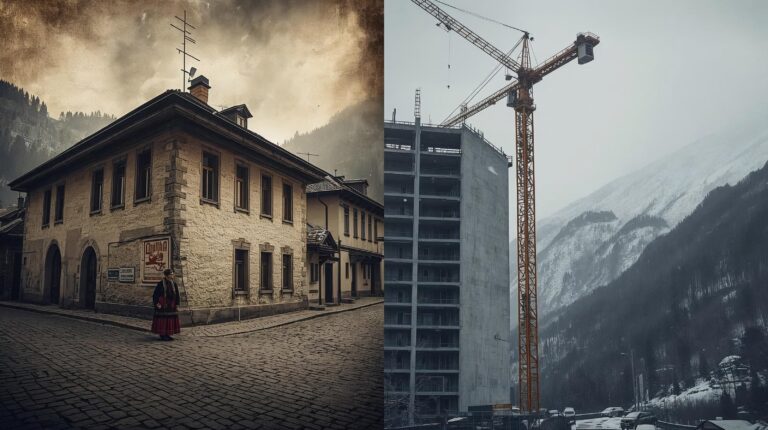
The architectural appearance here contrasts sharply with the traditional Bansko house. Large-scale apart-hotels are being built, often trying to imitate the Alpine style, but with a scale and density characteristic of an urban environment, not a mountain resort. The intensive construction in this area leads to a complete change of the landscape, with views of the mountain often being obscured by new concrete volumes.
3.2. Infrastructure collapse and the municipality's response
The unprecedented construction pressure is putting the existing infrastructure on the verge of collapse. Heavy construction equipment – concrete mixers, cranes, trucks with materials – is destroying the road surface along the main arteries of the city. In the spring of 2005, after the end of the winter season, the municipal administration is faced with the need for urgent and large-scale repairs. Mayor Alexander Kravarov announces an ambitious investment program worth 9 million leva for 2005, aimed at reconstructing the street network and building new facilities.
Key infrastructure projects (2005):
- Rehabilitation of main streets: The streets that have the heaviest traffic are being repaired as a priority: "Glazne" (the main connection to the lift), "Bulgaria", "Patriarch Evtimii", "Otets Paisii", "Drama" and "Tsar Boris".
- Construction of the Ring Road: The design and construction of a 6-kilometer ring road has begun. The goal is strategic - to move transit and construction traffic out of the city center to reduce noise and pollution for tourists and residents.
- Bridge facilities: A new bridge over the Glazne River is planned to improve connectivity between the two banks of the city and ease traffic.
- Water cycle and plumbing: In addition to the roads, the municipality and the state are working on projects to improve the water cycle, as the old water supply and sewage systems cannot cope with the dramatically increased consumption from the new hotels. The projects include replacing water transmission networks and planning treatment facilities.
3.3. Legal and Environmental Conflicts: The Expansion of the Ski Area
Perhaps the most significant and controversial moment in 2005 was related to the territorial organization of the Bansko Ski Area. On March 22, 2005, the Bansko Municipal Council voted to expand the scope of the ski area by an additional 112 hectares, exceeding the parameters of the initial concession from 2001.
This decision, subsequently approved by the Director of the Regional Inspectorate for Environment and Water-Blagoevgrad on September 8, 2005, became the occasion for a long-standing legal and public conflict. Environmental organizations (WWF, Coalition "For Nature to Remain in Bulgaria") claim that the changes in the Territorial Development Plan (TDP) of 2005 violate the Pirin National Park Management Plan and legitimize construction that was not foreseen in the concession agreement.
Specific violations cited by environmentalists include the construction of ski slopes wider than permitted, as well as the replacement of facilities without the necessary environmental impact assessments (EIAs). 2005 was the year when the institutions gave the green light for the de facto expansion of the area, which subsequently led to the exclusion of certain areas from the UNESCO World Heritage Site.
4. Tourism: Quantitative leap and change of profile
4.1. Statistical boom in visits
The winter season 2004/2005 turned out to be a record-breaking one, exceeding even the wildest forecasts. Bansko welcomed over 400,000 tourists, representing an almost 100% increase over the previous season (250,000 tourists). This exponential growth is due to the synergy between several factors:
- Increased bed capacity: The opening of hundreds of new apartments and hotels allows for the physical accommodation of a larger number of people.
- Aggressive Marketing: Bulgaria's positioning as "the most affordable ski destination in Europe" attracts budget tourists from the UK.
- Improved ski infrastructure: The new lifts and slopes make the resort competitive at an average European level.
During peak periods (Christmas, New Year, Student Holiday), the resort reaches full occupancy, disproving skeptics' concerns about an "oversupply" of beds.
4.2. Hospitality: The entry of the luxury segment
The year is key for Bansko's image due to the entry of the first international luxury brand.
Kempinski Hotel Grand Arena: The opening of this five-star complex is an event of national importance. The hotel officially opened its doors in the fall of 2005 (anniversary celebrations are often associated with the date October 26, 2005). It is the only hotel in Bulgaria, part of the Kempinski chain, and the only member of The Leading Hotels of the World in the resort at that time. Located directly opposite the gondola station, it introduces the ski-in/ski-out concept in its luxury version. The presence of such a brand serves as an anchor to attract higher-class tourists and business clients.
Hotel Lyon (Hotel Lion): In December 2005, the four-star Hotel Lyon was opened, adding significant capacity (over 190 rooms) and modern amenities such as a SPA center and conference rooms. These investments changed the structure of the offer - from small family hotels and guesthouses to large hotel complexes with a full range of services (all-inclusive, SPA, night bars).
| Hotel | Category | Opening date | Capacity (approx.) | Importance for the resort |
|---|---|---|---|---|
| Kempinski Hotel Grand Arena | 5 stars | October 2005 | 157 rooms/apartments | First international luxury brand; ski-in/ski-out. |
| Hotel Lion Bansko | 4 stars | December 2005 | 193 rooms | Mass high-end; increases capacity for organized groups. |
| Many aparthotels | 3-4 stars | Year-round | > 1000 new beds | They formed the "Gramadeto" neighborhood. |
5. Sports: Strengthening the ski area and World Cup ambitions
5.1. Investment program of "Yulen" AD
The concessionaire of the ski area, Yulen AD, implemented large-scale improvements in 2005, aimed at increasing the capacity and quality of service. This is an important part of the infrastructure transformation of Bansko as a sports center.
- New slopes and lifts: For the 2005/2006 season, new trails have been prepared in the area of "Zhelezn Most" and "Banderishka Polyana". The total length of the new trails and equipment reaches nearly 10 kilometers.
- Technical support: The artificial snow system has been expanded with equipment from TechnoAlpin, which is critical to guaranteeing the season in a changing climate. This allows the season to last from December to April.
- Alberto Tomba Track: The former Banderitsa slope was reconstructed and homologated to bear the name of the legendary Italian skier. It became the most difficult and prestigious track in the resort, intended for competitions of the highest rank.
5.2. Sports Calendar 2005: The Balkan Open Test„
The year 2005 was a crucial one for the resort's sports management. On February 26 and 27, 2005, the Balkan Open Cup in alpine skiing was held, which served as a dress rehearsal for hosting rounds of the European and World Cups.
Results and analysis of the competition:
- Organization: The competition is held on the Alberto Tomba track and has been highly praised by FIS representatives, including European Cup Director Dieter Posch.
- Participants: Attracting international competitors is key. In the women's giant slalom, Ana Jelušić (Croatia) dominates, followed by Marion Armelin (France). In the men's giant slalom, Miha Malus (Slovenia) wins.
- Bulgarian presentation: Bulgarian skiers showed a competitive level. Stefan Georgiev finished second in the slalom, and Maria Kirkova won the women's slalom.
- PR effect: The presence of the legend Mark Girardelli as a special guest solidifies his connection with Bansko. His role as an ambassador for the resort is a tool for lobbying the FIS for hosting rights.
This event is critical because it proves that Bansko possesses not only bed capacity, but also the technical capacity (tracks, timing, security) for professional sports.
6. Culture and Identity: Between Jazz and Folklore
6.1. International Jazz Festival Bansko 2005
In the midst of the construction summer, the cultural life of the city finds its refuge in the International Jazz Festival. Held from August 8 to 13, 2005, the eighth edition of the festival has established itself as the most prestigious summer event. The festival has strategic importance for the image of Bansko. It attracts a more intelligent and solvent audience during the summer season, when ski tourism is not operating. The concerts are held outdoors on Nikola Vaptsarov Square and are free, which democratizes access to high art.
Program and highlights:
- International participation: The stage welcomes musicians from 11 countries, including the United States, Germany, France, Belgium, and Egypt, making the square a cosmopolitan space.
- Bulgarian stars: The elite of Bulgarian jazz participates - Kamelia Todorova, Vasil Petrov, Angel Zaberski, Mario Stanchev.
- Atmosphere: The unique element of 2005 was the impromptu jam sessions in the bars after the official program. This "club culture" began to take shape then, mixing local musicians with world names.
6.2. Traditional calendar and social sustainability
Despite modernization, Bansko managed to preserve its roots in 2005.
- Ilinden celebrations: The August holidays, associated with the Ilinden-Preobrazhensko Uprising, remain a central element of local identity, uniting the native Banska Bystrica.
- Folklore: Groups like "Banski Starcheta" continue to be guardians of authentic two-part singing, although their role is increasingly commercialized as an attraction for foreign tourists in taverns.
6.3. The socio-cultural clash
The year 2005 exacerbated the conflict between the two faces of Bansko. On one side is the „old town“ with its stone walls, silence and traditions. On the other is the „new town“ (Gramadeto) – noisy, concrete, oriented towards English pubs and cheap alcohol for tourists. Local residents, although rich from the sale of properties, often express regret for the lost spirit of the town. The words of Maria Toteva that „greed prevailed over reason“ and „the charm of the old town has disappeared“, resonate with the sentiments of many who see 2005 as the beginning of the end of authentic Bansko.
7. Conclusion: The effect of Bansko's great transformation
The analysis of 2005 reveals a picture of a city in a state of extreme change. This is the year in which Bansko finally broke with its past as a quiet mountain resort and entered the global tourism industry with all the positives and negatives of this process.
Main conclusions from 2005:
- Economic: The real estate bubble is reaching its peak, fueled by external speculative capital, leading to short-term prosperity but posing long-term structural risks (unfinished buildings, overdevelopment).
- Urbanistic: The city is split into two zones - historical and new tourist, with infrastructure lagging drastically behind the pace of private construction.
- Environmentally friendly: 2005 was the year of the institutionalized expansion of the ski area in Pirin National Park, which became a catalyst for long-standing environmental conflicts.
- Tourist and sports: The successful hosting of the Balkan Open and the opening of the Kempinski Hotel validate Bansko's potential as a world-class destination, paving the way for the World Cup.
In retrospect, 2005 can be defined as the year of the "Big Bang" for Bansko - the moment of the creation of the modern resort, built on the foundations of unprecedented investment risk and ambition.

 English (UK)