

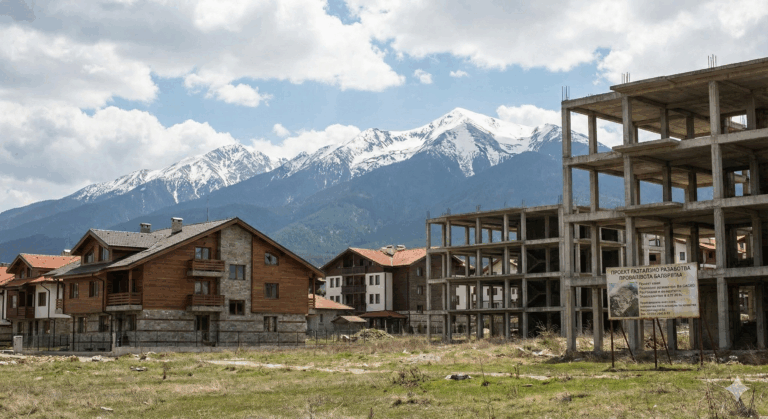
These „concrete monuments“ have become a symbol of the aggressive construction boom of the turn of the century and the subsequent stagnation. But what is their fate today and why do experts see in them a hidden potential for high profitability? In this detailed guide, we will analyze the reasons for their existence and the market prospects they offer.
Historical context: How did the “frozen” projects come about?
At the beginning of the 21st century, Bansko experienced a massive construction boom that often bordered on chaos. The investment wave led to the construction of a huge number of hotels and holiday complexes, concentrated mainly in the "Gramadeto" areas and around the starting station of the lift. However, many of them remained unfinished after the global financial crisis of 2008–2009.
Main reasons for abandoned buildings:
- Lack of long-term strategy: Lack of an overall vision for the development of the city as a sustainable year-round resort in the period 2004-2008.
- Imbalance in planning: Issuing building permits for over 20,000 new beds, without taking into account the capacity of the ski infrastructure.
- Speculative construction: Mass construction of aparthotels by inexperienced investors, relying solely on quick "greenfield" sales.
Reasons for stopping construction in Bansko
1. Economic factors and bankruptcies
The financial crisis caused a sharp drop in demand, which led to mass bankruptcies. Many owners failed to service their loans, as a result of which the properties were announced for public sale by private enforcement agents (PEAs). Even today, entire sections of complexes periodically appear in the registers of PEAs, awaiting their new owner.
2. Administrative obstacles and ZTA
The Spatial Planning Act (SPA) is merciless towards delays. According to Art. 153 of the SPA, a building permit loses its legal effect if the “rough construction” stage (Act 14) is not completed within certain deadlines. For many unfinished construction in Bansko This means the need for redesign according to modern energy and seismic standards, which is an expensive and slow process.
3. Market Oversaturation
In 2012, the supply of apartments exceeded demand by over 40%. This led to a logical collapse in prices and a withdrawal of investor interest for more than a decade. Only in the last 3 years (2023-2026) has the market managed to absorb a large part of the finished stock, turning its attention to the "frozen" projects.
Comparative analysis: New construction vs. Finishing an old site
| Indicator | New construction (2026) | Unfinished object (Act 14) |
|---|---|---|
| Acquisition price | High (€1200+ / sq.m) | Low to medium (€450 – €700 / sq m) |
| Completion deadline | 18-24 months | 6-12 months (with proper documentation) |
| Location | Peripheral areas | Often in top locations (near the gondola lift) |
| Risks | Material inflation | Structural defects, old installations |
Renaissance for “frozen” properties: Why is now the time?
A serious turnaround is observed in 2026. Bansko is no longer just a ski resort, but a leading hub for digital nomads and year-round tourism. This has fundamentally changed demand.
The driving forces behind this trend are:
- Restrictions for new construction: The new General Development Plan (GDP) of Bansko imposes strict restrictions on new construction sites, making existing skeletons extremely valuable resources.
- Boom in the rental market: The influx of remote workers requires modern living spaces, which stimulates investors to renovate old structures with the concept of "Co-living" spaces.
- Green policy: The municipality is encouraging the completion of old buildings before digging new foundations in order to reduce the ecological footprint on Pirin National Park.
Expert advice for buying an unfinished property
Before you invest in unfinished construction in Bansko, be sure to perform the following steps:
- Check for the presence of a "Construction Statement" on the condition of the concrete and reinforcement.
- Legal analysis for encumbrances, mortgages or pending cases against the previous owner.
- Checking the status of electricity and water bills (often a critical moment in Bansko).
Forecast and socio-economic impact
The Bansko mayoral administration expects that, if the current pace continues, a large part of the unfinished buildings will be put into operation by the end of 2028. This will eliminate visual pollution and increase the price of surrounding properties by about 15-20%.
From a social perspective, the completion of these projects generates employment in the construction sector and supports local businesses. Bansko is transformed from a city of “ghost buildings” into a modern, sustainable European destination.
Conclusion: Is it time for an investment?
The history of unfinished construction in Bansko serves as a lesson in the dangers of uncontrolled urbanization. Today, however, the situation is different. With better governance, clear rules, and increased demand, these buildings offer a second chance for both the city and savvy investors.
The transformation gives Bansko a chance to clean up its image and offer properties with real potential at prices that still allow for excellent returns.
 English (UK)