


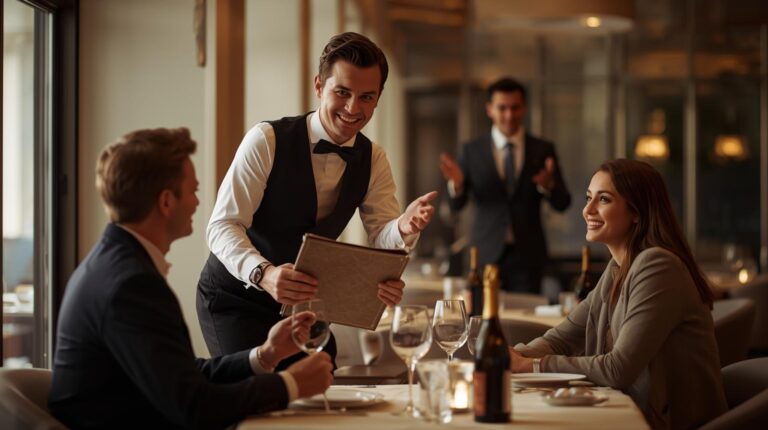
Many waiters in Bansko and the region suffer from the same "syndrome" at the peak of the season: „"I'm embarrassed to offer something more expensive, lest they think I'm being cheeky and just want to take their money."“ The result of this thinking is disastrous for both the business and the staff themselves.
When fear prevails, waiters become mere "postmen" (or "plate bearers") who mechanically carry orders from point A to point B. This way, you lose thousands of leva per year in lost profits, and the staff is deprived of well-deserved, fat tips.
The truth is that quality Upselling in the restaurant (upselling) is not a dirty word. It is not a scam. When done right, it is the highest form of customer care. The tourist who came to ski in Pirin does not know that you have a uniquely aged wine from Melnik, which is not sold in the supermarket. He doesn't know that the apple pie has just come out of the oven. It's your job to help him please himself.
🎓 What will you learn in this guide?
This article is “Pillar Content” for any restaurant owner or aspiring waiter in Bansko. We'll look at how to turn shy staff into confident salespeople using the power of words, psychology, and body language.
1. Kill the question „Do you want to…?“
The biggest enemy of high turnover is the „closed question“ – one that can be answered with „Yes“ or „No.“ When a customer has eaten a heavy meal of banska kapama, sach, or chomlek, their stomach is full, and their brain automatically turns on a defensive reaction and says „No“ to anything extra.
This is a psychological moment. The question "Do you want dessert?" sounds like: „"Do you want to spend more money and overeat?"“.
Instead of asking if they want something in general, offer them a specific temptation that paints a picture in their mind. Here's how to change the script for success Upselling in the restaurant:
| ❌ The Wrong Approach (Amateur) | ✅ The Right Upselling Approach (Professional) |
|---|---|
| „"Do you want dessert?"“ (Customer: „No, thank you, I’ve had enough.“) |
„"Have you tried our homemade blueberry cheesecake? The pastry chef took it out of the oven 10 minutes ago and it's still warm, perfect for sharing."“ |
| „"Something to drink?"“ (Customer: "One water.") |
„"Welcome! Since it's cold outside, would you like to warm up with some mulled wine or would you prefer some homemade ginger lemonade?"“ |
| „"French fries for a side?"“ (The standard, boring order.) |
„"The steak goes great with our sauteed potatoes with dill and garlic or grilled vegetables. Which do you prefer?"“ |
2. Sell stories, not products
Tourists come to Bansko for the emotion. Food is only part of it. Words create flavor even before the first bite. Neuromarketing has proven that descriptive adjectives can increase sales by up to 27%.
When a waiter describes a dish, he must make the customer swallow. If you say „Pork with cabbage,“ the customer imagines a cafeteria. If you say „Tender pork leg, slow-cooked for 4 hours with sauerkraut in a clay pot,“ the customer imagines a culinary masterpiece.
💡 Seller's Dictionary in Bansko:
Ban words like „nice,“ „tasty,“ and „normal“ in your restaurant. They don’t convey information. Replace them with words that engage the senses:
- Texture: Crispy, juicy, melt-in-your-mouth, creamy, golden crust.
- Origin (Very important for tourists): Homemade, from grandma's garden, local farm, game, from the Razlog Valley, herbs from Pirin.
- Preparation method: Slow cooked for 12 hours (Sous-vide), smoked over oak charcoal, hand-cut, baked in a bag.
3. The Alternative Method ("Either-Or")
This is a classic technique for upselling in the restaurant, which works flawlessly because it eliminates the possibility of refusal. When you ask "Do you want coffee?", you give 50% a chance to answer "No.".
But if you ask: „"How do you prefer to end the evening – with a short Italian espresso or a fluffy cappuccino?"“, you do two things:
- Psychological presumption: You take the sale for granted. You are confident that the customer wants coffee, the only question is what.
- Controlled selection: You give the client the illusion that they are in control of the situation by choosing between A and B, not between "Something" and "Nothing.".
In most cases, the customer chooses one of the two options without even thinking about the third (ordering nothing). This technique is especially effective when selling side dishes and appetizers.
4. Psychology: Guess who is standing in front of you
Not every method works for every client. A good waiter in Bansko must also be a psychologist. Observe your guests:
- Active Skiers: They come off the track at 4:00 PM, tired and hungry as wolves. Don't explain to them at length about the bouquet of the wine. Offer them something nutritious, quick and high in calories right away. Upselling tip: “Double portion” or “Extra meat/egg”.
- Couples on a romantic dinner: They are not in a hurry. They want an experience. This is the time for the most expensive wine and the most spectacular dessert.
- Business customers / Digital nomads: They often work from coworking spaces in the city. They want fast Wi-Fi, light meals (so they don't get sleepy), and good coffee. Don't offer them heavy meals with garlic.
5. The Gold Mine: The Drinks
Food fills you up, but drinks bring the mood (and the margin). Many waiters forget to offer a second drink when the customer's glass is almost empty (about 1/4 of the amount remaining).
The empty glass rule: Never leave the table “dry”.
- If the customer drinks wine: “Shall I bring another glass of the same wonderful Mavrud or would you like to try our Merlot?”
- If the client drinks water: “Would you like us to refresh the table with another bottle of water?”
Customers often get caught up in conversation and don't notice that their glasses are empty. Your intervention is a favor they will appreciate.
6. The Fine Line: Don't be a "shark"„
Important note: Good service is about helping, not pressuring. There is a fine line between being helpful (a consultant) and being annoying (a street vendor). If the customer flatly refuses your offer („No, I really can’t have dessert, I’m on a diet“), stop immediately.
Smile and say: „"I totally understand! I hope you enjoyed everything else. Can I bring you the bill then?"“.
This way you preserve the customer's dignity and a good impression. If you press again, the customer will leave with a bad feeling, which means a bad review on Google or TripAdvisor. Long-term reputation is more important than selling one cheesecake.
How can you implement this today?
Upselling is not a talent, it is a skill that is trained. Don't expect your staff to start doing it on their own. Owners and managers, your role is key:
- Organize tastings of new dishes. A waiter cannot enthusiastically sell a dish he has not tried.
- Have a “Dessert Contest.” Whoever sells the most desserts that week gets a bonus.
- Roleplay. Act out the scenarios from the table above before switching.
Is the team ready to sell?
Now is the time to prepare for the inevitable: dealing with unhappy customers and their reviews.


 English (UK)