


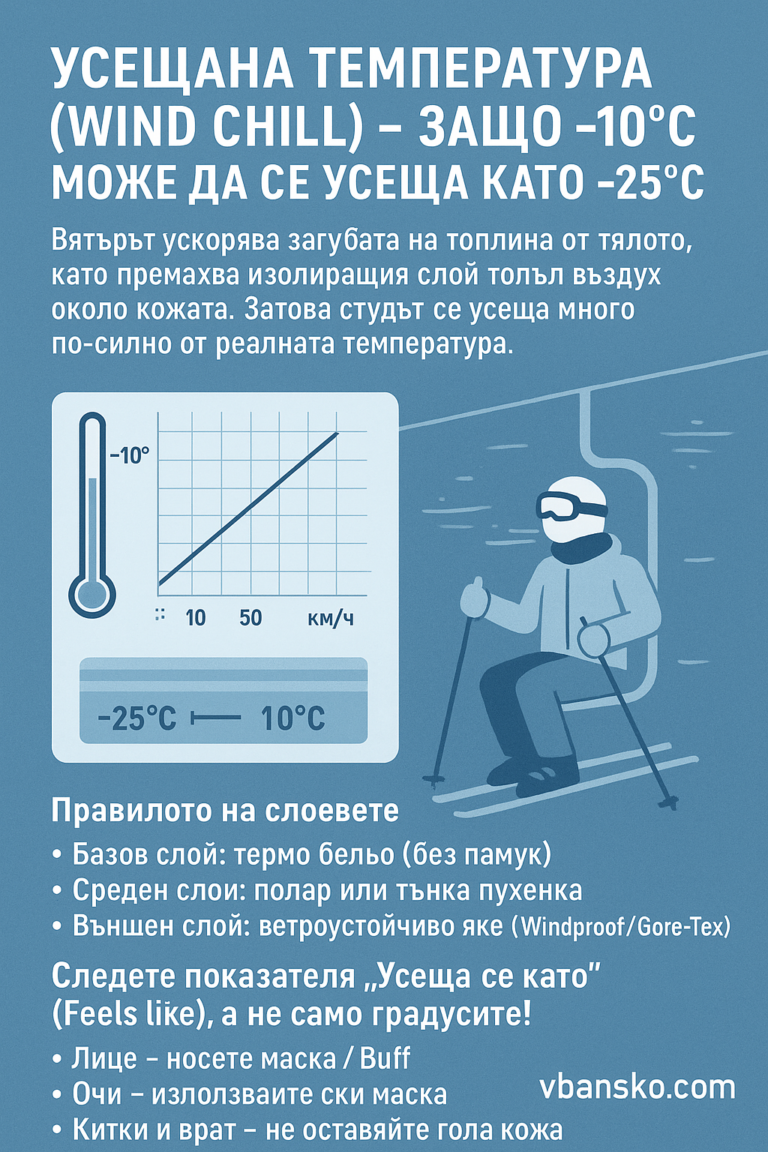
What is the Wind Chill effect?
Scientifically speaking, Wind Chill is not just a subjective sensation, but a measurable process of heat loss. When our body is exposed to cold air in Bansko, it naturally releases energy to heat a thin layer of air next to the skin. This layer acts as invisible insulation for us.
However, the wind literally „blows“ away this protective shell. The stronger the wind, the faster your body loses heat through convection. The result is that at a wind speed of 40 km/h, you cool down as quickly as if the temperature were 15 degrees lower than it actually is.
The critical points in the Bansko ski area
The wind in Pirin has its specific paths. The most exposed to the Wind Chill effect are:
- Peak Todorka: Due to the high altitude, the gusts here are often twice as strong as those on Banderishka meadow.
- The "Plateau" area: Open terrain without natural protection from trees, where the north winds act mercilessly.
- The Banderitsa 1 and 2 lifts: Sitting still at high altitude for long periods of time increases cooling to dangerous levels.
Felt temperature chart: How cold is it really?
To understand the scale of the risk, take a look at the table below. It shows how the perceived temperature in Bansko changes with wind speed.
| Temp. / Wind | 10 km/h | 30 km/h | 50 km/h |
|---|---|---|---|
| 0°C | -3°C | -6°C | -9°C |
| -10°C | -15°C | -20°C | -25°C |
| -20°C | -27°C | -33°C | -39°C |
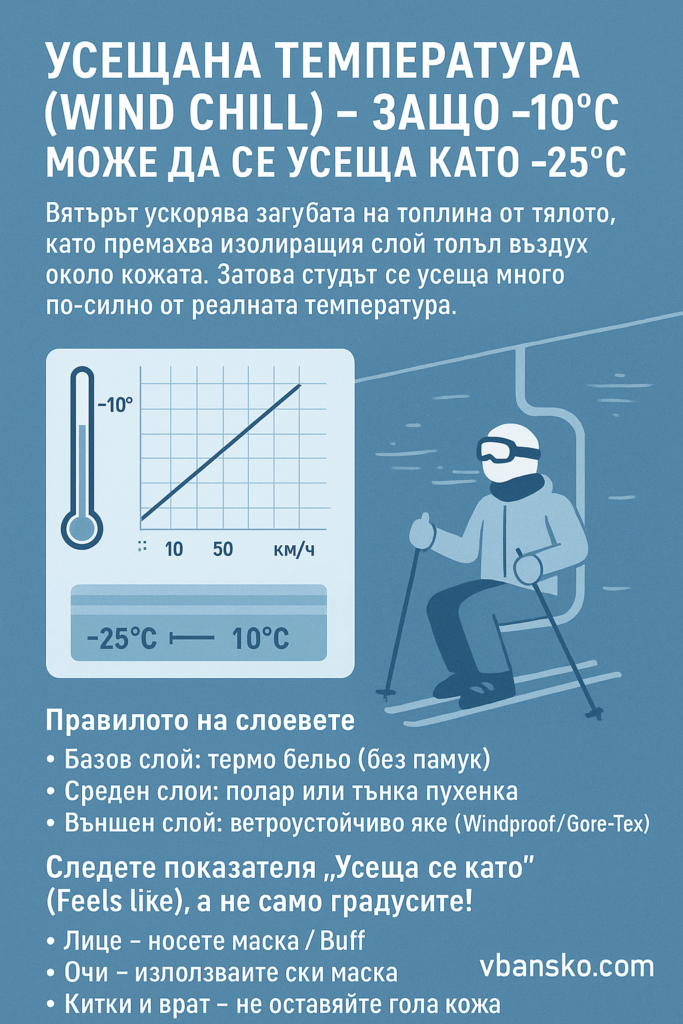
How to read the forecast correctly?
When planning your day, use reliable sources like Meteoblue or Snow Forecast. Always look for the indicator “Feels Like”. Here's how to deal with it:
- 0°C to -10°C: Suitable for everyone. Standard equipment is sufficient.
- -10°C to -20°C: Cold! Be sure to cover your face and add an extra fleece.
- Below -25°C: Danger of frostbite! Reduce your time outside. If you ride, do it in the forest (the lower part under the The Shiligarnika).
Dressing Strategy: The Three Layer Rule
To win the perceived temperature in Bansko, you need to think of your clothes as a system, not as individual pieces of fabric.
1. Base Layer: Your Second Skin
Forget about cotton! Cotton is the biggest enemy in the mountains. It absorbs sweat and dries slowly, turning into an icy compress in the wind. Use thermal underwear made of merino wool or high-tech synthetics.
2. Middle layer: The insulator
This is where fleece or thin down comes in. Their job is to trap warm air in their structure. In extreme Wind Chill, two thin mid-layers are more effective than one thick one.
3. Outer layer (Shell): The shield against the wind
This is the most important component against the wind. A jacket with a membrane like Gore-Tex is a must. Even if it is not thick, it must be 100% Windproof to stop the flow of cold air to the insulation layers.
Protection of vulnerable areas
The wind always finds the „weak spots.“ Pay special attention to:
- Face and nose: Use quality Buff or mask. Wind can cause frostnip in just minutes.
- Eyes: Sunglasses are not enough in windy conditions. Ski goggles seal the area around the eyes and prevent tearing and fogging.
- Wrists: Make sure the sleeves of your jacket overlap well with the gloves.
Professional advice: Apply a thick protective cream (not water-based!) to your face before going out. This creates an additional mechanical layer of protection against the cold.
Frequently Asked Questions (FAQ)
Q: Which application is most accurate for wind in Bansko?
A: For the ski area, we recommend Meteoblue or Snow-Forecast. They use models tailored to the mountain terrain of Pirin.
Q: Why do children feel the cold more strongly?
A: Children have a larger skin surface area relative to their total body mass and less subcutaneous fat. They lose heat much faster than adults.
Q: How do we recognize the early stages of frostbite?
A: Look for white, hard, or waxy patches on your skin (most commonly on your nose and cheekbones). If you experience any tingling or loss of sensation, go to the nearest tea shop immediately.
{
“@context”: “https://schema.org”,
“@type”: “FAQPage”,
“mainEntity”: [{
“@type”: “Question”,
“name”: “Which weather app is most accurate for Bansko?”,
“acceptedAnswer”: {
“@type”: “Answer”,
“text”: “We recommend Meteoblue or Snow-Forecast, as they provide specific data for the high mountain and take into account the Wind Chill factor.”
}
},{
“@type”: “Question”,
“name”: “At what temperature is it dangerous to ski?”,
“acceptedAnswer”: {
“@type”: “Answer”,
“text”: “At a perceived temperature below -25°C, the risk of frostbite on exposed skin is real and occurs in less than 15 minutes.”
}
},{
“@type”: “Question”,
“name”: “Why are cotton clothes dangerous in the mountains?”,
“acceptedAnswer”: {
“@type”: “Answer”,
“text”: “Cotton retains moisture and in windy conditions cools the body 25 times faster than air, leading to a risk of hypothermia.”
}
}]
}

 English (UK)