


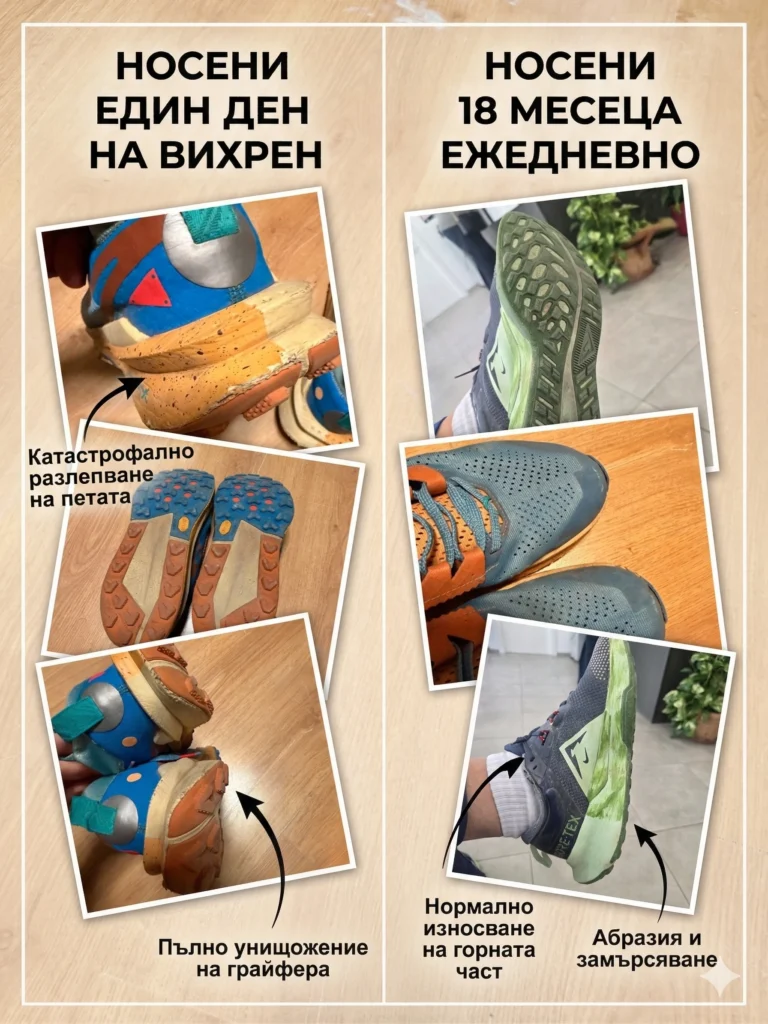
The results of this visual test are startling and prove a basic rule: the mountain, and in particular the Pirin marble, does not care about the brand and price of your equipment if it is not designed for this specific terrain.
The clash: 10 hours in Pirin vs. 1.5 years of normal wear
To understand the real strain that shoes endure on the trails to Vihren and The horse, take a close look at the history of the two pairs of sneakers from the photos in our gallery:
- Pair 1 (The Daily Veteran): These sneakers have been worn every day for a year and a half. They have been worn an average of 2 kilometers per day under normal conditions. That's over 1000 kilometers of use!
- Pair 2 (The new and expensive model): This pair has been worn for exactly 10 hours. This is the weather, necessary for a standard tourist hike from Vihren hut to the summit, passing along the Koncheto ridge and returning back.
The difference and their condition after this test are astonishing. The damage on the new pair, which spent only 10 hours on the abrasive Pirin marble, is completely comparable (and in some details even more severe) than the depreciation on the old pair after a year and a half of continuous walking.
Attention: What exactly happens to the shoe during these 10 hours?
After just one climb, the new and more expensive Nike model literally begins to suffer. The soft midsole foam is deeply gouged by sharp edges. The colorful paint is almost completely erased by friction on the rocks. Most worryingly, when the foot is aggressively twisted in narrow rock crevices, the sole begins to show signs of peeling. And all this happens in just one day!
Why are expensive sneakers not suitable shoes for Vihren?
Does this mean the brand makes bad shoes? Absolutely not. The problem is the purpose. Expensive trail running shoes are designed for lightness, speed, and cushioning. They use very soft and flexible foams that return energy when running on dirt, grass, or smooth forest trails.
Pirin, however, is a mountain of a completely different type. The rocks around Vihren and Koncheto are hard, extremely sharp and act like sandpaper. When you step with soft foam on a sharp marble edge, the weight of your body literally “cuts” the material. Flexibility, which is an advantage in the park, becomes a disadvantage here – your foot bends on every stone, which leads to rapid fatigue, bruises and the shoe itself peeling off.
Advice when choosing equipment
When you set off on the alpine routes above Bansko, forget about lightweight running shoes. Invest in classic trekking or approach shoes. They have a stiff midsole that doesn't flex easily, a full rubber toe cap to protect the toes, and a special rubber that's resistant to rock abrasion.
The lesson from this experiment
These photos are the best visual proof of what the mountain guides in Bansko keep repeating: the equipment must match the terrain. If a running shoe can withstand over 1000 kilometers on asphalt and light trails, but capitulates before 10 hours of rock climbing, then its place is simply not there.
So when you're packing your backpack for a hike in Pirin, leave your favorite soft sneakers at home. Opt for durability and protection to ensure you get home safely with shoes that still have soles.




 English (UK)