


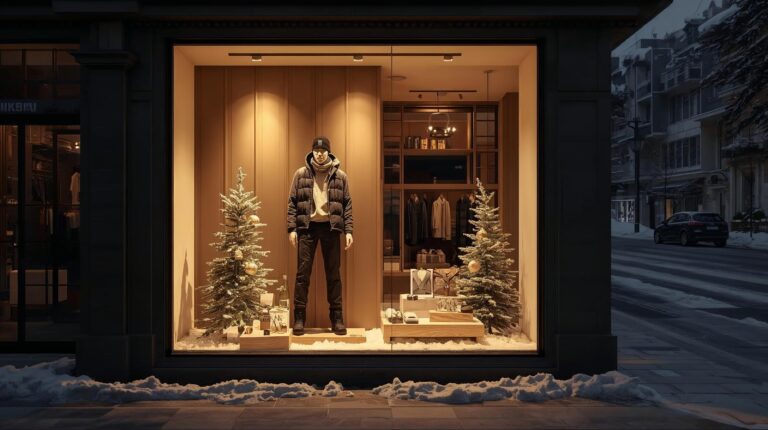
In winter, the conditions for street trading in Bansko are harsh. Temperatures often drop below -10°C, and icy sidewalks change the behavior of pedestrians. Tourists do not walk leisurely - they hurry, staring at their feet to avoid slipping, wrapped in scarves and hoods.
In this specific environment, your store has exactly 3 seconds, to grab their attention. If your window is dark, cluttered, or lacking in concept, you are practically invisible. It doesn't matter how good the merchandise is inside if no one steps through the door. This is where a professional comes to the rescue. visual merchandising.
1. Light: Your most effective salesperson
During the winter months, it gets dark in the mountains as early as 5:00 p.m. This means that over 60% of your active working day is spent in the hours when artificial lighting dominates. The biggest mistake of marketers in Bansko is the attempt to save energy by turning off outdoor lights.
💡 Psychology of the “Light Magnet”
People are instinctively attracted to light, especially in cold and dark environments. Warm light (2700K – 3000K) creates a sense of coziness and safety, which is critical for a winter resort.
Expert advice: Don't rely on general lighting. Use accent spotlights to create contrast. A product illuminated with three times the light intensity of the background automatically draws the eye.
2. The “Focal Point” Concept: The Art of Not Showing Everything
The common practice in small souvenir shops is to display every available item on the glass. The result? “Visual noise.” The customer’s eye becomes overloaded, their brain refuses to process the information, and they simply walk past. Visual merchandising requires focus.
How to create a focal point?
Choose one central theme for the week. If you're selling winter gear, don't put up 20 jackets. Have one mannequin in a dynamic pose that tells a story. Add elements like faux snow, wooden sleds or skis to create context.
- Vertical arrangement: Look from top to bottom.
- Pyramidal structure: Place the most important object at the top of a visual pyramid.
- Dynamics: Change the display every 14 days. Regular tourists should see a “new” store every week.
3. Price Transparency: Breaking Down Barriers
In an international resort like Bansko, there is an ingrained fear of so-called “tourist traps.” Many foreigners worry that the price depends on the language they speak. Clearly displayed prices in the window are not a “cheap approach,” but a powerful tool for building trust.
| Strategy: Hidden Prices | Strategy: Clear labels |
|---|---|
| The client assumes the highest possible price. | The customer makes a quick calculation and enters ready to purchase. |
| Psychological barrier and fear of bargaining. | Transparency signals professionalism and honesty. |
4. The Golden Rule: “Eye Level is Buy Level”
In visual merchandising, the height at which you place your products determines their turnover. The area between 120 cm and 160 cm from the floor is called the “Golden Zone.” This is the space that the pedestrian scans first, without making any effort.
- Over 180 cm: Use for decoration or large brand logos. Do not put small items there.
- Golden zone (120-160 cm): This is where your bestsellers and highest-margin products belong.
- Below 90 cm (Knee level): Dead zone for adults. Ideal for children's goods, toys or bulky items.
5. Social Proof and the “Open Door”
Even the most beautiful shop window can fail if the entrance looks inhospitable. In Bansko, heavy wooden or metal doors are often used to insulate from the cold. If they are thick, the customer cannot see what is happening inside and is subconsciously afraid to break the silence in an empty store.
The solution: If possible, provide a glass part of the door. When people see that there are already other customers inside, the instinct for social proof kicks in. An empty store repels, a full one attracts.
Checklist for your storefront in Bansko:
- Are the windows clean of salt stains and splashes from melting snow?
- Is there at least one brightly lit element that is visible from 20 meters?
- Have you removed old posters for events that have already passed?
- Is there enough “air” between the products, or is everything crammed in?
Are you ready for the next step?
Once you've mastered the art of attraction, it's time to optimize your costs. When is it actually cost-effective to operate off-peak dates?
 English (UK)