


Why is Pirin a “thirsty” mountain?
The main reason lies in geology. Northern Pirin is made up mainly of marble and limestone. These rocks form the so-called karst relief. The water from melting snow and rain does not remain on the surface, but immediately soaks into the cracks of the rocks, going deep underground. It comes to the surface again only at the foot of the mountain in the form of powerful karst springs.
This means that once you leave the area of the main huts like Vihren, Banderitsa or Yavorov, you are entering an area where the next source of water may be 6 or 7 hours of strenuous hiking. In this guide, we will look at how to properly manage the “water in Pirin” resource to make your hike safe and enjoyable.
1. Hydration systems: How to carry our water?
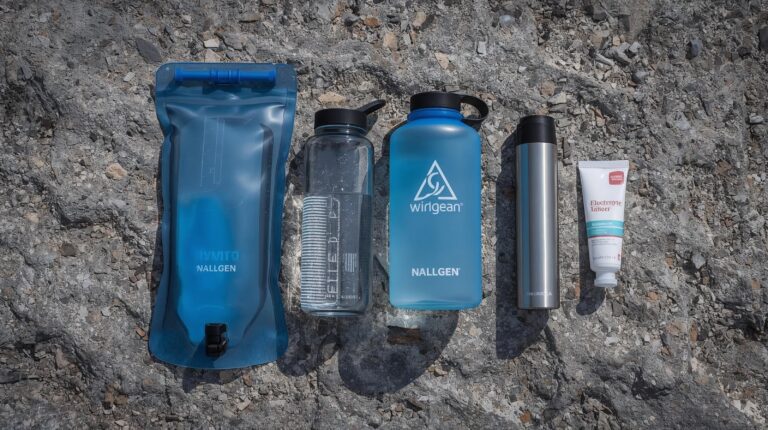
The choice of water container is no less important than its quantity. In the harsh conditions above Bansko, where the terrain is mostly rocky and steep, you have three main options:
A. Hydration system (Meh/Camelbak)
This is a soft reservoir that fits into a special compartment on the backpack. You drink through a hose attached to the shoulder strap.
- Advantages: It allows for “micro-hydration” – taking a sip every 10-15 minutes without stopping. This keeps your body constantly hydrated.
- Risks in Pirin: The Pirin trails are dotted with sharp moraines. If you fall on your back, the bladder can burst. Always keep it in a protective case and away from sharp objects in your backpack.
B. Hard bottles (Tritan/Nalgene)
Forget about the plastic bottles from the supermarket. They are fragile and unsustainable. Invest in a bottle of Tritan (BPA-free plastic).
- Advantages: They are indestructible. You can fill them with hot tea or use them as a thermos in your sleeping bag on cold nights.
- Tip: If your bottle is in the side pocket, use a carabiner to secure it against falling on the scree below Vihren.
C. Soft Flasks
A favorite of mountain runners, they are becoming increasingly popular with hikers. When the water recedes, they shrink, eliminating the annoying “splash.”.
vBansko's Golden Rule:
The ideal set for Pirin is: 2L bladder on the back + 500ml Soft Flask on the chest. In the large system you keep clean water, and in the small bottle you dissolve your electrolytes.
2. Safety and Filtration: Drinking from the Streams
The crystal stream below Muratov Peak looks tempting, but Pirin is a mountain where thousands of cattle graze freely. Water in Pirin below 2500 meters altitude is rarely completely safe for direct consumption without processing.
Animals (cows, horses) are often above you on the slope, even if you can't see them. Their droppings can contaminate the watershed with bacteria such as E. coli or parasites like Giardia. The last thing you want is... The horse, is a stomach disorder.
| Method | Efficiency | Advantage |
|---|---|---|
| Filter (Sawyer/Lifestraw) | 99.99% | Instant drinking, no bad taste. |
| Chlorine tablets | High | Lightweight and compact for the first aid kit. |
| Scrolling (Boiling) | 100% | The safest method of bivouac. |
3. Electrolytes: Why isn't water alone enough?
When you climb the steep mountainside to the Vihren hut under the hot July sun, you sweat profusely. Sweat is not just water – it is a solution of salts. If you drink only pure mountain water, which is extremely soft (poor in minerals), you dilute the concentration of salts in your blood.
This condition is called hyponatremia. Symptoms include headaches, dizziness, muscle cramps, and general weakness. Many people mistake these signs for sunstroke, but often it's simply a lack of electrolytes.
How to prevent cramps?
- Isotonic drinks: Add a soluble tablet with sodium, potassium, and magnesium to your water.
- Salty snacks: Instead of just sugary energy desserts, grab salty nuts or pretzels.
- Magnesium gel: Always carry a “shot” of liquid magnesium for emergencies if you feel muscle tightness.
4. Route planning relative to the water
Before you go, you need to know the "dry" areas. Here are the critical areas in Northern Pirin:
- The Marble Ridge (Vihren – Koncheto – Banski Suhodol): There is NO water here. From the moment you leave Vihren (or Kazana) hut until you descend to Yavorov hut or return, you rely only on what you carry.
- Tevno Lake: The water there is filtered, but in late summer the flow of the surrounding springs decreases dramatically.
- The Polezhan Ridge: Extremely panoramic, but absolutely dry.
Approximate fluid needs:
For an 8-hour hike in Pirin in August, an average tourist needs about 3.5 to 4 liters of fluids (water + tea + isotonic). Plan the weight of your backpack accordingly – 4 liters is 4 kilograms of weight.
⚠️ Important note about ice water:
Don't drink ice-cold water from high-altitude lakes in one gulp. The large temperature difference between your warm body and the water can cause shock, stomach cramps, and even heart arrhythmia. Drink in small sips and hold the water in your mouth for a second to warm it up.
Conclusion
There is water in Pirin, but it requires respect and planning. Don’t go “on a rampage” with just a small 500 ml bottle, thinking that you will find a water fountain on every corner. Prepare yourself with a good hydration system, don’t forget your electrolytes and always have a small filter in your first aid kit just in case.
The article was prepared by the vBansko team – your trusted guide to life and adventures at the foot of Pirin.

 English (UK)