


Water Column and Breathability: How to Read Ski Equipment Labels (Complete Guide to Bansko)
Anyone who has skied or snowboarded in Bansko, knows this feeling: you get on the lift in the morning, the sun is shining, but by noon the weather turns. Peak Todorka hides in fog, thick, wet snow begins to fall, and the wind seems to pierce through every hole in your clothes. At this moment, the difference between pleasure and torture is not in your skills on the track, but in the label on your jacket, which you probably ignored when buying it.
Terms like „20,000 mm,“ „breathable membrane,“ and „DWR coating“ often sound like a complicated marketing ploy. The truth is, they’re an exact science. In this article, we’ll break down what these numbers mean exactly and why the conditions in Pirin require a little more special attention to your gear than you might think.
What exactly is a "Water Column"?
The most common question in sports equipment stores is: „Is this jacket warm?“ However, the second one must be: „What is its water column?“.
Water Column is a laboratory unit for measuring the water resistance of a fabric. Imagine a 2.5 cm diameter tube placed vertically on the fabric. Water is poured into it. The number on the label indicates how many millimeters of water the fabric can withstand before it starts to penetrate it.
-
3,000 mm = 3 meters of water pressure.
-
10,000 mm = 10 meters of water pressure.
-
20,000 mm = 20 meters of water pressure.
Why do we need a high water column if it's not pouring rain?
You might be thinking, „I only ride when the weather is nice, why do I need 20,000 mm?“ The answer lies in one word: Pressure.
Water resistance is not just about protection from drops snow. It is a protection against water that tries to enter under pressure when interacting with the environment.
-
Sitting on the lift: When you sit on a wet chairlift seat (especially if it doesn’t have a „bubble“), your entire body weight presses the water against your pants. This pressure can easily exceed the equivalent of 5000-6000 mm of water column. If your pants have a lower index, the water will pass through them in seconds.
-
Snowboarders: They spend a lot of time sitting in the snow to buckle their rifles, or on their knees. The pressure of their knees on the wet snow creates enormous pressure.
-
The backpack: The straps of your backpack press the jacket against your shoulders. If it's sleet, that's where the water will penetrate first if the membrane is weak.
The Specifics of Pirin: Why is "Wet Snow" Enemy Number One?
Bansko is not in the Alps at 3000 meters altitude, where it is constantly -15°C and the snow is dry as powder. Our climate is milder, and the lower part of the slopes (Chalin Valog and Ski Path) often have temperatures around zero.
This creates what is known as „heavy“ or „wet“ snow. This snow contains a much higher percentage of water than dry snow. When it falls on your shoulder and melts from your body heat, it turns into a puddle. For Bansko conditions, we recommend a minimum 10,000 mm for a jacket and 15,000 mm for pants.
Guide to numbers: What to buy?
Let's take a look at what you get for your money according to the metrics:
0 – 5,000 mm (Water-repellent but not waterproof) These are clothes for urban conditions or for "Après-ski" (a walk along Pirin Street and a heated wine). They can withstand a light drizzle, but in a real snowfall or falling into the snow they will fail immediately.
5,000 – 10,000 mm (Mid-range) They are suitable for beginners who ski mostly on sunny days and do not go off the groomed slopes. However, if it rains heavily, you will feel damp after 2-3 hours.
10,000 – 15,000 mm (The golden mean for Bansko) This is the bare minimum for serious skiing. These clothes will keep you dry most days, even in moderate snowfall. They are ideal for resort skiers.
20,000 mm and up (High class / Freeride) This is the territory of Gore-Tex, Dermizax and high-end membranes. They are a must if you ride off-piste (freeride) where you are constantly in deep snow, or if you are an instructor/mountaineer who spends the whole day outside, regardless of the conditions.
Breathability: The Other Side of the Coin
Imagine wrapping yourself in nylon. It has a huge water column – absolutely nothing gets in. But if you go running with it, after 5 minutes you will be a pool of water. Why? Because your sweat has nowhere to go.
Here comes the role of Breathability (Breathability). This is the ability of the material to allow water vapor (sweat) to pass from the inside out.
It is measured in grams per square meter per 24 hours (g/m²/24h).
-
What does it mean: How many grams of sweat in the form of vapor can pass through 1 square meter of fabric in one day?.
Why is it critically important?
When you ski, your body generates heat and moisture. If this moisture remains under your jacket, it soaks into your thermal underwear. The moment you stop for a rest or get on an open lift, this moisture cools down sharply. The result is that you get cold, not because your jacket is leaking from the outside, but because you are wet from the inside. This is the so-called „sauna effect.“.
Breathability scale:
-
5,000 – 8,000g: Low breathability. Only suitable for light riding or relaxation. If you exert yourself physically, you will sweat.
-
10,000 – 15,000g: Good balance. Suitable for most skiers on the slopes.
-
20,000g+: High activity. A must for ski touring (panty) where climbing generates a lot of sweat, or for very aggressive riding.
The hidden details: Taped seams and DWR
Even if the fabric is 20,000 mm, water is cunning – it looks for the weakest spot. And those are the needle holes at the seams.
1. Taped Seams
For a jacket to be truly waterproof, its seams must be taped with thermal tape on the inside.
-
Critically Taped: Only the main seams (shoulders, hood) are taped. It is risky in heavy rain/snow.
-
Fully Taped: All seams are taped. This is the standard for quality gear. Always look for the words „Fully Taped Seams.“.
2. DWR coating (Durable Water Repellent)
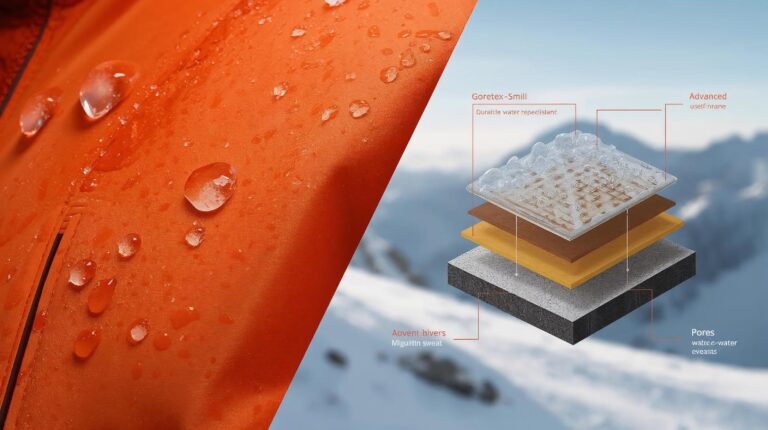
Have you ever noticed how water beads up on a new jacket and rolls off like mercury? That's the DWR coating. It's a chemical treatment on the outermost layer of the fabric. Important: DWR does not make the jacket waterproof (that's the job of the membrane underneath), but it does prevent the outer fabric from getting wet. If the outer fabric gets wet, the jacket becomes heavy and stops breathing (the membrane gets clogged by the water on top).
-
Tip: The DWR coating wears off over time. If your jacket starts to soak up water like a sponge, don't throw it away – just buy a waterproofing spray (sold at any sports store in Bansko) and spray it on after washing.
Caring for membranes: How not to ruin a 1000 lv jacket?
The quickest way to ruin your expensive gear is by washing it incorrectly. Membranes have microscopic pores. Regular washing powders and especially softeners clog those pores forever.
The rules are simple:
-
Never use fabric softener!
-
Wash at a low temperature (30-40°C) and without a spin cycle or on a very low cycle.
-
Use specialized membrane cleaners (liquid, such as Nikwax or Grangers). They clean without damaging the pores.
Conclusion: What should I choose for Bansko?
Let's summarize. To enjoy the full potential of Pirin without worrying about the vagaries of the weather, here is our "Gold Standard" for shopping:
-
For the piste skier: Look for a set with 10,000 mm / 10,000 g. This is the perfect price-quality balance.
-
For the snowboarder: Bet on trousers with 15,000 – 20,000 mm (because of the seating) and a 10,000 mm jacket.
-
For the freerider: Don't compromise under 20,000 mm / 20,000 g and fully taped seams.
Investing in technical clothing isn't just a whim. It's a guarantee that you'll stay on the mountain until the lifts close at 4:30 PM, instead of coming home shivering at lunchtime. And the best runs are often when the storm dies down.


 English (UK)