

1. The Dilemma: Hydration System (Breath) or Bottle?
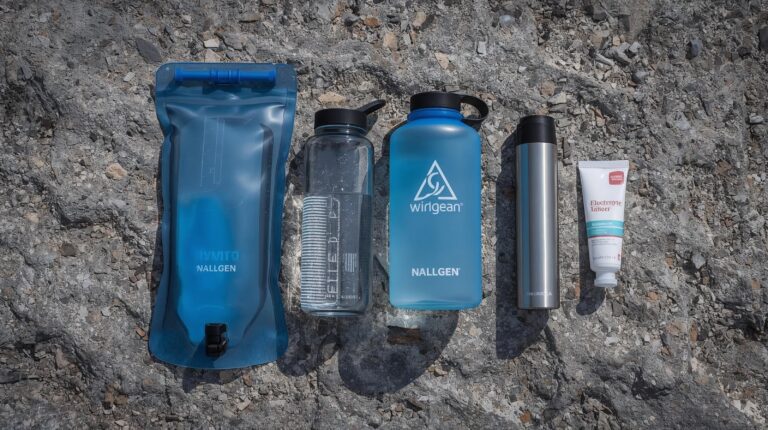
This is the eternal debate in mountaineering forums. Here are the advantages and disadvantages of the three main systems for conditions above Bansko:
A. Hydration system (Meh/Camelbak)
This is a soft tank with a hose that fits in a special pocket on the back of the backpack.
- Advantages: You drink often and little by little, without stopping and without taking off your backpack. This is the most effective way to prevent dehydration. The weight is distributed tightly to the back, which improves balance.
- Disadvantages: You don't know how much water you have left until it suddenly runs out. Filling up from a tap or stream is annoying - you have to take half your stuff out of your backpack.
- Risk in Pirin: If you fall badly on your back on the sharp moraines (which is not out of the question), the bellows could burst and flood all your clothes and electronics.
B. Classic hard bottles (Tritan / Nalgene)
Forget about disposable mineral water bottles – they get crushed, burst, and pollute the environment. We're talking about specialized bottles made of sturdy plastic or metal.
- Advantages: They are virtually indestructible. You know exactly how much water you have. The wide neck allows for easy filling from shallow streams.
- Disadvantages: You have to stop or be very flexible to get them out of the side pocket of your backpack. This often leads to “lazy” drinking and dehydration.
C. Soft Flasks – The hit of the season
These are the bottles you see on mountain runners' shoulder straps. They collapse as you drink from them, and the vacuum prevents the water from rinsing out.
- Advantages: The water doesn't "sting". When empty, they don't take up any space. They sit on your chest and are super accessible.
- Tip: A great combination is to have one large bladder in the back (for a basic supply) and one Soft Flask in the front for an isotonic drink.
2. Is it safe to drink from streams? (Filtration)
In Pirin, we often see crystal clear streams and think, “This is the cleanest water in the world.” Unfortunately, this can be a dangerous misconception.
The grazing problem:
Pirin is an actively farmed mountain. In the summer, herds of cows, sheep and horses graze high above the forest belt – often around Muratovo Lake, Spano Pole and Tevno Lake. Animals pollute the watershed, even if you can't see them right now.
Drinking unfiltered water poses a risk of stomach infections (E. coli, giardiasis) that can turn your transition into a nightmare. Here are the solutions:
- Capped fountains: If the water flows from a pipe (tap), it is usually safe.
- Filter bottles/straws: Devices like Lifestraw or Sawyer They are lightweight and remove 99.91% of bacteria. They are a must if you plan on hiking off-trail.
- Tablets: The old chlorine/silver tablet method works, but you have to wait 30 minutes and it tastes like a swimming pool. Use them only as a last resort.
3. Why is water ONLY not enough? (Electrolytes)
Have you ever had a painful cramp in your calf or thigh after 4-5 hours of walking? Or had a terrible headache, even though you drank a lot of water?
The cause is called hyponatremia (salt depletion).
When you sweat in the heat of Vihren, your body loses not only water, but also valuable salts (electrolytes) - sodium, potassium, magnesium. If you drink only pure mountain water (which is poor in minerals), you further dilute your blood. The result is fatigue, cramps and even fainting.
The solution:
- Carry soluble electrolyte tablets (isotonic) and drop one into your bottle for every liter of water.
- Magnesium shots (liquid magnesium) are a "first aid" for an impending cramp.
- Eat salty nuts, not just sweet wafers.
4. Temperature: Why is ice water a mistake?
Many people make the mistake of freezing the bottle in the freezer the night before or filling it with just ice water to keep it "cool.".
When your body is overheated, drinking ice water (close to 0°C) causes thermal shock of the stomach. The result is spasm and digestion stops. The body wastes a lot of energy to „warm“ this water in your stomach, instead of using the energy to walk. Drink lukewarm water, and in winter – definitely warm tea.
How much water do we need? (Indicative table)
| Transition type | Summer (July-August) | Winter |
|---|---|---|
| Light (Banderishka meadow – The huts) | 0.5 – 1 liter | 0.5 liter (tea) |
| Medium (Muratovo Lake / Okoto) | 1.5 – 2 liters + Electrolytes | 1 liter (tea) |
| Severe (Stormy / The horse / The guards) | Minimum 3 liters! | 1.5 – 2 liters |
The final tip of vBansko
Don't rely on just one source. The ideal combination for Pirin is:
- 2-3 liter bag in the backpack with clean water.
- One 500 ml bottle (Soft flask) with dissolved electrolytes/magnesium in the shoulder strap pocket.
- Small filter (straw type) in the first aid kit for emergencies.
This way you are prepared for everything the mountain can offer you.

 English (UK)