


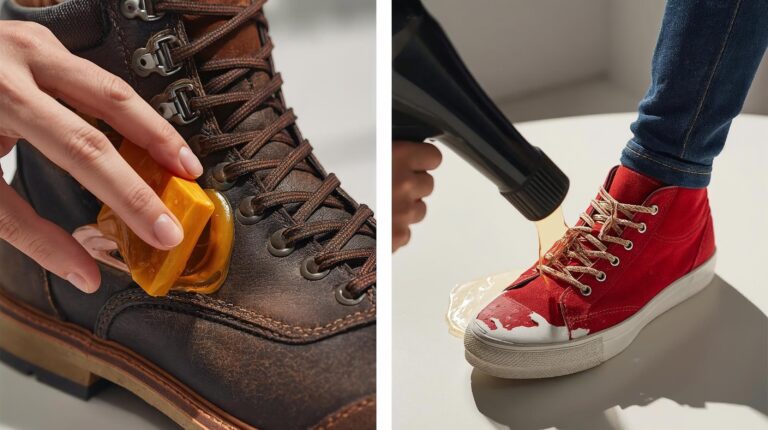
PART 1: Smooth Leather – Waxes and Greases for Maximum Insulation
Leather shoes are the most durable choice for hiking in Pirin, but leather is a “living” material. It has pores that need natural oils to maintain its elasticity. If you don’t take care of it, the leather dries out, cracks, and starts to drink water like a sponge. For them, ordinary sprays are just superficial cosmetics that don’t provide a long-lasting barrier.
Professional application of beeswax
For real waterproof shoe protection leather, use products like Sno-Seal or Granger's G-Wax. The process is a ritual that requires attention:
- Cleaning: Wash off the mud with a soft brush and lukewarm water. The wax will not penetrate the dirt, it will only “seal” it on top.
- Warming up: Gently heat the skin with a hair dryer on medium heat. This opens the pores of the skin so they can absorb the protective layer more easily.
- Rub: Use your fingers instead of a rag. The heat from your body melts the wax and it penetrates deep into the structure of the material.
Critical area: Seams and joints
The seams are the weakest point of any shoe. They are made up of thousands of tiny holes punched by needles. When applying your waterproof shoe protection, apply a double or triple layer specifically on the seams. Rub it in vigorously until you see that the holes in the thread are completely filled with wax.
PART 2: Textiles and Membranes (The Gore-Tex Technological Approach)
Modern hiking boots often use synthetic materials (mesh) for lower weight. Wax is prohibited in these boots, as it will clog the breathable passages of the fabric and the membrane underneath. Your goal here is to restore the factory DWR (Durable Water Repellent) coating.
Use specialized sprays that are designed to work with breathable fabrics. It is important to know that the DWR coating wears off from the abrasive action of mud and snow, so the impregnation should be repeated every 3-4 serious mountain hikes.
| Material | Product Type | Treatment frequency |
|---|---|---|
| Smooth skin | Wax / Grease | Once per season or after drying |
| Textile / Membranes | DWR Spray | Every 30-40 km hike |
| Suede / Nubuck | Special spray for nubuck | After every major cleaning |
PART 3: Language and Connections – The Hidden Paths of Water
Very often, tourists complain that their shoes leak, even though they have waterproofed them. The reason is often the tongue. It is usually made of a softer and more permeable textile to be comfortable when moving. The water soaks into it and runs down the sock directly into the shoe.
The solution: Pay special attention to the tongue. Spray it with spray twice as much as the rest of the shoe. Also, consider replacing cotton laces with synthetic ones, as cotton absorbs moisture and acts as a wick, drawing water in.
PART 4: Waterproof Socks – Your “Plan B”
If you're a trail runner or just love lightweight sneakers that don't stand a chance against puddles, waterproof socks are the technological miracle that will save you. They work like a "sandwich" of three layers: an inner layer of merino wool, a middle layer of hydrophilic membrane, and an outer layer of durable nylon. With them, you can literally step into the stream and your foot will stay dry. This is the best waterproof shoe protection, when the shoe itself is no longer reliable.
PART 5: How to dry our shoes properly?
Proper drying is just as important as waterproofing. If you leave wet shoes directly on the radiator in the hotel in Bansko, heat will make the leather brittle and break down the sole adhesives. Always remove the insoles and use newspaper or special low-temperature electric dryers that preserve the integrity of the materials.
Conclusion
The investment in quality waterproof shoe protection pays off at the first puddle on the trail to Vihren hut or The horse. Don't underestimate the details – seams, tongues and laces are the critical points that require attention. Maintain your gear regularly and it will provide you with comfort and safety in the mountains for years to come.
 English (UK)