


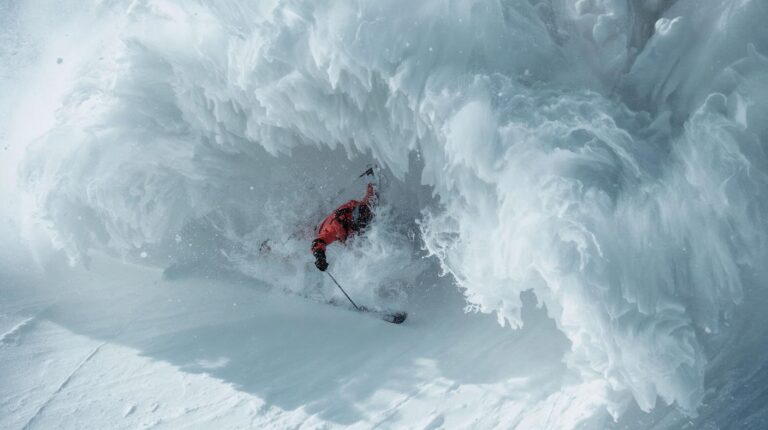
This is the scenario that no one wants to think about, but every freerider should have a reflex for. Seconds here equal lives.
Imagine the perfect day in Pirin. The sun is shining over Todorka Peak, and an unspoiled powder slope opens up before you. You take the first turn, feel the euphoria, but suddenly you hear that distinctive, dull rumble – “Wump!“. The snow around your skis cracks like a spider web and the entire slope starts to go downhill.
At this point, panic is a natural reaction, but it is also your biggest enemy. Surviving an avalanche is not a matter of luck, but of lightning-fast, correct decisions and preliminary preparation. This article is not intended to scare you, but to program your brain with the correct algorithm of action.
⚠️ Before we continue: The equipment
No amount of snowswimming skills will help your friends find you in time if you don't have a signal. Before you step off the piste, make sure that:
- Yours Avalanche Device (Pips) It's turned on, charged, and on your body.
- You have additional passive protection such as RECCO system in your clothes.
PHASE 1: The Start (The First 3 Seconds Are Crucial)
An avalanche usually starts slowly but accelerates exponentially. You have a window of about 2 to 4 seconds in which you still have control over your destiny.
1. Escape to the side (45 degrees)
A major mistake is trying to run downhill to “outrun” the avalanche. This is almost impossible – dry avalanches in Pirin can reach speeds of up to 200 km/h in seconds. Your only chance is to head obliquely (at a 45 degree angle) towards the edge of the avalanche. The snow there moves more slowly. Aim for a “rescue island” – a group of trees, a large rock or the crest of a ridge.
2. Drop the anchors (Sticks and Skis)
This is the moment that requires training. If you are with poles, never put them on your wrists when skiing off-piste! In an avalanche, poles act as an anchor – they dig deep and pull you to the bottom of the snowpack, where the pressure is deadly. Skis/snowboards have the same effect. If your skis don't release on their own, try to free yourself from them (this is extremely difficult on the move, which is why freeride ski setup is key).
3. Avalanche backpack (Airbag)
If you have an avalanche backpack, pull the handle immediately, as soon as you realize you are in danger. Don't wait to see if it will "go away". The inflated balloon makes you more voluminous and physics (the reverse segregation effect) will push you to the surface.
PHASE 2: Dragging (The Fight in the “White Hell”)
If you are unable to escape and are swept away by an avalanche, it feels like being in a centrifuge full of concrete blocks. The snow is not soft – it is heavy and crushing.
- 🏊 Swim for your life: Don't curl up into a ball (unless you're hitting trees). Make powerful swimming movements with your arms and legs, with your back facing the slope, feet down. The goal is to stay afloat. Imagine you're in a raging river - fight the current to float to the top.
- 😶 Close your mouth: An avalanche creates a cloud of fine snow dust. Inhaling it can cause spasm of the larynx or fill the lungs with water, leading to “dry drowning” or asphyxiation before you even stop. Clench your teeth and lips.
PHASE 3: Stopping and Stacking (Critical Actions)
When you feel the avalanche start to slow down (this happens abruptly), you need to act immediately. You have about 1-2 seconds before the snow “sets”.
Creating a life-saving volume
The snow in an avalanche rubs together, heats up slightly, and when you stop, it freezes instantly, turning into a solid mass like concrete. You won't be able to move a finger. So, just before the final stop:
- Raise your hands in front of your face: Take a boxing stance or make a “triangle” with your hands in front of your nose and mouth. This will create Air Pocket. Without it, the ice mask will stick to your face and suffocate you in minutes.
- Deep breath: Take in as much air as possible to expand your chest. As the snow settles around you, exhale gently. This will give your chest 1-2 centimeters of room to move so you can breathe. If you exhale before the snow settles, you won't be able to take in air again because of the pressure.
PHASE 4: Under the Snow (Survival Psychology)
You are overwhelmed. It is dark. It is quiet. The fear is indescribable. Here begins the hardest battle – the one with your own mind.
Statistics show that you have over 90% chance of survival in the first 15 minutes. Then the curve drops sharply.
What to (not) do under the snow:
- DO NOT SHOUT: Snow is an excellent sound insulator. Your screams won't be heard on the surface, but they will use up precious oxygen very quickly. Only scream if you hear footsteps or drilling directly overhead.
- Zen mode: Panic increases your heart rate and oxygen consumption. Try to calm down. Meditate. Think about your friends upstairs already searching with their devices.
- If you don't know where it is upstairs: If you have a little space, spit saliva out of your mouth. Gravity will pull it down. If you can move your hand, dig in the opposite direction. If you can't, just save energy.
BONUS: If you are the witness
If you see a friend getting buried, your actions are their only chance. The EMS (Mountain Rescue Service) won't arrive for 15 minutes.
- Keep an eye on: Keep your eyes on the victim as they are carried away by the avalanche. Remember the point where you last saw them (“Last Seen Point”).
- Safety: Make sure there is no danger of a secondary avalanche before entering the field.
- Switch to SEARCH: Everyone in the group should switch their avalanche transceivers to search mode.
- Call (if you are a group): One person calls 112 or the direct emergency number (1470 for Bulgaria) while the others search. If you are alone – search first, then call!
Conclusion: Knowledge is power, but practice is life
Reading this article is the first step, but in a real situation, adrenaline erases memories. So if you love freeriding in Bansko, sign up for an avalanche safety course at BASSES or other organization.
Practice searching with friends. Practice getting your backpack out. Let the mountain be a place of pleasure, not tragedy. Be prepared and get home alive!
 English (UK)