


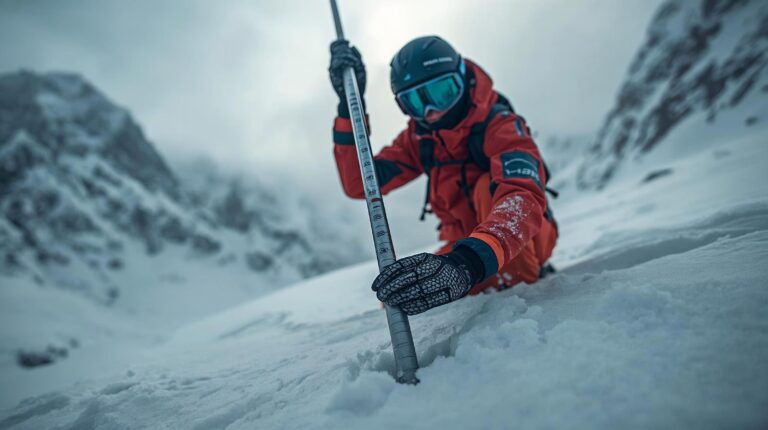
Every freerider in Bansko knows the mantra about the “Holy Trinity” of equipment: device, shovel and probe. But while the device gets most of the attention because of the electronics, the humble avalanche probe is often underestimated. The truth is that without it, you are practically “blind” under the snow. In this article, we will look at what it is exactly and why it can be the difference between life and death in a critical situation.
⏱️ The 15-minute rule
The statistics are ruthless: after 15 minutes under the snow, the chances of survival drop dramatically. Without avalanche probe, the weather for precise fixation of the body increases many times, making rescue almost impossible.
What is an avalanche probe?
Physically, it is a collapsible pole that resembles the poles of a tent, but is designed to withstand serious loads. A quality avalanche probe consists of several segments connected by a steel rope or strong Kevlar cord.
Its main function is “Pinpointing.” The avalanche transceiver will guide you to an area of 2-3 square meters, but only the probe can tell you exactly where to stick the shovel.
How does it work in practice?
- 🎯 Fixing: It is probed in a spiral until the tip meets the body of the buried victim. The sensation of hitting a backpack or body is “soft and elastic,” unlike a hard hit on earth or stone.
- 📏 Depth: On each avalanche probe It has a graduated centimeter scale. This shows you how deep the victim is.
- Mining strategy: If the probe shows a depth of more than 1 meter, do not dig directly from the top, but start lower on the slope to make a tunnel.
How to choose: Aluminum or Carbon?
You will find two main materials on the market. The choice depends on your riding style and priorities.
| Material | Who is it suitable for? | Advantages and Disadvantages |
|---|---|---|
| Aluminum | Freeriders, Avalanche courses, Rescuers | ✅ Easily breaks through hard avalanche terrain snow and ice cubes. ❌ A little heavier. |
| Carbon | Ski touring (Touring), Splitboard, Competitors | ✅ Extremely lightweight. ❌ Can be more fragile when hit by stone; more expensive. |
Advice for Bansko: In Pirin, the snow cover can be very deep, especially in the gullies. We recommend avalanche probe with a minimum length of 240 cm, and preferably 280 cm or 320 cm. Shorter probes are often useless in deep burial.
Added benefit: Snow check
Experienced mountaineers don't just use their probe in case of an accident. Before you start climbing a steep slope, you can use it to check the stratigraphy (layers) of the snow.
Simply sticking the probe in gives you a feel for hard ice crusts or hollow layers (sugar) that are potential “sliding surfaces” for an avalanche. It’s a quick test that can keep you from taking a risky descent.
Conclusion
Never go off-piste without full equipment. Your avalanche probe It should always be in your backpack, assembled and ready in seconds. Practice with it at the beginning of each season so you can act instinctively if necessary.

 English (UK)