


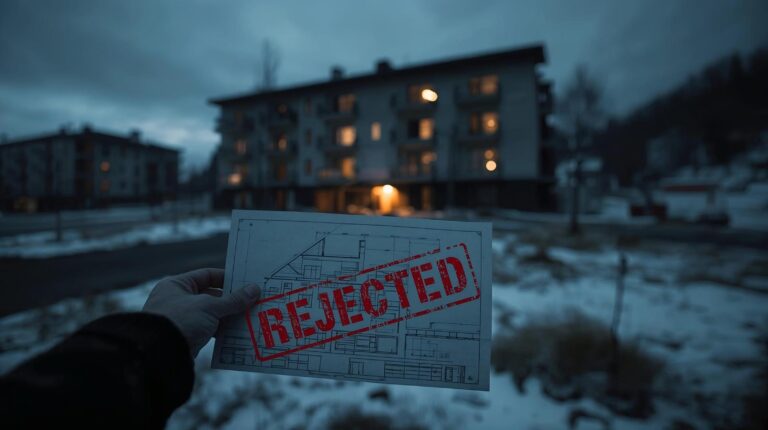
Imagine the following situation: You liked an apartment in Bansko. The building is beautiful, the facade is finished, there are windows, even the tiles in the hallways are glued. The broker (or builder) reassures you: “Everything is ready, we have Act 15, we are just waiting for the commission for Act 16. It is a formality.”
Be careful! In the world of real estate, especially in resort areas, the word “formality” often hides problems worth millions of leva. The truth is that building without Act 16 is simply a pile of building materials arranged in the shape of a block.
Why do some buildings remain “forever waiting”? What are the reasons for the State Admissions Commission (DNSK) or the Municipality to refuse the coveted signature? Here are the 5 most common scenarios that block properties in Bansko.
1. The Curse of the “Substation” (Lack of Connection)
This is the #1 reason for unfinished buildings in Bansko over the past 15 years. A building may be perfectly constructed, but if it does not have power and a connection to the electricity grid, it will never receive a permit for use.
The investor is required to pay a fee for joining “Electrohold” and often build a substation at his own expense. This facility costs tens, sometimes hundreds of thousands of leva. If the builder has run out of money at the end (a common scenario), he simply leaves the building on “temporary construction current” and hopes that the owners will raise money among themselves to buy a substation. This often leads to scandals and years of delay.
2. Greed: Significant deviations from the project
The second most common killer of Act 16 is the discrepancy between what is on the drawing (the approved architectural design) and what is actually built.
The examples in Bansko are numerous:
- Additional floor: According to the design, the building has 4 floors, but the builder decided to create a "hidden" fifth floor in the attic space and sell more apartments.
- Change of purpose: The underground parking lot has been converted into a spa center or the warehouses have been turned into studios.
- Larger built-up area: The building has "gone" beyond its boundaries and has encroached on neighboring property or municipal land.
The result: The DNSK refuses to put into operation until the illegal parts are removed. And removing a floor is often impossible without demolishing the entire structure.
3. Land and regulation issues
Sometimes the problem is not the bricks, but the ground beneath them. Bansko borders Pirin National Park and environmental legislation is strict.
There are cases of buildings built on agricultural land, the procedure for changing the status (RLE) of which was not completed correctly. Or it turns out that part of the building falls into a protected area or a power line easement. In such cases, legalization is practically impossible, and the building remains a monument to lawlessness.
4. Missing “Minor” Documents
To convene an acceptance committee for Act 16, the builder must present a folder of documents as thick as “War and Peace.” The absence of even one of them halts the process:
- Technical passport of the building: A mandatory document that describes all the characteristics of the construction.
- Contracts with Water and Sewerage: Similar to electricity, if there is no sewage system or the water supply has not been handed over to the water supply company, there is no Act 16.
- Fire safety: If the staircases are narrower than standard or there are no fire hydrants, the fire department will not sign the report.
5. Financial collapse of the investor
This is the saddest reason. Issuing Act 16 costs money – state fees, fees for a supervisory company, fees for the cadastre.
If the builder went bankrupt after Act 15 (he sold everything and the money is spent), there is no one to initiate the procedure. The apartment owners find themselves in a deadlock – they own the properties (with a Notary Deed), but cannot use them legally. The only way out is to join forces and pay for the procedures out of their own pockets, which is difficult in a building with 50 owners, half of whom are foreigners.
How to check before purchase?
Don't take the seller's word for it. Here are three steps to check:
- Inspection in Bansko Municipality: Submit a construction status inquiry. Are there any stop orders?
- Check at Electrohold/Plumbing: Does the building have an open lot and a paid connection contract?
- Require a “Certificate under Art. 181 of the ZUT”: This is the completion document (Act 14/15). Look at the date. If Act 14 is from 2009It's the year, and there's still no Act 16 - run far away.
Conclusion
The lack of Act 16 is not always fatal – sometimes it is a matter of months of delay. But it is often a diagnosis of “clinical death” of the investment. The difference between the two conditions lies in the documents. If you cannot read them yourself, seek an expert before paying the deposit.
Don't risk your money on problematic buildings!
Play it safe. Only view properties that already have a permit issued. Permit to Use (Act 16).

 English (UK)