

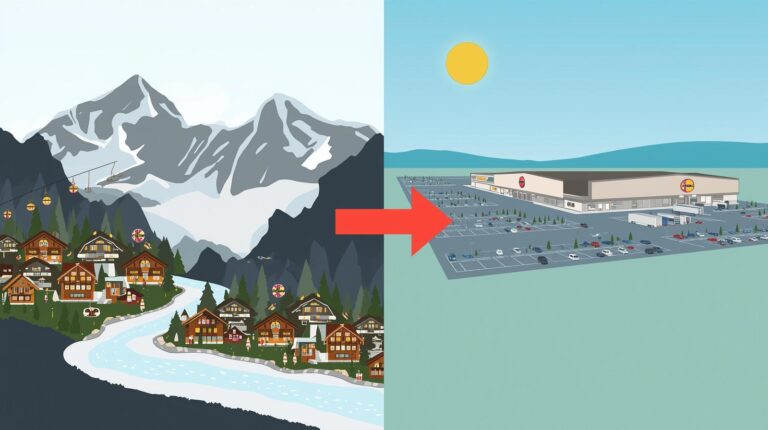
This is the question that almost every tourist asks themselves after the third day at the resort: “Why is there not a single large hypermarket in a world-famous ski resort, except for Billa?”. You are looking for Lidl and Kaufland in Bansko in Google Maps, but the navigation persistently sends you to the neighboring town of Razlog.
1. The “Dead Months” Trap and Demographics
Giants like Kaufland do not work on the principle of “having a store”. They operate with strict algorithms. For a hypermarket to be profitable, the model usually requires a settlement or commercial area with over 30,000 to 50,000 permanent residents.
- Reality: The permanent population of Bansko is about 9,000 people.
- The problem: Tourists generate huge turnover, but only for 3-4 months (winter) and a little in the summer (August).
2. Razlog is the strategic “Hub”, and Bansko is the “Pocket”
It may sound strange to the tourist, but for big business Razlog is the more important city in the region. It plays the role of a transport and trade center.
Logistics and “Big Box” format:
Large chains need huge plots of land for “Big Box” warehouses and parking lots for hundreds of cars. Razlog is on the plain and has an industrial zone, while Bansko is dense, with steep and narrow streets, unsuitable for trucks and large-scale construction.
Transport hub:
A store in Razlog serves the entire region – not only Bansko (6 km away), but also Belitsa, Yakoruda, Banya and Dobrinishte. If the store were in the center of Bansko, residents of other towns would avoid it because of the traffic in the resort.
3. The “Cannibalization” Effect”
In retail, there is a term cannibalization. Lidl already has an extremely successful and busy store in Razlog.
If the company invests 5-10 million leva for a new site in Bansko (only 6 km away), they will not gain new customers. They will simply move some of their customers from Razlog to Bansko. This means double the cost for almost the same total turnover.
4. Billa: The Monopoly of Convenience
Currently Bill is the only international player “inside” the city. Why did they succeed and the others didn’t?
- Flexible format: Billa, unlike Kaufland, can open smaller stores (supermarkets) that fit into residential buildings or malls.
- The problems: The lack of competition leads to what we all see – huge queues during peak hours, rapid stock shortages, and sometimes compromises with the quality of fruits and vegetables.
The Future: Will there be new stores? (2025/2026)
Despite rumors, don't expect a hypermarket in the center of Bansko. The town is partially under the auspices of UNESCO and borders the Pirin National Park, which makes new large-scale construction almost impossible. The hope is in another direction:
What to do?
Instead of getting angry that there is no Lidl and Kaufland in Bansko, adopt the locals' strategy:
- Use Billa and small shops only for emergency purchases (bread, water, beer).
- Plan one major shopping trip per week in Razlog – it only takes 10 minutes by car.
 English (UK)