

2010was not just another chronological year, but a moment of qualitative leap. The city began its transformation from the phase of extensive expansion to technological and infrastructural improvement. With the launch of the new "Platoto" lift, the start of the large-scale "Water Cycle" project and the fever around the preparations for the World Cup, Bansko began to cure the "childhood diseases" of the transition and to acquire a European appearance.
International recognition: "Winter Capital of the Balkans"„
The efforts of the local authorities and investors to establish the brand were officially rewarded at September 30, 2010 in Novi Sad, Serbia. During the International Tourism Fair, the Balkan Association of Hoteliers and Restaurateurs (BAHA) awarded the city the "Winter Capital of the Balkans" award.
Why was this award important for the region?
The symbolism was extremely strong – the award ceremony took place on the territory of the main competitor in the region (Serbia and the Kopaonik resort). This legitimized the Bulgarian project as the undisputed leader in Southeast Europe in terms of:
- Modern accommodation and high-class hotel services.
- Capacity and technical equipment of the ski area.
- Integration of cultural and sports tourism.
Technological breakthrough in the ski area: The Plateau Lift„
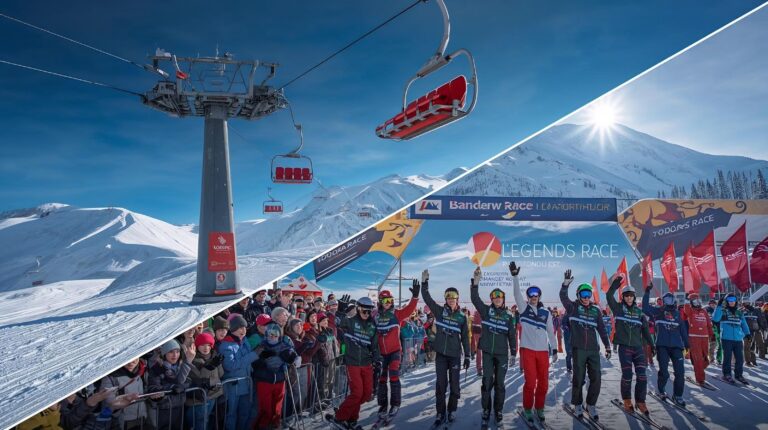
For active athletes, 2010 brought one of the most important technological achievements – solving the problem of „plugs“ in the high part of the mountain. The commissioning of the „Platoto“ chairlift changed the dynamics of the ski area forever. The investment of the concessionaire „Yulen“ AD brought to Pirin the latest generation technologies, the work of the Austrian-Swiss giant Doppelmayr.
| Parameter | Value / Description |
|---|---|
| Facility type | 4-seater high-speed (detachable) |
| Elevation difference | 381 meters (from 2141 m to 2522 m above sea level) |
| Capacity | 2200 people per hour |
| Travel time | 5 minutes and 30 seconds |
In parallel with the new lift, the artificial snow system snow was expanded to over 260 guns. This has turned Bansko into a „safe destination“, capable of guaranteeing perfect slopes from December to mid-April, regardless of the vagaries of the weather. the weather.
The World Cup: Dress rehearsal for the world's elite
The entire second half of 2010 was spent preparing for the most significant sporting event in Bulgaria's history - the Alpine Skiing World Cup. The legendary Banderitsa slope, known as Tomba, was the subject of round-the-clock preparation and strict inspections by the International Ski Federation (FIS).
„"The climax was on December 11, 2010, when Banderishka meadow 8 world legends, including Mark Girardelli and Petar Popangelov, gathered to open the new season.“
Infrastructure: The city as a construction site
While innovations were being introduced in the mountains, the center of Bansko was going through difficult but necessary moments. 2010 was the year of „"The Great Excavation"“. Through the "Water Cycle" project, funded by European programs, the complete replacement of the outdated water supply and sewage network has begun.
This modernization was critical to stop the huge losses of drinking water and provide capacity for new neighborhoods such as "Gramadeto" and "Glazne". At the same time, the expansion of gasification began to solve the problem of air cleanliness - a key factor for the image of the "Winter Capital of the Balkans".
The real estate market and the cultural renaissance
After the financial crisis of 2008, 2010 brought the long-awaited sobering up. Speculative capital was replaced by more sustainable investors. Bulgarian families and Russian buyers saw Bansko as a place to „"second home"“, and not just a tool for quick profit. This has led to higher standards in vacation property management.
Culturally, the 13th International Jazz Festival with stars like Solomon Burke and the first Bansko Opera Fest proved that the city is a living organism even outside the active ski season. Bansko has become a year-round destination, combining authentic traditions and modern art.
Do you want to find out what Bansko looks like today?
Check out our current analyses of the property market and investment opportunities in the new season.

 English (UK)