


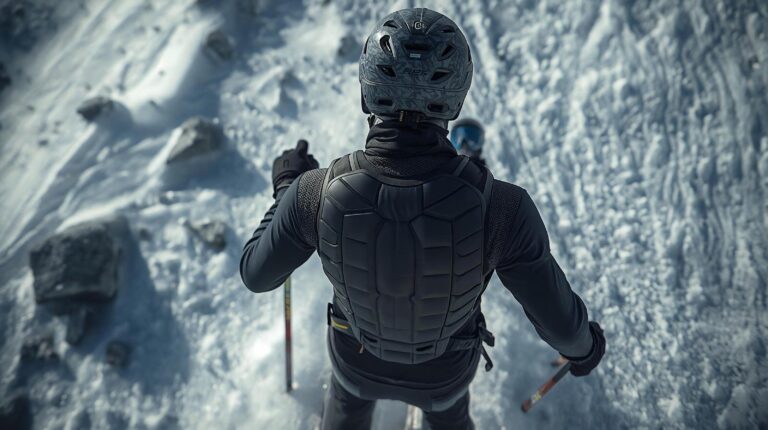
At the beginning and end of the season, or when the winter in Pirin is milder, the snow cover is often deceptive. From above, the track looks like a perfect white canvas, but just centimeters below the surface are sharp rocks, rock edges and roots. In freerider slang in Bansko they are called “sharks”, because they “bite” suddenly and without warning. That is why the quality ski helmet and back protector are not just a fashion, but a vital necessity under these conditions.
⚠️ Warning: Hidden danger
A blow to a rock is a “point load.” Unlike a blow to packed snow, which spreads out the force, a rock concentrates all the energy of the impact on one small point on the body.
1. Ski Helmet: Not Just for Beginners
It's a myth that helmets are only for those who fall a lot. When you hit a hidden rock, your skier or snowboarder skills don't matter - physics takes over.
What to look for when choosing?
- ✅ MIPS technology: (Multi-Directional Impact Protection System). This system allows the helmet to gently slide around the head upon impact, reducing the rotational forces that cause concussions.
- ✅ Correct size: Yours ski helmet It shouldn't click. When you shake your head, it should move along with the skin on your forehead.
- ✅ Certificate: Be sure to look for a standard EN 1077 (European standard for ski/snowboard helmets).
Important notice: If your helmet has suffered a serious impact (even if there is no visible crack), replace it immediately. Its internal structure (the EPS foam) has already been compromised and will not protect you a second time.
2. Back Protector: The Forgotten Hero
While the helmet became standard, the reliable back protector (the so-called “turtle”) is still overlooked by many. This is a mistake. The spine is a complex system that is extremely vulnerable when it encounters a hard object.
Imagine falling on your back at 40 km/h. If you fall on snow, it will hurt, but you will probably get up. However, if there is a stone hidden under the snow, it acts as a wedge. The protector has one main purpose – to distribute the force of this impact over the entire area of your back.
Comparison of types of protectors
| Protector type | Characteristics | Advantages and Disadvantages |
|---|---|---|
| Hard shell | Classic plastic panels. | Excellent against sharp objects (rocks), but often heavier and inflexible. |
| Soft foam (Viscoelastic foam / D3O) | Soft when worn, harden instantly upon impact. | The modern choice. Much more comfortable for all day, follow the curves of the back. |
When you choose ski helmet and back protector, for the protector, look for a certificate EN 1621-2. Level 2 offers better shock absorption and is highly recommended for light snow conditions.
3. The Golden Rule: “I don’t ride without a bumper”
When there is little snow, the risk of injury increases dramatically not because of speed, but because of the terrain. Here are three quick tips:
- Don't rely on your backpack: A backpack can help a little, but if it contains a thermos, camera, or pump, these items can seriously injure you if they fall on your back. Use a backpack with built-in protector or wear a separate one under your jacket.
- Heat: In addition to protection, your back protector and the helmet retain heat, which is a huge bonus on cold January days in Bansko.
- Confidence: When you know you are protected, you drive more calmly and with better control.
Conclusion
Hidden gems do not forgive mistakes. Investing in quality ski helmet and back protector is an investment in your future on the track. It is better to have equipment that you “may” not need today than to need it once and not have it.