


Often overlooked and picked up at the last minute, ski poles are much more than „support sticks.“ In fact, they are the subtle instrument that initiates every turn, the metronome of your ride, and your shield against fatigue.
The right one choosing ski poles is essential not only for balance, but also for rhythm, proper body positioning (which protects your knees and back), and moving along the flat sections of the ski area. Bansko. As part of the full ski equipment, they hold a special place – they are your connection to the rhythm of the mountain. In this guide, we’ll look at how to determine the right size, what material to choose for your needs, and why „feathers“ (the circles below) matter, which could save your ski day.
1. How to determine length? (Golden rule and table)
Length is the most critical factor when buying or renting. If you can't test the poles in your ski locker, use this guide based on your height:
| Your height (cm) | Recommended pole length (cm) |
|---|---|
| 150 – 160 cm | 105 – 110 cm |
| 160 – 170 cm | 115 – 120 cm |
| 170 – 180 cm | 120 – 125 cm |
| 180 – 190 cm | 130 – 135 cm |
| Over 190 cm | 135 – 140 cm |
Important: Test while wearing ski boots to anticipate the additional height.
2. Material: Aluminum or Carbon? (Health vs. Elegance)
When choosing your ski poles, you will come across two main materials. Both have their advantages depending on your riding style, riding frequency, and budget.
Aluminum poles (Classic strength)
This is the most popular, versatile and economical choice. They are made of aluminum alloys (most often the base aluminum 5083 or the lighter and harder 7075).
- Advantages: Inexpensive and extremely durable. When hit hard, aluminum bends but rarely breaks, meaning it can often be straightened out and reused.
- Disadvantages: They are heavier and have a higher so-called "swing weight" (you need more force to swing them).
- Who are they for: Perfect for beginners, children, amateurs who ride infrequently, and freestyle skiers who often fall or hit them.
Carbon poles (Composite / Premium)
Preferred by advanced skiers, carbon poles offer uncompromising low weight and a sleek look. They often have a slimmer profile.
- Advantages: Extremely lightweight and slim profile. They have a low "swing weight" which reduces hand fatigue. They are much more flexible and absorb vibrations at impact better.
- Disadvantages: They are more expensive than aluminum. In the event of a very strong impact, carbon does not bend, but breaks (splinters), becoming unusable.
- Who are they for: For piste skiers, advanced riders, freeriders and anyone looking for maximum lightness and comfort all day long.
3. Handles and Straps: Classic vs. „Click“ Systems
The connection between the glove and the stick is key not only for comfort but also for your safety.
- Standard strap: You put your hand through the strap from the bottom up and grab the handle along with the strap. This is a cheap, reliable and versatile option. The disadvantage is that sometimes the strap slips on the glove.
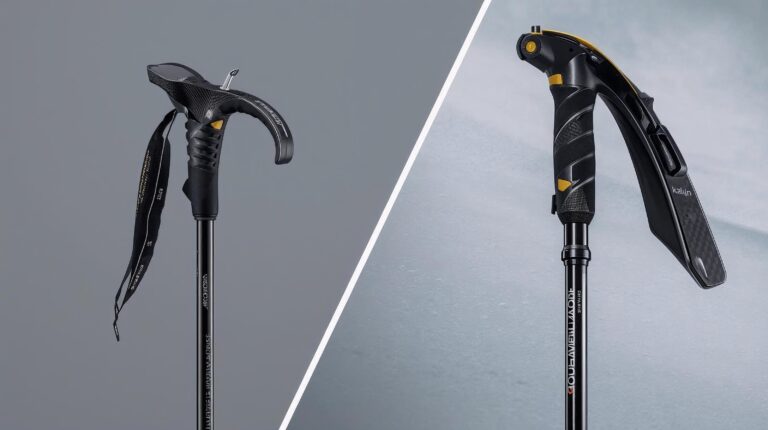
- Click/Trigger type systems (e.g. Leki Trigger): This is a modern innovation where the glove has a small ring built into or added to it that „clicks“ directly into the pole handle. This provides perfect control, direct energy transfer and, most importantly, a safe release in the event of a fall to prevent thumb injuries (the so-called „ski thumb“).
4. Baskets: Size matters
That little plastic ring at the bottom of the stick is called a „feather“ or rosette. It’s not for decoration – its function is critical for grip and balance.
⛷️ Small Feathers (Runs)
They are used for groomed, hard slopes. They are small and aerodynamic so they don't catch on snow when turning.
🏔️ Big Feathers (Freeride/Powder)
They have a large diameter to prevent the pole from sinking deep into the soft snow. A must if you go off-piste or ski in broken, heavy powder!
Important: For Bansko, where the slopes are often broken powder in the afternoon, large feathers are much more useful than small ones.
Specialized types: Telescopic poles
If you plan to go ski touring (pantene) in Pirin, you will need telescopic poles. They allow you to change the length – shorter when climbing (so that your hand doesn't hang too high and tiresome) and longer when descending.
Conclusion
Don’t underestimate your ski poles. The right size will improve your ski stance instantly, and a comfortable grip will reduce hand fatigue. For Bansko conditions, a pair of sturdy aluminum poles (to start with) or a lightweight carbon model with medium-sized tips are the all-around everyday warriors. Invest in poles that „disappear“ in your hands so you can enjoy every turn under Vihren!