



Why does preserving Pirin require a change in thinking?
As travelers and nature lovers, we often blame institutions. We complain about the lack of infrastructure, but we forget that the mountain is not a city park. The successful Pirin mountain conservation It begins the moment we realize that we are just guests in this harsh but fragile habitat.
The Japanese Paradox: Crystal Clearness Without Trash Cans
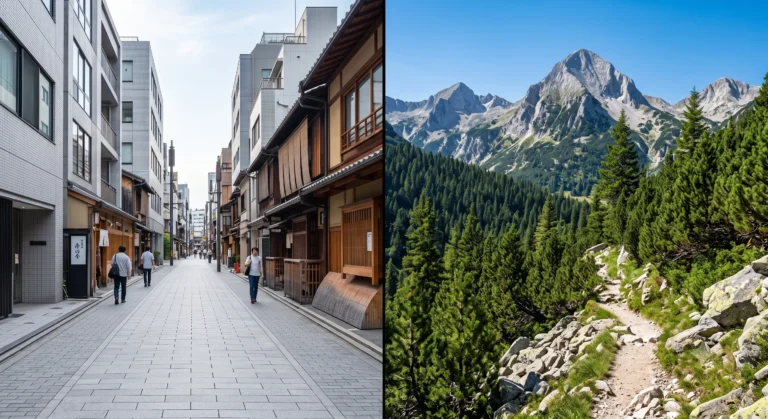
Anyone who has visited Tokyo, Kyoto or Osaka has encountered a very specific “problem”. You buy street food, eat it and instinctively start looking for a trash can. You walk one block, two, three… There are simply no trash cans! At the same time, the streets are so impeccably clean that you can literally sit on the sidewalk without getting dirty.
The secret of the Japanese lies not in a magical and invisible garbage collection system, but in a deeply rooted mentality. Japanese children are raised from a very young age with one simple and golden rule: „"If you take something with you outside, you take the waste home"“. People put their trash in their bags and backpacks and only dispose of it separately when they get home or at specialized points. This model of personal responsibility is the key that we need to implement in our mountains.
The problem with garbage in Pirin National Park
Pirin National Park is a UNESCO World Heritage Site. It is our sanctuary, just as Mount Fuji is sacred to the Japanese. During the active summer months, thousands of tourists set off from Bansko and Dobrinishte towards the high mountain routes. Unfortunately, along with the tourist flow, the amount of waste is also increasing.
Often on the trails you hear excuses like: „"But there's nowhere to throw it here!"“ or „"The bins in front of the hut are already overflowing"“. This misunderstanding of mountain specificity is the greatest enemy of nature.
Warning: Why shouldn't there be trash cans high up in the mountains?
The truth is that at altitudes above 2000 meters, trash cans are not just missing – they are categorically contraindicated. There are several reasons for this:
- Wild animals: Food scraps and the smell of garbage attract wildlife (bears, foxes, wild pigs). This disrupts their natural feeding habits and creates dangerous situations for both them and tourists.
- Logistical nightmare: Garbage collection on steep alpine paths is impossible. There are no garbage trucks that can reach Tevno Ezero or Polezhan Peak.
- The wind: Strong mountain winds easily scatter waste from overflowing bins (even around accessible huts) for miles around the park.
3 golden rules for cleanliness on mountain trails
To achieve real Pirin mountain conservation and to get closer to the Japanese mentality, strict laws or heavy fines are not needed. All that is needed is a slight change in habits. Here's how to apply the Japanese model during your next transition:
- The empty backpack rule: When you start climbing from Bansko, your backpack is full of heavy food, water, and equipment. When you come down, all that's left are the empty packs that weigh a few grams. If you had the strength to carry them up full, you certainly have the strength to carry them down empty. There's no point in lightening your load by leaving trash on the mountain.
- Bring your own “Japanese” bag: Always put at least one sturdy trash bag or ziplock bag in your backpack pocket. Use it to collect absolutely everything – from fruit peels to used wet wipes.
- Throw it down, into civilization: Take your trash back to Bansko, Banya or Dobrinishte. The infrastructure there allows not only trouble-free garbage collection, but also separate disposal for recycling.
Expert advice for eco-tourists in Bansko
To minimize your footprint even before you set foot in Pirin National Park, plan your luggage wisely:
- Use reusable bottles (thermos or metal cans). There are enough clean mountain fountains and springs in Pirin.
- Avoid using wet wipes. They are made of synthetic fibers (plastic) and do NOT degrade in nature, even though they look like paper.
- Bring your food in reusable boxes, instead of wrapping it in aluminum foil and plastic bags, which can easily be blown away by the wind.
- Banana and orange peels take years to decompose in the harsh and cold alpine climate – never throw them in the forest under the pretext that they are “biodegradable”.
Pirin is a reflection of our society
The beauty of Pirin is a given, but its preservation is our choice. The community in Bansko and the region makes enormous efforts to maintain the trails, markings and cleanliness around key tourist locations, but the main responsibility falls on us ourselves – the tourists.
The greatness and culture of a nation are manifested not only in the shiny centers of big cities, but also where no one is looking at us – high in the mountains. Let's apply this little Japanese trick the next time we step on the trail. Let's put the trash in our backpack and leave only footprints behind us. Because Pirin is not just a mountain, it is our common home!