



When we hear "Pirin", raw marble peaks, glacial lakes and centuries-old walls immediately come to mind. But the mountain has another, much warmer and more exotic face. Welcome to Tisata reserve„ – located in the low western slopes of Pirin and on the slopes of the Kresna Gorge. Here the Alpine cold gives way to the Mediterranean breeze along the Struma River valley. The reserve protects the largest natural habitat of juniper trees in Europe, and passing through it along the two specially regulated eco-trails is like a journey into a different climate zone.
Regulated paths for passing through the Tisata reserve„
📊 Technical data (Total for both trails)
- ⏱️ Duration: About 2 – 3 hours per sector (easy pace)
- 📏 Distance: Short hikes (between 3 and 6 km)
- 🔥 Calories: ~300 – 450 kcal
- 🚶 Avg. speed: ~2.5 km/h (pleasant dirt paths)
- ⛰️ Min/Max height: Low altitude (between 200 and 600 m)
- 📈 Elevation: Minimal (mainly sloping areas and hills)
- 🟢 Marking: Information signs of Pirin National Park and markings for the borders of the reserve
- ⚠️ Difficulty: 1/6 (Very easy – excellent for families and beginners)
💡 Interesting information
- The reserve was created back in 1949 under the name „"Yew Grove"“, and in 1977 its territory was expanded and received its current name - "Tisata".
- The largest deposit of is preserved here. juniper tree (Juniperus excelsa) in Bulgaria and Europe. These trees are true stoics, able to survive on rocky terrain with minimal moisture.
- In addition to the unique flora, the reserve is home to an exceptionally rich Mediterranean-type biodiversity, including rare species of butterflies, reptiles (such as the leopard dragon) and over 100 species of birds.
🚗 How to get there? (Logistics)
Unlike the high-altitude routes in Bansko and Dobrinishte, the starting point for the Tisata reserve is a town Kresna.
From Sofia or Bansko you should head to the Kresna Gorge on the main road E79. The reserve is divided into two sectors (Eastern and Western) by the Struma River itself and the international road. The starting locations are easily accessible by car.
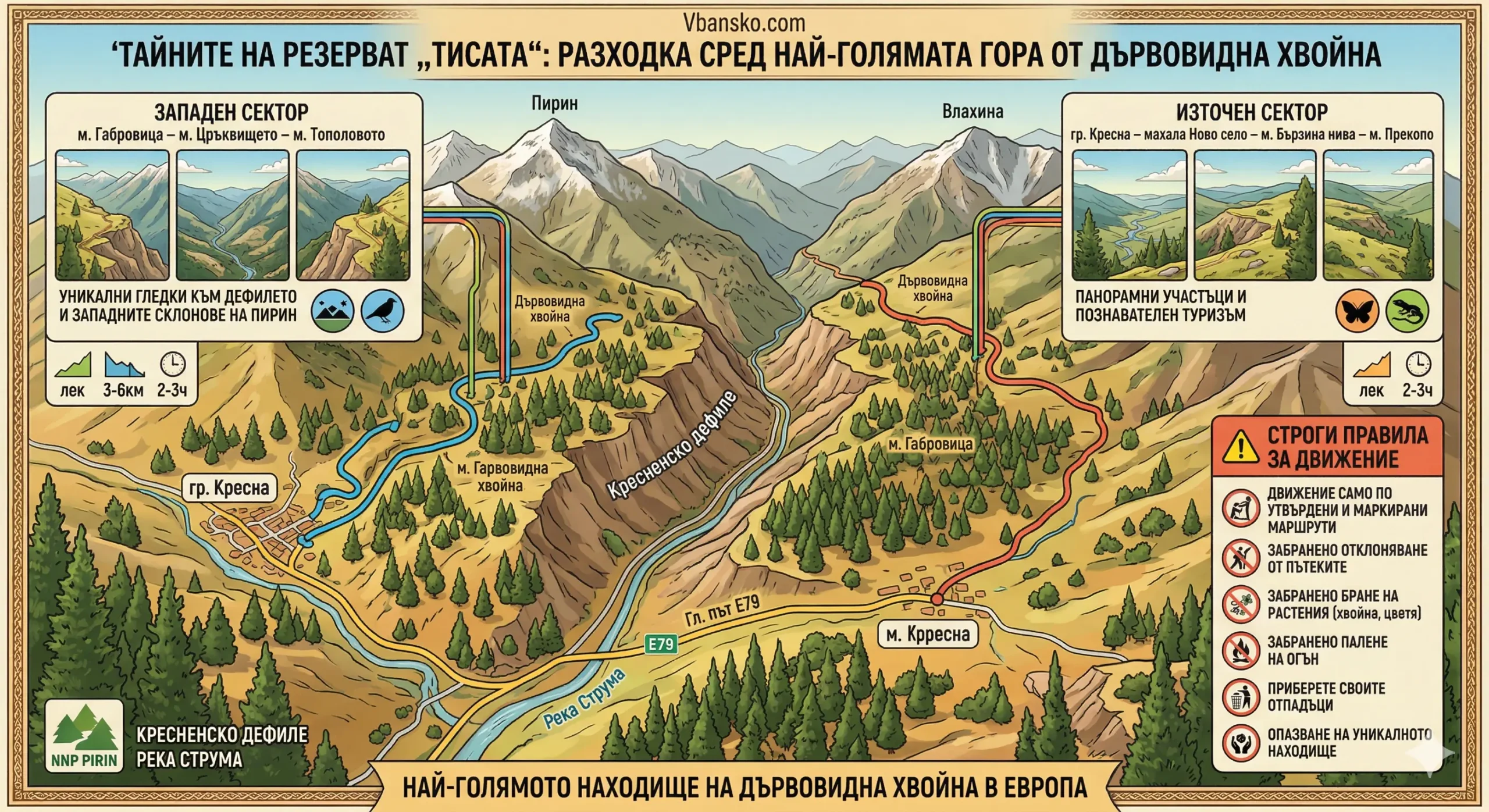
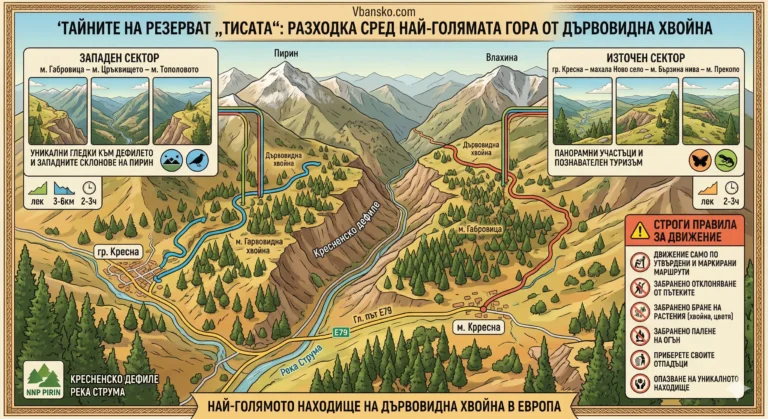
A detailed map of the most popular hiking trails in the Tisata Reserve on the western slopes of Pirin near Kresna, with routes through a juniper forest, the Demyanishta Valley and hills above the Kresna Gorge, plus conservation rules.
🥾 Description of permitted routes
Due to the strict protection regime, movement in the reserve is permitted. only and solely along two specific paths – one for each sector.
1. The Western Sector (The Gorge from Above)
Route: Gabrovitsa - Tsrukvishteto - Topolovoto
This trail is extremely scenic. It runs along the hills west of Struma (in the Vlahina mountain range, which falls within the reserve). The route offers breathtaking panoramic views straight down to the meanders of the Kresna Gorge, as well as a fantastic view of the steep western slopes of Pirin proper. A great place for photography!
2. The Eastern Sector (Heart of the Juniper Forest)
Route: Kresna town – Novo Selo hamlet – Barzina Niva area – Prekopo area
This route starts from the town of Kresna itself and enters the low western branches of Pirin. Here you will immerse yourself in the true kingdom of the juniper tree. The path has a strongly expressed cognitive character. The air is saturated with the specific, slightly resinous aroma of juniper, and the silence is broken only by the singing of birds.
⚠️ Strict visiting rules
You are in strict reserve – the highest category of protection in Bulgaria. Please strictly follow the following rules:
- Don't deviate. from the marked eco-trails under no circumstances!
- Picking plants (including herbs, flowers and juniper berries) is absolutely prohibited and punishable by heavy fines.
- Lighting fires, camping, and making loud noise are prohibited.
- Take all your waste with you – there are no trash cans in the reserve.
❓ Frequently Asked Questions (FAQ)
What is the best season to visit?
Unlike the alpine Pirin, Tisata is best visited during spring (April – May) & autumn (October – November). In the summer it gets extremely hot and stuffy here, and the shade from the junipers is scarce.
Are there any water fountains along the route?
Water sources are very rare in this specific karst and Mediterranean region. Be sure to bring at least 1.5 – 2 liters of water per person.