



Bansko without queues: how software can solve the 15-year-old ski lift problem
Anyone who has skied in Bansko knows what a morning looks like: hours of waiting in front of the gondola lift to get to the slope. The "Bansko without queues" offer (Smart Q Bansko) says something simple — this problem is not solved by new construction alone. Much of it can be solved with software, even in the coming seasons.
The proposal is written in an 8-page document and has already been officially sent to the mayor and the Municipal Council of the Municipality. Bansko, as well as to the management of the ski area - "Yulen" AD.
Important clarification: this is not an argument against the second cable car line and does not take sides in the dispute between investors and environmentalists. This is an operational solution that can work while institutions make the big decisions.
The tourist is not so much annoyed by the wait as by the fact that he has no choice and does not know how long he will have to wait. A person who does not know when he will get on and cannot do anything about it gets angry. "Bansko without queues" puts control back in the hands of the guest.
How it works: the three corridor model
The system is only turned on during the busiest window of the day — between 08:30 and 11:00. The rest of the time, the lift operates as usual, without any restrictions.
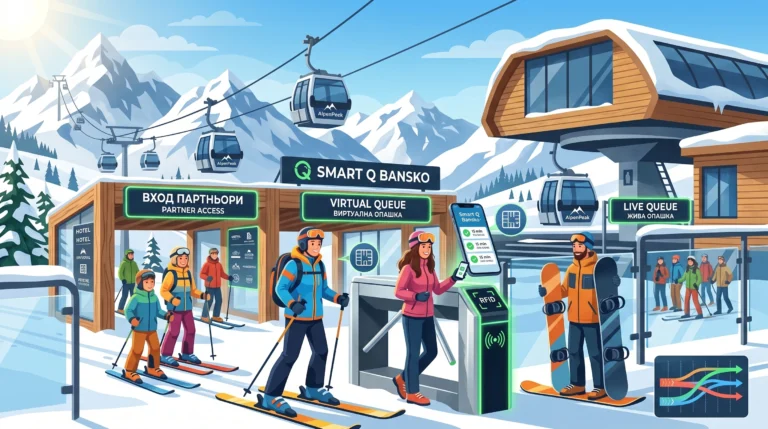
In this morning window, the lift capacity is software divided into three lines:
Corridor A — to 15%
Partner access
For guests of hotels with active contracts with the ski area. Such access still exists today - the new thing is that for the first time there will be a publicly announced ceiling and it will be possible to check.
Corridor B — start 40%
Virtual queue
You reserve a 15-minute slot through the mobile app, arrive at your scheduled time, and pass through a smart turnstile in minutes. During the pilot seasons, it's completely free.
Corridor B — start 40%
Ordinary live tail
For people without a smartphone or no desire to plan. This queue never stops moving and will be noticeably shorter because some of the people are already distributed in the time.
This is not a "line-skipping lane"„
This difference is the most important thing in the entire project and deserves to be stated clearly.
There are already paid systems around the world where you pay and pass. in front of the rest — a separate lane with priority on the lift itself. In North America, such programs are called Fast Tracks or Reserve Pass. They work, but everywhere they encounter serious resistance from local people and regular skiers, because they create a feeling of two categories of customers at the same facility.
With the priority lane, one person literally overtakes another in a spot right in front of them. With the slot system, no one overtakes anyone else — people just arrive at different times in the morning. The total lift capacity is the same, but it's spread out wisely, instead of everyone piling up at 8:30 a.m.
Personal data: no facial recognition
The rules to make it fair to everyone
- Slot cancellation: free up to 30 minutes before the time. The slot is returned to the system and someone else can take it.
- No-show: In case of 3 no-shows without cancellation within the season, access to the virtual queue is suspended for 7 days.
- Delay: You have 15 minutes of free time after the end of the slot. After that, the slot is lost.
- Lift closed in bad weather: All affected slots are automatically restored — without going to the cashiers and without applications.
The economy: dead time becomes turnover
This is perhaps the strongest argument. The hours a tourist spends standing in the cold are dead time — they bring no income to the hotels, restaurants, or the municipality.
When the guest knows that he is boarding at 09:45, he does not leave at 07:30 to keep order. He has a leisurely breakfast, drinks coffee, and goes shopping in the center.
How much does it cost and when does it pay off?
The investment is many times smaller than any new construction:
| Feather | Indicative amount |
|---|---|
| Backend, algorithm, integration with the lift system | 120,000 – 160,000 euros |
| Mobile app upgrade | 60,000 – 80,000 euros |
| 4–6 smart turnstiles plus installation | 100,000 – 140,000 euros |
| Design, testing, staff training | 70,000 – 90,000 euros |
| Total (one-time) | 350,000 – 450,000 euros |
The payback period depends on whether paid services are introduced at all. If the system remains completely free, it is paid for indirectly - through the turnover that remains in the city. If, after the pilot seasons, a symbolic fee is introduced only for the most sought-after early slots, the investment is returned in 2 to 4 seasons.
Does this work anywhere else?
Yes, for years. Disney & Universal Studios keep people in their restaurants and shops instead of in lines precisely through such software. Major ski operators in the US and Canada already work with reservations and flow management. Airports and museums have been doing the same for decades. This is not an experiment — this is standard practice that in Bansko simply has not yet been implemented.
„"This will become a queue for the rich"“
The pilot seasons are completely free for everyone. The live queue remains free at all times and under all conditions. A fee is only discussed in the third phase and only for the early peak hours — not for the entire day and not for the lift ride itself.
„"Older people without smartphones will suffer"“
The live queue always remains open and never stops moving. In addition, reservations can also be made at the cash desk, on site, by an employee.
„"Hoteliers will take everything"“
Quite the opposite — today peer-to-peer access exists, but no one knows what share of capacity it occupies. The proposal sets a cap of 15% and makes it public and verifiable.
Schedule: implementation in 4 phases
- Phase 0 (fall 2026): decision making, selection of contractor and rescheduling of ski school classes.
- Phase 1 — test launch (February–March 2027): a partial pilot with only software and hand-held scanners to collect real data.
- Phase 2 — full implementation (season 2027/28): installation of smart turnstiles, full capacity, completely free for tourists.
- Phase 3 - discretionary (season 2028/29): possible premium slots, only for the early hours and only if the data from the first two seasons justifies it.
FAQs
What is the "Bansko without queues" project?
Software solution (Smart Q Bansko), written in an 8-page document and sent to the Municipality of Bansko and "Yulen" AD. It allows the tourist to reserve an exact 15-minute time to board the cable car via a mobile application, instead of physically waiting in line.
Will it be paid?
Not in the pilot seasons — then the virtual queue is free for all. The live queue remains free always. Only after two seasons of real data can a symbolic fee be discussed, and then only for the earliest hours when demand is highest.
How much does implementation cost?
Between 350,000 and 450,000 euros in one go — many times cheaper than building a new facility. If premium slots are introduced in the future, the amount is returned in 2 to 4 seasons.
Is the consent of environmentalists necessary?
No. The project is completely digital — it does not require logging, EIA, or building permits. It is an optimization of the already existing infrastructure.
Is there a problem with personal data?
No. The system does not use facial recognition and biometrics. The reservation is only linked to the factory RFID number of the ski pass, which is fully compliant with data protection regulations.
Will the living queue get longer because of this?
The opposite. People with a reserved time don't stand in line, but come at a specific time. This way the flow is spread out over time and the live queue becomes shorter, not longer.