


ℹ️ About the scope of this guide
This is the most comprehensive technical guide for apartment renovation in Bansko, which you will find online. It is designed for owners who want long-term quality, energy efficiency and trouble-free operation. Here we look at the “skeleton” of the home. For interior solutions, furniture and decoration, please see the link to the specialized Furnishing Guide at the end of the article.
Bansko is a unique location that presents property owners with challenges unknown in big cities or on the Black Sea coast. This is not just about replacing tiles and painting. Here we are fighting nature. The climate at the foot of Pirin is harsh – with severe winters, temperatures falling below -15°C, and intense sunshine in the summer.
When you start apartment renovation in Bansko, you need to consider three critical factors that will determine whether your investment will be successful:
- Extreme temperature amplitudes: Materials shrink and expand dramatically, leading to cracks and compromising inexpensive repairs.
- Seasonal operation: Many properties sit empty and unheated for months, which is a recipe for damp, mould and frozen pipes.
- Specific logistics: Access to specialized equipment and qualified craftsmen during the active ski season is severely limited.
In the following lines, we will examine the entire process in detail - from the bureaucracy in the municipality to the installation of high-tech heating systems.
PART I: BUREAUCRACY, RULES AND ORGANIZATION
Before you buy the first bag of cement, you need to ensure the legal and organizational framework for the renovation. Fines for non-compliance with regulations in resort areas are serious, and relations with neighbors are key.
Permits: When should you visit Bansko Municipality?
Many homeowners believe that they can do whatever they want in their own home. This is not entirely true. The Spatial Planning Act (SPA) is categorical:
- Current repair (Without permission): For internal renovations that do not affect the structure (demolition of non-load-bearing walls made of plasterboard or "four" brick, replacement of flooring, bathroom renovation, painting), a building permit is not required.
- Structural changes (With permission): If you plan to open a door in a load-bearing wall or to merge two apartments, you need a project from a structural engineer and approval from the municipality.
- Facade (Critical for Bansko): Changing window frames to a different color or pattern, glazing a balcony, or installing external insulation that changes the appearance of the building requires a permit. In Bansko, there is a high regard for the architectural appearance (stone cladding, wood), so any irregularities on the facade often lead to removal orders.
Condominium, Noise and Working Hours
In gated complexes, the rules are even stricter. Before the start:
- Notification: Stick a note in the entrance and notify the property manager of the repair deadline.
- Deposit: Check if the complex requires a refundable deposit for damage to common areas (scratched elevator, broken tiles in the entrance).
- Rest hours: According to the regulations, noisy construction and installation activities are PROHIBITED between 2:00 PM and 4:00 PM, as well as after 10:00 PM until 8:00 AM.
- Seasonal bans: This is specific to ski resorts. In many complexes, it is absolutely forbidden to carry out noisy renovations during the active winter season (from December 15 to March 31) so as not to disturb tourists. Plan your renovations for spring (April-June) or autumn (September-November).
Construction waste management
Disposing of construction waste in household waste containers (beaver type) is strictly prohibited and is punishable by fines from the Municipal Inspectorate.
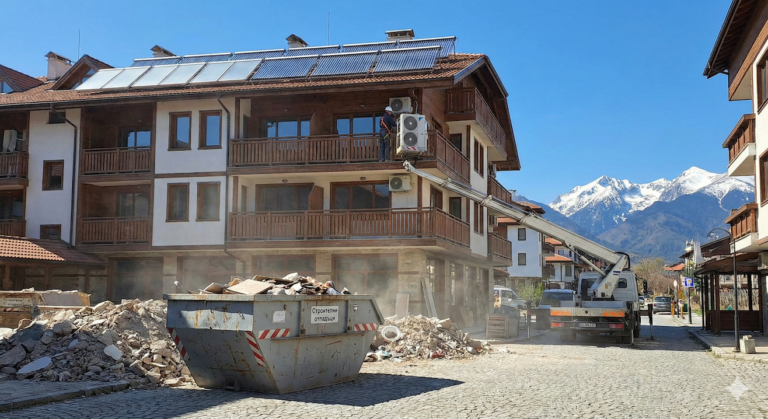
For major repairs, it is mandatory to order metal container for construction waste (4 or 7 cubic meters). In the Bansko region and Razlog Several licensed companies operate. The container is left in front of the building for a certain period (usually 3-5 days). If you are in a complex, coordinate the placement with the management so as not to block the parking lot or ambulance access.
PART II: HEATING AND ENERGY EFFICIENCY
This is the most important section. Heating in Bansko is not a luxury, but a matter of survival of the property. Electricity is the main source, as gasification is limited to certain areas.
1. Heat Pumps (Air-to-Water): The Gold Standard
If you are looking for maximum comfort and low bills in the long run, a heat pump is the best solution. It extracts energy from the air even at low temperatures.
- Advantages: Extremely low energy consumption (COP coefficient above 3 or 4). One system provides both heating and domestic hot water (no need for separate boilers).
- “Underfloor heating” option: The heat pump works most efficiently with water-based underfloor heating. The comfort of stepping onto a warm floor after a day in your ski boots is incomparable. In addition, underfloor heating dries the floor evenly, which is important for wet equipment.
- Important for Bansko: Since power outages are not an exception during storms, the system must be filled with propylene glycol (antifreeze) instead of clean water. If the power goes out for 2 days at -15°C, the clean water will freeze and burst the pipes in the floor, causing total damage.
2. Hyperinverter air conditioners and Specific installation
The most popular solution. Be sure to choose “Nordic” models or those that guarantee operation down to -25°C.
Specifics of the installation (Avtovishka): The architecture in Bansko often includes tall buildings with steep roofs and deep eaves (alpine style). Access to the facade for installation of an outdoor unit is often impossible for climbers or with a ladder. Be sure to budget for cherry picker rental. This is the only safe way to install or service an outdoor unit on the 3rd or 4th floor under the wooden eaves.
3. RES: Solar collectors and Photovoltaics
Bansko enjoys a large number of sunny days, even in winter. Investing in renewable energy makes perfect sense:
- Thermosolar panels (for water): If you are on the top floor or in a house, evacuated tube collectors are ideal. They work efficiently even in sub-zero temperatures and can provide up to 70% of hot water for free.
- Photovoltaics: For your own consumption, especially if you use a heat pump or electric convectors.
PART III: INSTALLATIONS (PLUMBING AND ELECTRICAL)
Electrical Installation: More than Just Cables
At apartment renovation in Bansko, the electrical diagram must be rethought according to the needs of the tourist.
- Additional contacts:
- In the hallway/hallway: Critically important! This includes electric ski boot dryers. If you don't have a power outlet, you'll have to run power strips throughout your apartment.
- In the kitchen: Provide at least 3-4 free sockets above the worktop. Tourists bring their own appliances or use a toaster, kettle and coffee maker at the same time.
- Next to the beds: In the age of smartphones, the lack of a power outlet next to the pillow is a huge disadvantage. Add USB/Type-C ports directly to the outlets.
- Appliance protection: Electric shocks are common. Installing voltage relay (Voltage Protector) directly in the panel is a mandatory insurance for your equipment. It automatically cuts off the current if the voltage goes beyond the norms (below 190V or above 250V), and releases it when it stabilizes.
Plumbing, Basements and Ski Lockers
The basements in Bansko are not just storage rooms for compotes. They are valuable ski lockers. But they are often damp and poorly maintained.
- Basement transformation:
- Ventilation: If there is no window, cut an opening to the hallway and put a ventilation grille on the door. Skis rust in a humid environment.
- Security: Replace the flimsy wooden door with a solid metal one. Ski equipment is expensive and thefts from basements are not uncommon.
- Under: Install granite tiles and form a base of at least 10 cm. This allows for easy washing of the mud and lye that falls from the shoes.
PART IV: INSULATION AND “ENCLOSURE” OF THE HOUSING
Doors and Security
The door is the first barrier against the cold from unheated corridors.
- Entrance door: Don't compromise. You need an "armored" door with mineral wool filling (for thermal insulation) and good seals. Thin Chinese doors condense and freeze.
- Smart access: If you are going to rent out the property (Airbnb/Booking), now is the time to run a cable to the door for an electronic lock or choose a battery-operated model with a keypad. Self-catering is standard in Bansko.
- Interior doors: Avoid honeycomb (cardboard) bathroom doors. Moisture will swell them in two seasons. Opt for solid MDF or water-resistant composites.
Suspended Ceilings and Lighting
Many of the old plasters are warped or cracked from the subsidence of buildings. A suspended plasterboard ceiling solves several problems:
- Aesthetics: Perfectly smooth surface.
- Insulation: Allows for the placement of 5 cm of wool over the cardboard. Since heat rises upwards, this drastically reduces losses, especially if the neighbor above is not heated.
- Lighting: Allows for the integration of LED panels and skylights. We recommend dividing the lighting into zones (“Strong” for cleaning and cooking and “Ambient” for relaxing).
Windows: Fighting condensation
In Bansko, condensation on windows is a huge problem due to the large temperature difference (25°C inside, -10°C outside). The water runs down and ruins the parquet and walls.
- The solution: Triple glazing with argon gas and high-energy glass is mandatory.
- Ventilation: Be sure to install micro-ventilation valves on the window frames. They allow minimal air exchange, which removes moisture without cooling the room when you are away.
PART V: FINAL WORK (THE FINAL)
Bathroom Renovation
The most expensive room. This is where the risk is greatest.
- Waterproofing: Don't rely on the joints alone. Before tiling, coat the floor and walls (up to 2 meters high in the shower area) with liquid waterproofing and put rubber tape on the corners. Buildings in the mountains "move" and joints crack.
- Linear siphon vs. Shower cabin: Ready-made shower enclosures with a tray are difficult to clean and the plastic ages. A better option is a sloped tile, a stone threshold and a linear siphon. More hygienic and long-lasting.
Flooring
You need to find a balance between comfort and durability.
- Corridor and Kitchenette: Only granite tiles. Tourists enter with shoes with grippers, full of pebbles, sand and lye. Laminate doesn't stand a chance.
- Living Room and Bedrooms: High-class laminate (AC4 or AC5, 8mm or 10mm). It feels warmer than tiles. Natural parquet is risky – if the humidity varies (due to inconsistent heating), the wood dries out or swells.
The renovation is complete. What's next?
The walls are painted, the sockets are in place, and the bathroom is lit. Now it's time to turn the empty space into a cozy home. How to choose a sofa bed that is comfortable to sleep on? What mattresses are suitable for renting? How to decorate in an alpine style?
(Click to continue to Part II)
 English (UK)