

When we talk about Pirin Park, we are not just talking about a geographical location or a tourist attraction above Bansko. We are talking about one of the last “green islands” of Europe, where the time flows differently. While the world below is changing at a rapid pace, here, in the high mountain belts, there are still guards who were young saplings during the time of the First Bulgarian Kingdom.
Pirin was included in the UNESCO World Heritage List in 1983 not only for its marble peaks, but also for its unique forests. In this in-depth article, we will take a detailed look at the “lungs” of the mountain, debunk the myths about logging, and teach you how to recognize the majestic murki.
The Scale of Green Treasure: Statistics and Facts
Many people ask themselves: “How big is the forest really?” The answer is impressive, but requires context. Pirin Park covers a total area of 40,356 hectares. Of this, the “green mantle” – the forest fund – covers about 23,000 hectares (or over 57% of the territory).
To get an idea of the scale, let's break down the numbers based on forestry studies:
📊 The forest mathematics of Pirin
| Total forest area | ~23,000 hectares |
| Average density | 200-500 trees/hectare |
| Estimated number of trees | 4.6 to 11.5 million |
| Average age of the forest | 85 years |
| Dominant type | Conifers (90-95%) |
Note: The average age is relatively high for Europe, which is an indicator of a healthy ecosystem with minimal human intervention in the core areas.
The Lords of Pirin: Species Composition
Pirin is unique in that it is home to Balkan endemics – species that are found nowhere else in the world except on the Balkan Peninsula. While spruce reigns in the Rhodope Mountains and beech in the Balkan Mountains, Pirin is the kingdom of The Moors.
1. White Mura (Pinus peuce) – Queen of the Mountain
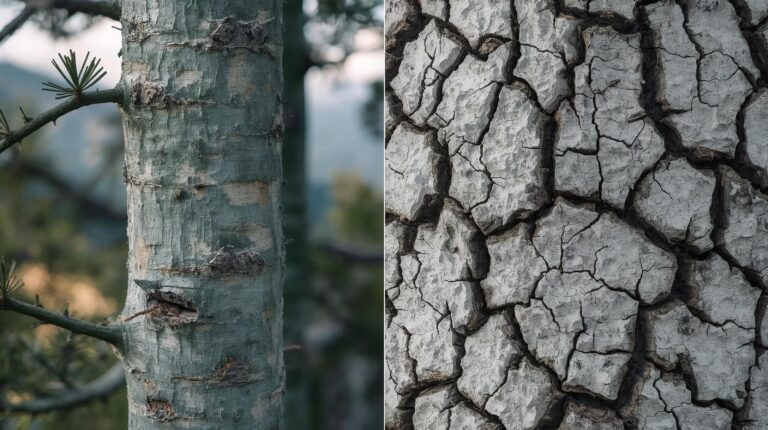
This tree is the symbol of Pirin Park. It is endemic to the Balkans and is extremely resistant to harsh conditions. The white fir has smooth, gray-greenish bark (hence its name) and soft needles, gathered in bundles of five. It grows slowly, but lives for centuries. Its root system is powerful, which allows it to hold the soil on the steep slopes above Banderishka Polyana..
2. Black Mura (Pinus heldreichii) – The Warrior of the Rocks
If the White Fir is the queen, the Black Fir is the armored warrior. It thrives at even higher altitudes (up to 2,600 m above sea level) and often grows directly on marble cliffs where it seems impossible for life to exist. Its bark is cracked, rough and gray, resembling scales of armor. It is extremely resistant to storms and lightning.
How to distinguish them? (Tourist's Guide)
Many tourists in Bansko confuse the two types. Here's a quick comparison chart that will make you an expert on your next hike:
| Characteristics | White Pine (Pinus peuce) | Black Mura (Pinus heldreichii) |
|---|---|---|
| Bark | Smooth, gray-green | Cracked, with rough tiles (flakes) |
| Pine cones | Long, hanging down | Shorter, bluish before ripening |
| Needles | Soft, gentle | Hard, prickly, gathered in bundles |
| Habitat | Moist, deep soils | Dry, rocky and limestone terrains |
The legend is alive: Baikusheva mura
We can’t talk about the trees in Pirin without paying tribute to the patriarch of the Bulgarian forests. The Baykushev fir is not just a tree, it is an institution. It is located near the Banderitsa hut and is named after its discoverer – forester Kostadin Baykushev, who described it in 1897.
Her age is estimated at over 1,300 years. This means that when this tree was a small sapling, Khan Asparuh was probably still strengthening the foundations of the First Bulgarian State. With its dimensions – a height of 26 meters and a trunk circumference of 7.8 meters – it is a miracle of nature, having survived fires, storms and human history.
Ecological balance: The forest is more than just trees
An often overlooked fact is that the health of Pirin Park depends not only on living trees, but also on the so-called “dead wood.” Fallen trunks are home to thousands of species of insects, fungi, and microorganisms that recycle nutrients.
In addition to the coniferous giants, about 5% of the park is occupied by deciduous species – mainly beech and oak in the lower parts (the “Betolovo” area, for example). These areas are critically important for biodiversity, providing food for bears, deer and wild boars in the autumn.
The Threats: Truth and Speculation
National news is often full of alarming headlines about “the logging of Pirin.” What is the reality?
- Bark beetles and sanitary felling: In recent years, Bulgaria, like the whole of Europe, has been struggling with bark beetle (Ipidae) infestations provoked by warmer winters. This necessitates the implementation of “sanitary felling” – the removal of diseased trees in order to save the forest. The line between sanitary and commercial felling is thin and is subject to constant civil control.
- Infrastructure: The desire to expand ski Bansko is a constant conflict. Currently, thanks to the park status and court decisions, mass logging for new slopes is blocked, preserving the integrity of the centuries-old forests.
- Climate change: This is the biggest “silent killer.” Drought weakens the immune system of trees, making them more vulnerable to disease. However, the murres show enviable resilience compared to spruce forests in other mountains.
The future of the forest and our role
Pirin is proof that nature is stronger than us, but also that it is fragile. The restoration of a forest of White Fir takes centuries. Artificial afforestation in Pirin is difficult and often unsuccessful due to the specific terrain, so natural regeneration is of key importance.
🌲 How can you help as a tourist?
When visiting Bansko and Pirin Park, follow three simple rules that save trees:
- Do not light fires outside of the regulated areas: Forest fires are the biggest threat to the murres, which are rich in resin and burn like torches.
- Don't "cut" the paths: Direct paths through the forest lead to soil erosion, which exposes tree roots and slowly kills them.
- Report: If you see trucks with unmarked wood or suspicious logging in protected areas, report it by calling 112 or using the Executive Forestry Agency app.
The forests of Pirin are a living treasure that belongs not only to Bansko or Bulgaria, but to the world. They are our shield against climate change and our temple for spiritual rest. Let us protect them.