


Analysis Summary:
In this article we will look at how 400 snowmakers in ski area Bansko defeat climate change, what the "wet bulb" is and why SnowFactory technology is key to the start of the season.
Part I: Why is nature no longer enough?
To understand the scale of the system for artificial snow in Bansko, we need to look at the geographical position of the resort. Located in the northern foothills of Pirin, it is only 150 km from the Aegean Sea. This proximity brings humidity, but also frequent warming from the south, which can raise temperatures by 15 degrees overnight.
For the concessionaire Yulen AD, relying solely on natural precipitation is a risk that the business cannot afford. Statistics show that below 1600 m above sea level (where the critical „Ski Road“ is), natural snow is often insufficient. If this 7-kilometer section were not covered, thousands of tourists would find themselves stranded in queues for the cabin. Today, close to 90% from the tracks are covered by a technological arsenal that guarantees a season from December to April.
Part II: The Arsenal – Artificial Snow Technologies in Bansko
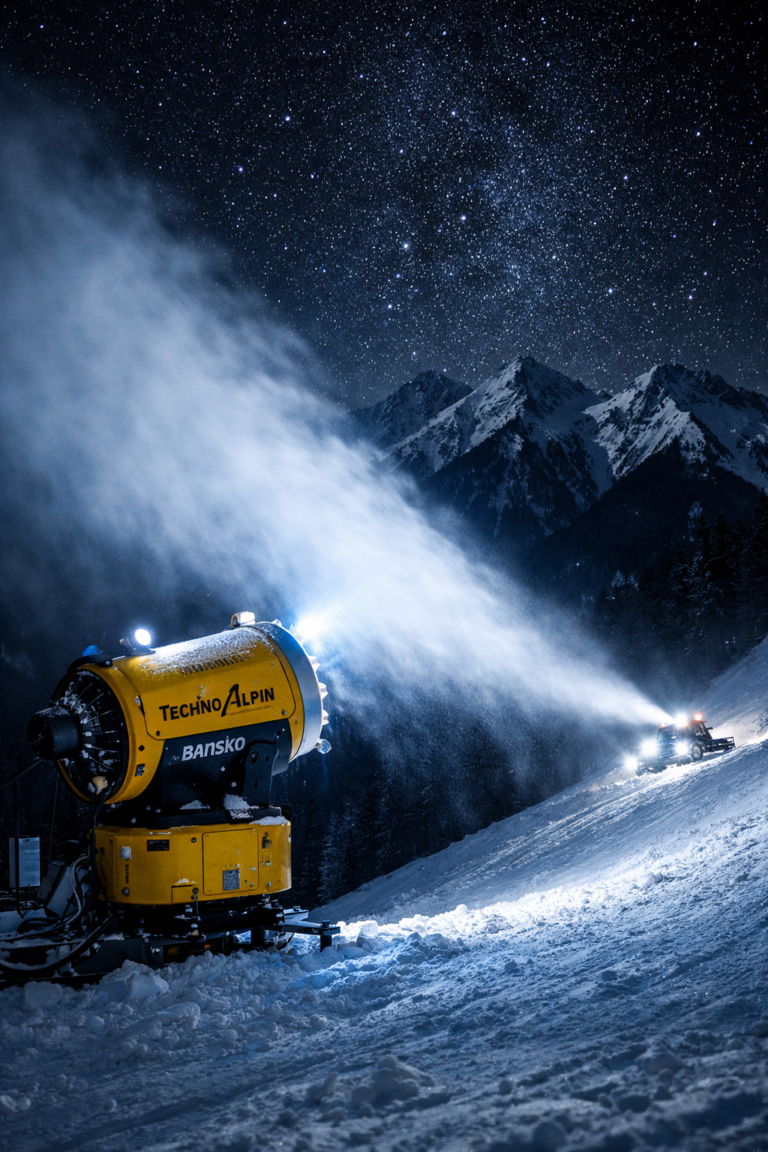
Bansko's technology park consists mainly of Italian machines from the leader TechnoAlpin. Each type of machine has its own specific “combat mission”.
1. Fan Guns
Models like TF10 and TR8 are the "heavy artillery". They use a powerful fan that disperses water droplets over a long distance. At their heart, nucleators mix water and air, creating ice nuclei around which larger water droplets freeze. They are ideal for large areas such as the "Platoto" and "Shiligarnika".
2. Snow Lances
These 10-meter aluminum tubes are the “silent infantry”. They operate without a fan, relying on gravity and height to give the drop time to freeze. They are used primarily in forest clearings and on the „Ski Path“ because they are energy efficient and silent.
3. SnowFactory – The high temperature revolution
On Banderishka Polyana is located SnowFactory. It's a giant industrial refrigerator in a container. Unlike cannons, it can produce ice crystals at temperatures up to +15°C. This machine provides “snow insurance” for the children’s areas and the final straight, regardless of the whims of the the weather.
Part III: The Physics of the “Wet Bulb”
The biggest mistake is to think that artificial snow requires just -1°C. Engineers in Bansko monitor the parameter Wet Bulb Temperature (wet bulb temperature).
When the air is dry, evaporation from the surface of the water drop cools it further. This allows the guns to work even in +2°C actual temperature, if the humidity is very low. However, in high humidity (fog), production stops even at -2°C because the drops just fall like rain.
💡 Pro tip for skiers:
Technical snow has a density of around 500 kg/m³, while fresh fluffy snow is around 100 kg/m³. This makes the slopes in Bansko more durable, but also harder in the morning. Always check the edges of your skis – they are your best friend on technical snow.
Part IV: The Digital Brain ATASSpro
Making artificial snow in Bansko no longer dependent on manually rotating cranes. The entire mountain is controlled by software ATASSpro. Each gun is a weather station. The system automatically decides:
- When to turn on based on the exact local temperature.
- How many nozzles to open (more cold = more water = more snow).
- At what angle should the jet be launched relative to the wind direction?.
Part V: Infrastructure and Capacity
To operate 400 machines, a complex network of cast iron pipes has been built underground. Bansko's pumping stations have a flow rate of over 470 liters per second. That's enough power to fill an Olympic-sized swimming pool in 80 minutes. Thanks to recent upgrades, the "Ski Road" can be completely snowed in less than 72 hours, weather permitting.
| Parameter | Value / Technology |
|---|---|
| Total number of guns | ~400 pieces |
| Area coverage | 90% from the arable tracks |
| Maximum flow rate | 470 l/sec |
| Critical technology | SnowFactory (for operation above 0°C) |
Ecology and the future of skiing
Although artificial snow is the subject of debate regarding water and energy consumption, it remains the only way to sustain the economy in the region. The water is taken in a regulated manner from the Banderitsa and Demyanitsa rivers and returned to the ecosystem when it melts in the spring. Without these technologies, the winter season in Pirin would be 40-50 days shorter, which would lead to serious economic consequences for the local community.
Conclusion
The next time you descend the perfect velvet of Bansko, remember that this is a triumph of engineering thought. Artificial snow in Bansko is a complex symphony of physics, software, and 24/7 labor. This is the magic of modern skiing – half nature, half science.

 English (UK)