


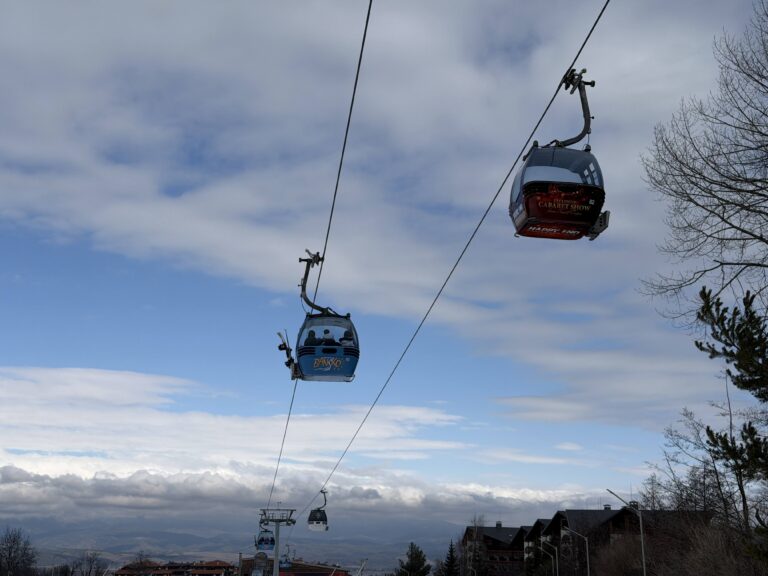
Related useful information: If you are looking for practical information on ticket prices and opening hours, don't miss our Complete guide to the Bansko cable car.
Why does the elevator stop “for no reason” in mid-air?
You are traveling calmly and suddenly the gondola slows down and stops completely. There is a silence that often causes anxiety. It is important to know: when the lift stops suddenly and starts again after a minute or two, this It's definitely not an accident.. On the contrary, this is evidence that the systems for safety of the gondola lift in Bansko they work flawlessly.
Main reasons for short stops:
- Boarding of passengers with reduced mobility: The operator manually stops or slows the line to ensure safe boarding for people in wheelchairs, skiers with injuries, or families with bulky strollers.
- Door safety sensors: Each cabin has an inductive sensor. If a ski boot, backpack strap or pole prevents the door from closing tightly, the system automatically blocks movement.
- Automatic distance regulation: The central computer monitors the distance between the cabins. At the slightest deviation, a “micro-pause” is made for synchronization.
Communication and connection with the operator
The feeling of isolation is among the main fears. The engineers at Doppelmayr (the manufacturer of the lift) have envisaged three levels of communication:
- SOS Intercom System: Most modern gondolas have a module for two-way communication with the control room.
- Full mobile coverage: The route in Bansko is well covered by all mobile operators. In case of emergency, you can contact the emergency services directly.
- Video surveillance: Each station is under constant visual control, allowing operators to react instantly to any unusual situation.
Evacuation Protocols: Plan A and Plan B
Even in the event of a complete power outage in the region, there are backup systems that guarantee your security.
| Plan A: Diesel generators | In the event of an electric shock, powerful diesel engines are turned on, emptying the line in 1-2 hours. |
| Plan B: Alpine Rescue | In the event of a mechanical blockage, rescuers from the MSS lower each passenger individually using alpine ropes and harnesses. |
*Important: In the history of the Bansko lift, a mass alpine evacuation under Plan B has never been necessary.
The "Bite" Mechanism: Why won't the cabin detach?
Many tourists worry that the gondola may simply slip off the rope. Technologically, this is almost impossible with proper operation. The gondolas are connected by the so-called. detachable device (Grip).
This mechanism uses huge industrial springs that exert constant pressure on the steel rope. The force of the “bite” is calculated to withstand a weight many times greater than the capacity of 8 people. At the stations, the device opens mechanically using special rails, and when leaving – it closes again. Each grip undergoes daily visual and periodic defectoscopic control.
The wind and the protective clearing
To ensure maximum safety of the gondola lift in Bansko, the management monitors the wind speed through anemometers on each tower body. At speeds above 15-20 m/s, the lift speed is reduced, and at gusts above 25 m/s, the facility is preventively stopped.
Regarding the risk of falling trees (as happened in Austria in 2024), a strict protocol is implemented in Bansko:
- Wide clearing: The course is cleared of trees to a distance greater than the height of the tallest surrounding tree.
- Annual sanitary felling: Experts mark and remove diseased or dangerous trees near the line every fall.
Comparison: Why are incidents abroad different?
Examples of tragedies in Italy or Austria are often given. It is important to distinguish between the types of lifts:
- The Stresa-Mottarone case: There it is about human negligence - the emergency brakes were intentionally blocked by the staff. In Bansko, the systems are automated and protected from such interference.
- Swing cable cars: Most major accidents occur in huge cabins for 100 people, which have a completely different design from the "gondola" in Bansko.
Conclusion from the experts
Statistically speaking, a cable car ride is safer than traveling by car to the resort itself. Every morning, before the first customer steps into the cabin, the facility performs an “empty run,” during which sensors check every inch of the rope and every pulley on the poles. Your safety is not just a promise, but the result of strict engineering discipline.


 English (UK)