


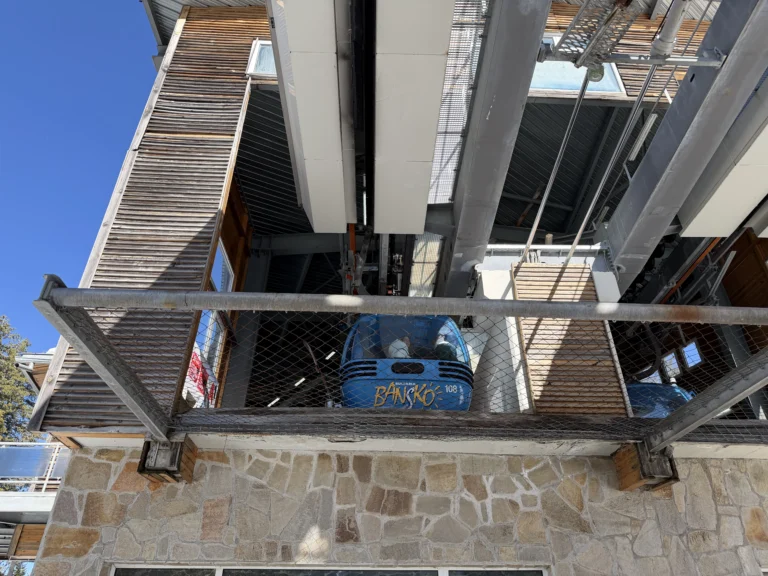
History and scale of the Bansko cable car
Opened in December 2003, the Bansko gondola lift transformed the resort from a small mountain town into the ski capital of the Balkans. Its route is over 6 kilometers long, making it one of the longest in Bulgaria. The lift overcomes a difference in altitude of nearly 600 meters, connecting a lower station (Banderitsa) with an intermediate station (Chalin Valog) and an upper station (Banderishka meadow).
The facility's capacity is designed to transport up to 2,400 people per hour, with each gondola holding 8 passengers. In order for this huge machine to operate without interruption, it requires daily monitoring and precise maintenance, carried out by a team of dedicated specialists.
The mechanism of operation: How do the cabins "unhook"?
The main difference between the old lifts and the modern gondola in Bansko is the technology of the detachable grip. In fixed lifts, the chair moves at the same speed as the rope – this makes climbing difficult and dangerous at high speeds.
The decoupling process step by step
With the Bansko gondola lift, the process is automated and happens in fractions of a second:
- Entering the station: When the cabin approaches the station, a special metal rail presses a lever on the roof grip.
- Unhooking: The lever compresses powerful steel springs that open the „jaws“ holding the rope. At that moment, the cabin separates from the fast rope (moving at 6 m/s).
- Delay through tyrfors: The cabin steps onto a rail and is lifted by tirfori – rubber wheels that smoothly reduce its speed to 0.5 m/s. This allows tourists to board comfortably.
- Acceleration and bite: Once the passengers are inside, another series of twirls accelerates the car back to rope speed before the jaws automatically „snap“ it again.
Safety: Why is there no danger of the cabin falling?
Many people feel a little uncomfortable at the thought of just one "pin" holding them in the air. The engineers at Doppelmayr however, they have implemented a triple security system.
The force of disc springs
The grip is held closed by packs of pre-tensioned steel springs. Their force is so great that the friction between the metal and the steel rope is many times greater than the weight of a full cabin. Even on the steepest incline, slipping is physically impossible.
The wind and the sensors on the poles
Tourists often ask why cable car Bansko closes in the wind, if it is quiet in the city. In the mountains, gusts can be ten times stronger. For protection, the following are used:
- Anemometers: Wind speed sensors on each pole. If the norms are exceeded (usually above 15-20 m/s), the lift speed is reduced or it stops.
- RPD (Rope Position Detector): Sensors that monitor whether the rope is exactly in the center of the pulleys. If the wind deflects it sideways, the lift stops to prevent the rope from coming out of its bearings.
Technical specifications and engines
The heart of the lift is located at the upper station of Banderishka Polyana. It is there that the huge electric motors that drive the steel cable are located. The system also has backup diesel engines that can complete the course of the cabins even in the event of a complete power outage in the Bansko region.
| Characteristics | Data |
|---|---|
| Facility type | 8-MGD (8-seater gondola line) |
| Route length | 6,233 meters |
| Maximum speed | 6.0 meters per second |
| Travel time | Approximately 25 minutes |
| Number of poles | 42 pieces |
Practical tips for your trip
To make your day in ski area Bansko more pleasant, follow these tried and tested tips:
- Early departure: The cable car opens at 08:30. If you want to avoid the queues during the peak season (January-February), be at the bottom station around 08:00.
- Intermediate station: You can get off or on at the intermediate station “Chalin Valog”. This is an excellent option for advanced skiers who want to ski on the steeper slopes there.
- Equipment: Don't forget that it is warmer in the cabin, but immediately after getting off at Banderishka Polyana you will feel the difference in temperature (often over 5-7 degrees difference with the city).
- Wardrobes: There are numerous ski lockers and cafes around the bottom station where you can leave your rental equipment.
Understanding the complex technology behind cable car Bansko gives us the peace of mind to enjoy nature. This facility is an example of Austrian precision in the heart of the Pirin Mountains, designed to operate safely in the harshest winter conditions.
Are you planning a winter vacation in Bansko?


 English (UK)