


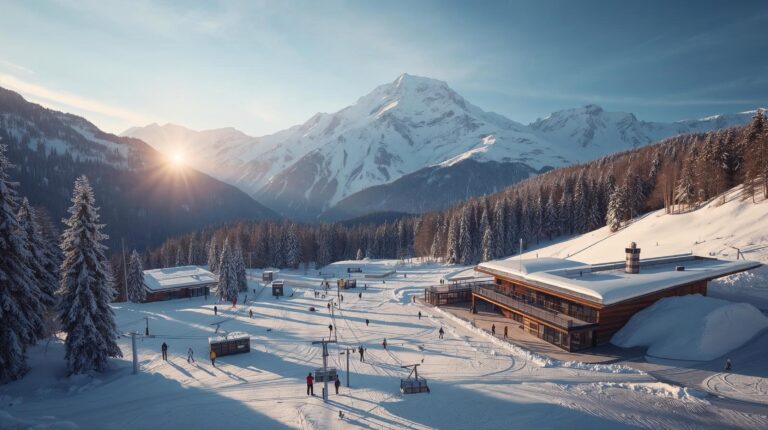
Chronology of the development of Bansko Ski Area
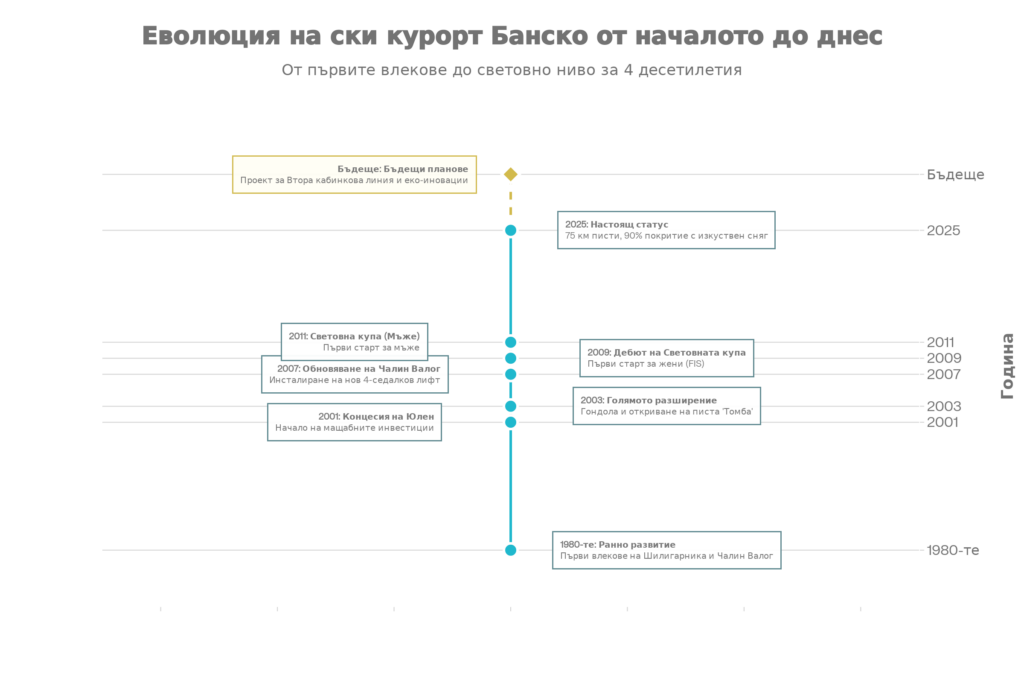
The resort was not built simply track by track, but through large-scale periods of technological and infrastructural transformation. Here's how Pirin has changed over the years.
Stage 1: “The First” – The Romantic Period (1980s – 2000)
Before the modern era, skiing in Bansko had a very different spirit. The infrastructure was fragmented, and access to the higher reaches of Pirin was a challenge reserved for the most ardent enthusiasts.
- The Shiligarnika (The Heart): This is the historical core. Back in the 1980s, the first ski runs in the area of today's ski runs No. 5 and 10, served by "anchor" type ski lifts, operated here.
- Chalin Valog: The oldest terrains, which we know today as runways No. 15 and 16, served as a training base.
- The logistical constraint: The lack of a cable car forced skiers to travel by private cars or overcrowded buses along the narrow road, which often took hours.
Stage 2: The Great Change and the “Tomba” Era (2001 – 2004)
The key moment for Bansko ski area occurred in 2001 with the start of the concession of “Yulen” AD. In just three years, the ski map was redrawn, putting Bansko on the world map.
The Gondola: The Backbone of the Resort
In 2003, the 8-seater gondola line was opened Doppelmayr. It revolutionized the city (990 m above sea level) by connecting it with Banderishka meadow (1620 m above sea level) in less than 25 minutes. This turned the mountain into a single, easily accessible system.
Track #9: Birth of a Legend
If Shiligarnika was the beginning, then Tomba was the claim to world fame. Designed as a technical and uncompromising course, it was personally opened by Alberto Tomba in December 2003.
“Bansko is no longer just a hill for beginners, but a World Cup arena capable of hosting the best skiers in the world.”
Stage 3: Expansion and Connection (2004 – 2010)
After building the “backbone”, the resort focused on capacity and diversity. This period was marked by the mastery of the highest parts and the creation of iconic links.
| Area / Object | Meaning |
|---|---|
| The plateau | Wide “blue highways” (runways 3 and 11), ideal for mass tourism. |
| The ski road | 7 km of trail, allowing a descent from 2600 m directly to the city. |
| FIS Home Teams | First starts for the World Cup, which established the image of the Bansko Ski Area. |
Stage 4: Technological modernization (2010 – 2025)
During this period, the focus shifted from new trails to optimization and artificial snow. Due to the restrictions of Pirin National Park, development became “smart”.
By 2025, Bansko will have over 400 technical snow guns, covering 90% of the territory. This guarantees a season from December to mid-April, regardless of weather changes. The old ski lifts of Chalin Valog were replaced with modern 4-seater lifts, minimizing the weather for waiting.
The future of Bansko Ski Area after 2025.
The look ahead is focused on three main pillars:
- 🚀 Second cable car line: The project, which will eliminate queues in the city and duplicate the access capacity to Banderishka Polyana.
- 🌿 Green innovations: Switching to electric snowplows and low-energy snowmaking systems.
- ☀️ Year-round model: Transforming Bansko Ski Area into a 12-month destination with bike parks and alpine attractions.
From a ski lift on Shiligarnika in the 1980s to the title of “Winter Capital of the Balkans” – the evolution of Bansko ski area is proof of the potential of the Bulgarian mountains. Today, with its 75 km of perfectly maintained slopes, the resort looks confidently towards the next decade.

 English (UK)