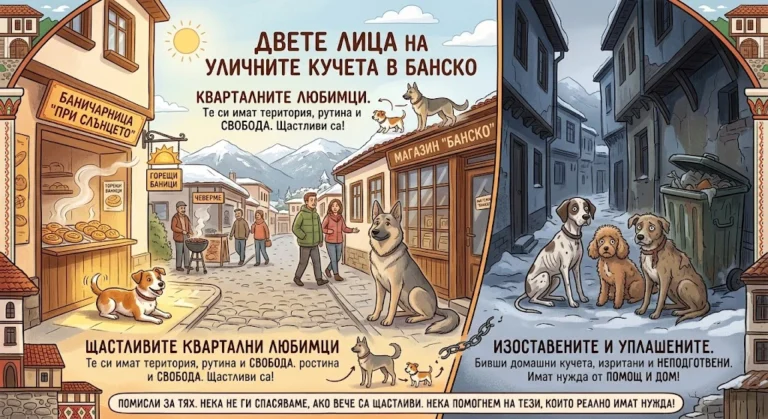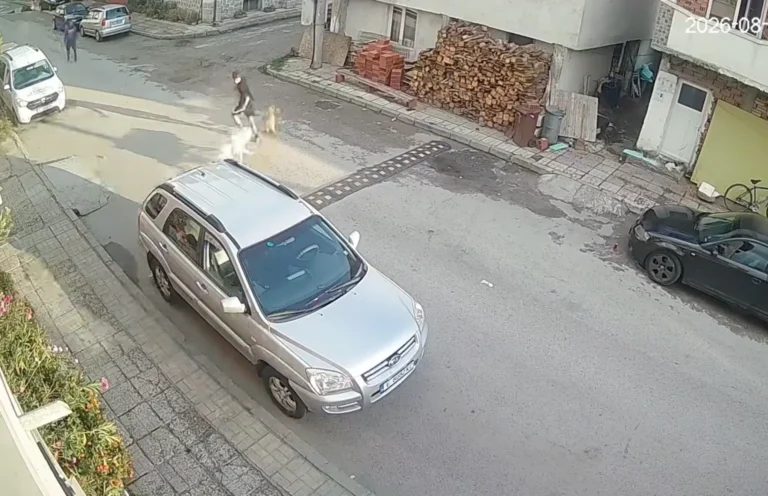




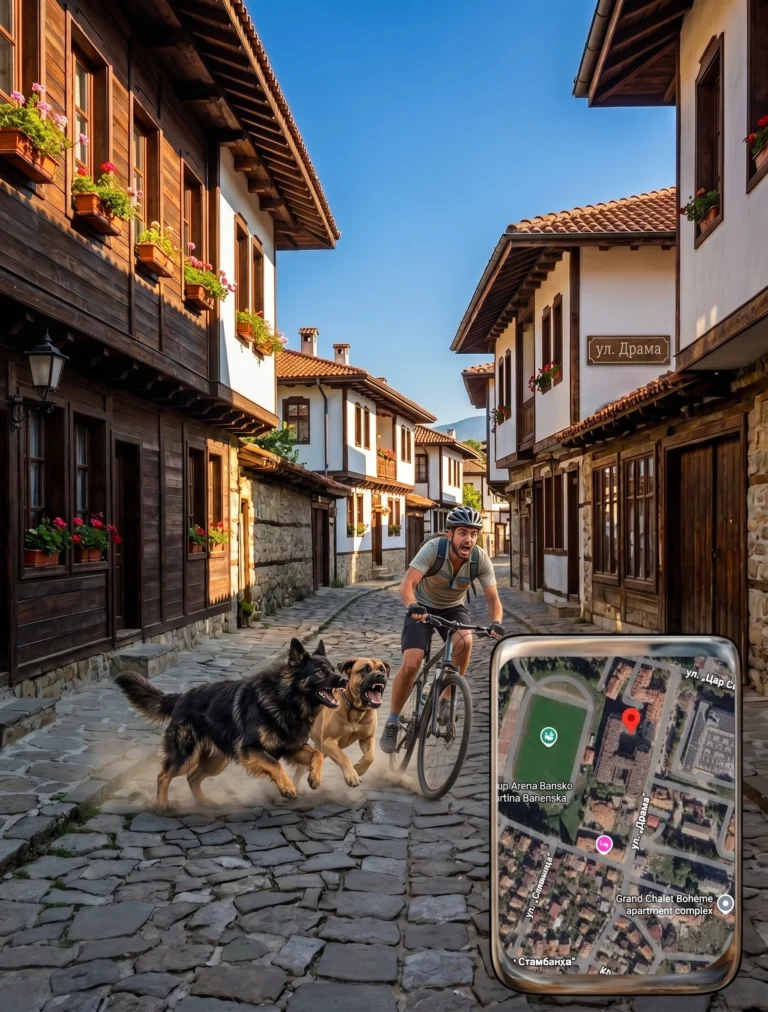
It is important to know: The presence of large and thoroughbred stray animals around the cable car base station, pedestrian areas, and main streets often causes legitimate concern among families with children and guests from Western Europe.
Why is the problem with stray dogs in Bansko so specific?
Moreover, the situation here is not limited to the presence of small, common street breeds. Increasingly common on central arteries such as ул. Пирин & ул. Найден Геров large dogs can be seen. Among them, breeds such as питбул, кане корсо, huskies, as well as various types of shepherd dogs. As a result, the feeling of insecurity among some tourists is increasing immensely. According to local observations, the reasons for this concentration are complex:
- Abandoned pets after the construction boom: A common practice in the past, and still today, is for unscrupulous owners or investors to hire a large dog to guard a site. Consequently, after construction is completed, the animal is simply abandoned on the street.
- Free-range yard dogs: On the other hand, a large portion of the animals roaming the city during the day actually have owners. They let them roam freely, which is in direct violation of municipal ordinances, but has been widely tolerated for decades.
- Lack of mass castration: Despite the efforts of local volunteer organizations, the rate of reproduction often outpaces the neutering programs. [ADD: Official statistics of the Municipality of Bansko on the number of neutered animals in the last year].
Comparison with the top ski resorts in Europe
To understand why Western tourists are reacting so sharply, we need to make an objective comparison. Bansko has the ambition and potential to compete for tourists with over 300 leading destinations. Let's look at the real situation with them.
The Alps: A culture without stray animals
In countries like France, Austria, Switzerland and Italy, the concept of stray dogs is practically non-existent. In prestigious resorts like Chamonix, Courchevel, Zermatt, Sölden or Livigno You will not encounter crowds around the lifts. Therefore, tourists there feel completely calm at any time of the day.
This result was not achieved by chance. First of all, strict legislation requires mandatory microchipping and strict control. In addition, high local taxes on unneutered dogs and hefty fines for abandoning a pet play a huge preventive role. [ADD: Average fine for an off-leash dog in Austria].
Central Europe: Andorra, Slovakia and Poland
If we look at Bansko's direct competitors in the price range, the picture is again different. Resorts such as Grandvalira (Andorra), Jasná (Slovakia) and Zakopane (Poland) offer similar conditions and budgets, but there is no problem with stray dogs there. As a result, families often prefer these destinations precisely because of the feeling of overall urban order and safety.
The Balkans and the Caucasus: The Regional Context
Unlike Central and Western Europe, this case is more widespread in the Balkans. In resorts such as Пояна Брашов (Romania) or Копаоник (Serbia) you can also spot some stray animals. However, the concentration of stray dogs in Bansko, especially from large breeds, is much more noticeable.
Interesting fact: The only major exception in the wider region is the resort Гудаури (Georgia). There, the local mountain dogs have become a tourist attraction. They accompany skiers on the slopes, but they are necessarily neutered, have clear ear tags, and are extremely socialized with people.
How does this affect tourism and the image of Bansko?
On the other hand, tourists nowadays expect predictability and security. When a guest from the UK or Germany pays for a ski pass and first-class accommodation, he also expects a corresponding urban environment. The sight of stray pit bulls and shepherds does not fit into the idea of a peaceful winter holiday.
Of course, locals know that most of these animals are harmless and simply looking for food or warmth. However, for a foreigner who is unfamiliar with the dog mentality, encountering a pack at dusk can be traumatic. As a result, such experiences are often reflected in online review platforms. [ADD: Percentage of tourists mentioning street dogs in their negative reviews of the resort].
The Road to Decision: Are We Ready for the Big League?
To build and maintain the image of a 100% European resort, the city must address this issue institutionally. This does not mean inhumane treatment, but quite the opposite. The main steps include:
- Strict control over pets: Imposing real fines for owners who let their dogs walk alone during the day.
- Enhanced neutering campaigns: Joint efforts between local authorities, veterinary clinics and the non-governmental sector.
- Expanding shelter capacity: Ensuring adequate conditions for removing large and potentially problem breeds from the streets.
In conclusion, taking care of the urban environment is a shared responsibility. If you witness an aggressive animal or an unscrupulous owner, it is always a good idea to inform the relevant authorities.
FAQs
Are all stray dogs in Bansko dangerous?
Most stray dogs in Bansko are not aggressive and are used to human presence and the noise of the city. However, among them are often found large breeds such as pit bulls and Cane Corso, whose behavior in a pack can be unpredictable, especially in the dark hours of the day.
Are there stray dogs in other ski resorts in Europe?
In Europe's leading ski resorts, such as those in Austria, France, Switzerland and Italy, stray dogs are completely absent. They enforce extremely strict laws for the protection and control of pets, including mandatory microchipping and hefty fines for abandonment.
Where do the purebred street dogs in the city come from?
A large part of the purebred stray dogs in Bansko are abandoned by their owners, after initially being taken in as guards for construction sites or properties. Another significant part are domestic yard dogs, whose owners deliberately let them roam freely around the city during the day, contrary to the rules.