



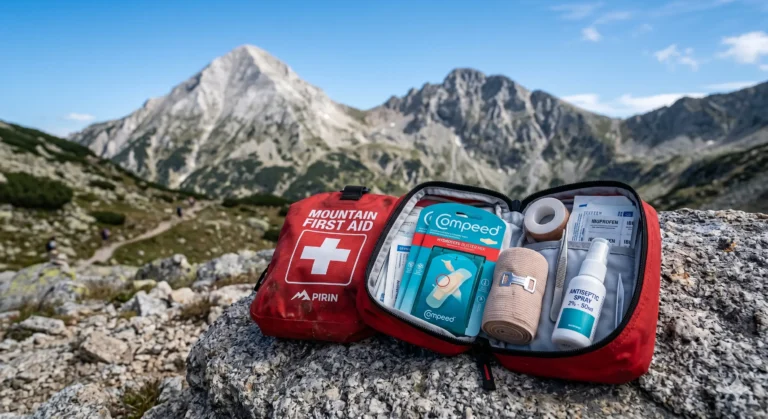
Your personal mountain first aid kit is not just a weight in your backpack – it is your life insurance. In the fifth part of our series on “The Ten Most Important Elements”, we will look at how to assemble a compact, lightweight and truly effective first aid kit that will be useful to you in the harsh conditions of the most beautiful Bulgarian mountain.
Why are ready-made first aid kits often useless?
Many novice hikers are tempted to buy a ready-made first aid kit from the supermarket or gas station. As experts with experience in the regional terrain, we advise you to avoid this for two main reasons:
- Excess weight and volume: Ready-made packages often contain things you won't use (like huge metal scissors or a pound of cotton) that take up valuable space.
- Low quality of materials: The patches in them are often not waterproof, and in 90% cases, specialized hiking supplies, such as hydrocolloid patches, are missing.
Expert advice for Bansko and the region
Before you head to Vihren hut or Shiligarnika, check the availability of specific medications at local pharmacies in Bansko. The town has well-stocked stores, but in the height of the season some specific blister patches quickly run out.
The Holy Trinity of Traumas in Pirin
The statistics of the Mountain Rescue Service (MSS) shows that the most common problems are not dramatic fractures, but minor injuries, which can, however, turn your hike into hell and force you to end your vacation prematurely.
1. Blisters and Pimples (Enemy #1)
The Pirin terrain is extremely rocky. The constant friction in the shoe when climbing and descending the moraines quickly leads to blisters. A regular adhesive plaster will peel off at the first sweat on your feet. Be sure to wear hydrocolloid patches (Compeed type). They act like a “second skin”, relieve pain instantly and stay in place even with intense movement for days.
2. Sprains and joint injuries
One wrong step on an unstable stone can lead to a sprained ankle. Wear elastic bandage or, even better, self-adhesive cohesive bandage. It will stabilize the joint and allow you to descend to the nearest hut on your own, instead of having to organize a rescue operation.
3. Cuts and abrasions
Sharp granite rocks and tough squatting can cause serious lacerations. Your kit should contain sterile gauze, a disinfectant (e.g. chlorhexidine – it doesn’t take up space and doesn’t sting like iodine), and a roll of waterproof adhesive tape.
Medications: The bare minimum for survival
Always consult your doctor before including any medications in your mountain first aid kit. Here is the basic list that every prepared hiker in Pirin brings:
| Type of medication | Mountain application |
|---|---|
| Painkillers (NSAIDs) | Ibuprofen or liquid analgin. They help with altitude headaches or muscle pain after a long hike. |
| Antihistamines | Critically important for insect stings or unexpected allergic reactions to alpine vegetation. |
| Gastrointestinal | Loperamide or activated charcoal. Mountain sickness leads to rapid dehydration, which is dangerous. |
| Electrolytes | Soluble tablets to restore salt balance during heavy sweating under the strong Pirin sun. |
Special focus: The dangers of fauna in Pirin
In the lower and middle parts of Pirin (especially in the foothills below Sinanitsa Peak or around the Banderitsa region) poisonous snakes are found, most often this is The Viper. It is important to know that in your personal mountain first aid kit there is no room for anti-snake serum – it is stored in a refrigerator and is only applied by a medical professional in a hospital setting.
- Do not cut or burn the wound!
- Do not try to suck out the poison by mouth.
- Do not apply a tight tourniquet – this can lead to necrosis and loss of the limb.
The correct action: Stay calm. Flush the wound with water, immobilize the limb (make a makeshift splint) and immediately contact EMS or call 112. Restricting movement slows the spread of the venom into the lymphatic system.
Organizing and storing your first aid kit
For your first aid kit to be functional, it should be:
- Waterproof: Use a bright (red or orange) Dry Bag. In Pirin, unexpected afternoon rains often occur, and a wet bandage is a useless bandage.
- Easily accessible: Don't stuff it in the bottom of your pack under your spare clothes. You should be able to get it out in less than 30 seconds.
- Updated: Once a year, before the start of the summer season in Bansko, check the expiration dates. Medicines exposed to temperature fluctuations in your backpack can lose their properties faster.
Conclusion
Carrying a well-stocked mountain first aid kit is not a sign of pessimism, but of high mountaineering culture and responsibility. Pirin is a mountain for the prepared. Be the person in the group who knows how to react, and don't let a small rash or headache ruin the magic of your adventure above Bansko.