


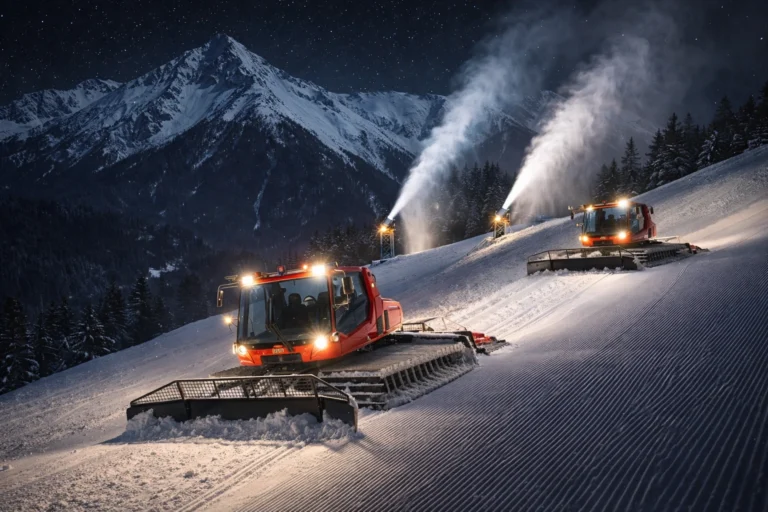
Turning the rutted, icy, and baboon-filled snow into the perfect morning “corduroy” requires high technology, around-the-clock work, and a precise understanding of snow physics. In this guide, we’ll take you behind the scenes of the night shift in Pirin.
1. Operation “Clean Mountain”: The Key Role of the Ski Patrol
Before any heavy equipment can start, the mountain must be completely safe. The daily maintenance of the slopes in Bansko begins with the joint work of the ski patrol and the Mountain Rescue Service (MSS). They make a final, methodical descent along absolutely all marked trails.
Their job is to check for stranded, lost or injured tourists, as well as for forgotten equipment on the slopes. Only when the patrol reports over the radio that the entire ski resort is “clear of people” do the giant machines get the green light to leave the garages.
2. The magic of technical snow in Bansko
If weather conditions allow, the artificial snow installations are the first to come into operation. The Bansko ski area has a network of over 400 top-class guns, connected in a gigantic high-pressure infrastructure, powered by huge water tanks.
- How a snowflake is born: The guns don't just make snow out of thin air. They mix pre-chilled water with compressed air. The water is sprayed into microscopic droplets that freeze in the air and fall like real snow.
- Fans vs. Copycats: On the wide sections of the slopes (such as “Kolarski pat”), powerful turbine guns with fans operate, which throw snow dozens of meters away. On the narrower paths, “snow spears” are used – long aluminum tubes that are more energy efficient and rely on the natural fall from a height to freeze the drop.
3. The Heavy Artillery: The Ratracs in Action
The heart of any ski slope maintenance in Bansko are the snow groomers (snow machines). These machines cost hundreds of thousands of euros and look like real spaceships from the inside. Their work process takes place in three main stages:
- Pushing the snow up: Throughout the day, thousands of skiers slide the snow down by gravity. The snowcat uses its large front paddle to scoop up these masses and push them back up, filling in the holes.
- Grinding and homogenization: The rear cutters (powerful rotors with sharp teeth) break up ice and hard lumps. They mix the old snow with the newly created artificial snow, creating a strong and homogeneous base.
- Shaping the “velvet”: The rubber finishing boards behind the cutter press the snow down and give it the characteristic grooved shape. The grooves are not just for beauty – they increase the contact area of the snow with the cold air for faster freezing.
Future technologies and winches for steep slopes
Modern snow groomers in Bansko are equipped with radar systems (such as SNOWsat). They scan the thickness of the snow under the tracks and display a 3D map to the operator. This way, he knows exactly where the snow cover is critically thin and where there is excess to move.
For legendary steep runs like the Alberto Tomba, a regular snowmobile cannot climb without rolling the chains. That's why they are used ratchets with winches. The machine is attached to a massive anchor at the top with a kilometer-long steel cable that pulls it up while pushing tons of snow against gravity.
Many tourists wonder why the slopes aren't "smoothed" in the morning. The answer is in the process sintering. When the snow blower grinds the snow, the crystals break down and warm up. If you drive right after the machine, the snow will be soft as sugar and will turn into baboons in minutes. It takes 4 to 8 hours in sub-zero temperatures for the snow to bond molecularly and create the hard base that awaits you in the morning.
4. The snow park and the battle with the avalanches from Mount Todorka
On The plateau, where the Bansko snow park is located, specialized Park Cats (snowmobiles with more flexible blades for building jumps) are used. After them come the “shapers” – teams that manually, with shovels, smooth the edges of the jumps (kickers) and shape the approaches to the rails for maximum safety for freestylers.
Before dawn, the most dramatic part of the preparation takes place – avalanche control. The French Gazex system has been installed on the steep slopes of Mount Todorka. By remotely detonating a mixture of oxygen and propane, a shock wave is created that breaks away dangerous snow caps and causes controlled avalanches while the slopes are completely empty.
5. Practical tips: How to get the most out of the slopes?
Understanding how nighttime slope maintenance works in Bansko can make you a better and more strategic skier:
- Early Birds: For clean carving and high speeds, catch the first gondola. From 08:30 to 10:30 the snow sintered overnight is the hardest and most flawless.
- Fresh snow syndrome: If heavy snow falls after the snowcats have passed (e.g. at 03:00), the slopes will not be smooth in the morning. There will be soft snow on the hard base - great for freeriding, but difficult for beginners.
- Follow the sun: The eastern slopes warm up first and the snow there “relaxes” earlier. By noon they can turn into slush, so move to the northern slopes, where the snow cover stays tighter for longer.
- Avoid afternoon naps: In narrow places like the ski slope, large snowdrifts always form at the end of the day. If you are a beginner, it is better to go down with the gondola to avoid injuries.
The perfect conditions in the mountains are no coincidence. They are the result of the round-the-clock work of dozens of professionals who transform Bansko into a world-class resort.
 English (UK)