


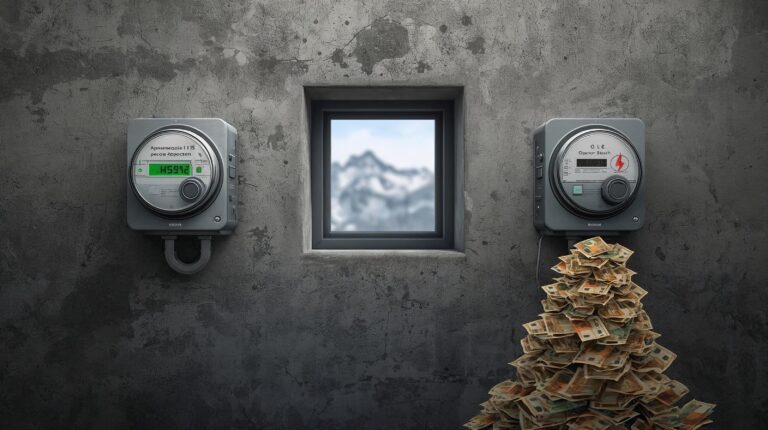
During the inspection, the broker mentions in passing, almost casually, that „the complex is still on public power,“ but is quick to assure you that this is a „temporary situation“ and „the documents have been submitted.“ You are ready to put down a down payment and head to the bank for a mortgage.
WARNING: STOP RIGHT HERE!
The phrase „"total current"“ or „"industrial current"“ is the biggest and most dangerous "red flag" in the real estate market in Bansko in 2026. This is not just a minor inconvenience. This is a structural problem that can not only triple your winter heating bills, but also make getting a mortgage absolutely impossible at any reputable bank in Bulgaria.
In this detailed analysis, we will unravel the problem with industrial electricity in Bansko, why it is so prevalent, and why banks are running away from such properties like fire.
1. The Fundamental Difference: Household vs. Industrial Electricity
Before we understand why banks are scared, we need to clarify the basic concepts of the energy market in Bulgaria, which often confuse foreign and even local buyers.
Domestic electricity (For households)
This is the standard. The electricity you use in your main residence. Its price is regulated by the state through KEWR (Energy and Water Regulatory Commission). Prices are predictable, stable and socially acceptable. Most importantly: each apartment has its own, individual account and electricity meter with the electricity distribution company (in Bansko this is ERM Zapad, part of Electrohold). You pay only and only what you have spent, and you are responsible only for your account.
Industrial Electricity (For Business)
This is electricity intended for factories, hotels, restaurants and office buildings. Its price is the free market and changes dynamically – sometimes daily or hourly, depending on stock market indices. Historically, especially during winter months and during energy crises, the price of industrial electricity can be 2 to 4 times higher than that of the household one. It also includes additional fees for "obligations to society" and higher network services.
The genesis of the problem in Bansko: During the construction boom (2005-2010), many investors of holiday complexes did not complete the procedure for connecting the buildings to the ERM West network. They left the entire complexes on „temporary construction electricity“ or on a common industrial electricity meter registered in the name of the investor company or the management company. Dozens of buildings in Bansko operate in this way to this day.
2. Why do banks massively refuse mortgages for properties with industrial electricity?
For you, as a buyer, industrial electricity means shockingly high bills in the winter. However, for the bank, it means something much scarier: UNACCEPTABLE FINANCIAL AND LEGAL RISK. Banks don’t want to own collateral that is problematic. Here are the three main reasons why lenders are closing the door on such deals in 2026:
Reason A: Report of serious legal and technical irregularities
Many buyers believe that once a building has Act 16 (Certificate of commissioning), everything is fine. This is a huge misconception. The presence of Act 16 is a necessary, but not a sufficient condition for the presence of household electricity.
The lack of individual lots is often a symptom of a deeper and more expensive problem: the investor may not have built the necessary substation, may not have paid the fees for connection to the ERN West, or the building's internal installation may not meet modern requirements. For the bank, this is a property with an "unclear technical status," the repair of which could cost the condominium tens of thousands of leva.
Reason B: The Nightmare of „Collective Responsibility“
This is the biggest fear of every creditor. When a building is on a common electricity meter, the bill arrives in the name of a single legal entity (for example, the building management company). This company pays the huge common bill and then redistributes it among the owners based on internal (often unsealed and illegitimate) control electricity meters.
At this point, the property becomes uninhabitable – without heat, without light, without hot water. The uninhabitable property loses its value instantly and becomes unsaleable (illiquid). If the borrower stops paying their mortgage, the bank is left with collateral that is worth next to nothing.
Reason B: Direct threat to the client's solvency
When the bank calculates whether you can afford the loan, it looks at your debt-to-income ratio. But it also takes into account your living expenses.
If you heat with electricity in Bansko (which is the most common case) and are on an industrial tariff, the electricity bill for a small two-room apartment in January can easily reach 600 – 900 BGN. If we add the loan installment, your monthly expenses become unaffordable for an average income. Banks know this and preemptively refuse financing because the risk of you stopping servicing the loan due to unaffordable utility bills is huge.
3. The Myth of the „Quick Fix“ of Batches
Brokers selling such properties often use reassuring phrases: „"The procedure is underway," "We are raising money for a substation," "We will have household electricity in a month or two.".
Expert advice from Bansco.com:
Be extremely skeptical. There are complexes in Bansko where these promises have been repeated annually for 10 years. The transfer from industrial to domestic electricity is a complex, slow and expensive bureaucratic process, requiring full unanimity of the condominium, new projects and significant investments in infrastructure. If you are buying with a mortgage, do not rely on promises about the future - insist on a property with already opened, active individual household lot.
4. How to check the property before making a down payment?
Don't just rely on the seller's or agent's verbal assurances. Here are the steps for a quick and safe check:
- Request the latest OFFICIAL electricity invoice: Don't settle for a random note or Excel spreadsheet from the property manager. Ask for a real invoice from ERM Zapad. Look at the owner – if it's a company and not the individual seller, that's a bad sign. Look at the price per kWh – if it's significantly above the regulated household price, it's industrial electricity.
- Request an ITN/Customer Number: Every legitimate residential subscriber has a unique customer number (CIN) with ERM West. If the seller cannot provide you with such a number for the specific apartment, then it does not have its own batch.
- Inspect the electricity meters: Ask where the electricity meter board is. If you see one huge common electricity meter or multiple small, unsealed ERM Zapad control electricity meters, run far away.
Conclusion
Buying a property on industrial electricity in Bansko is a financial gamble that almost no bank wants to finance in 2026. The low initial price is quickly made meaningless by the astronomical bills and the constant risk of being left in the dark and cold because of other people's debts. If you are planning a purchase with a mortgage, this type of property should definitely be dropped from your list of options, no matter how tempting the offer seems.
Not sure about the electricity status in your chosen property?
Don't risk losing your deposit or being denied a loan. We can perform an independent verification of documents and guide you to properties with guaranteed household bills suitable for bank financing.




 English (UK)