


In this analysis we will consider:
- The Anatomy of the 2008 Property Bubble;
- Why 2015 was the “golden bottom” for buyers;
- How digital nomads and inflation changed the game;
- Are the levels of 1100+ euros/sq m a new bubble or a sustainable reality?.
Era 1: The Gold Rush and the British Invasion (2005 – 2008)
To understand today's situation, we need to go back to the beginning of the millennium. Back then, Bansko was not just a town under Pirin, but El Dorado for foreign investors. Between 2004 and 2007, the resort was aggressively advertised in the UK and Ireland as the "Alps of the Balkans", but at the price of a prefab apartment in London.
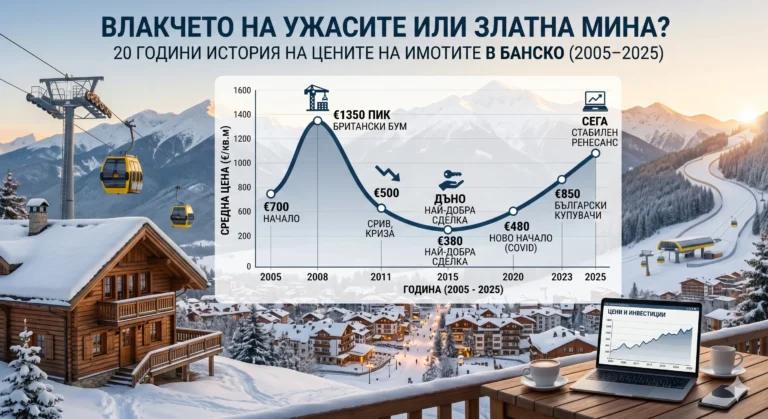
Marketing dreams: British pensioners and young speculators bought properties „off-plan“, often relying solely on colourful brochures. At the time, Bansko was a huge construction site. Prices started at a reasonable €700/sq m, but the hysteria quickly inflated the bubble. By the end of 2007, deals for luxury apartments near the gondola were reaching unimaginable levels. 1300–1500 euros/sq.m..
Era 2: The Burst and the „Decade of the Buyer“ (2009 – 2018)
The global financial crisis of 2008 hit Bansko with devastating force. The collapse of the British pound forced thousands of foreigners to exit the market at once. A “free fall” in prices followed.
The absolute bottom (2014–2016): If there was ever a time to invest, it was 2015. That's when the market hit rock bottom. 40-square-meter studios were selling for 10,000-12,000 euros. The average price per square meter fell to a historic low of 380 euros.
Important change: During this period, the profile of the buyer changed. The English were replaced by Bulgarians from Sofia, Plovdiv and Varna. They were looking for a bargain holiday base and were much more demanding of the quality of construction.
Era 3: The Renaissance and the New Normal (2020 – 2025)
The COVID-19 pandemic has become an unexpected catalyst for property prices in Bansko. Lockdowns have made people realize the value of nature and clean air. The city has become a global hub for digital nomads, which has created a new type of demand – for year-round use.
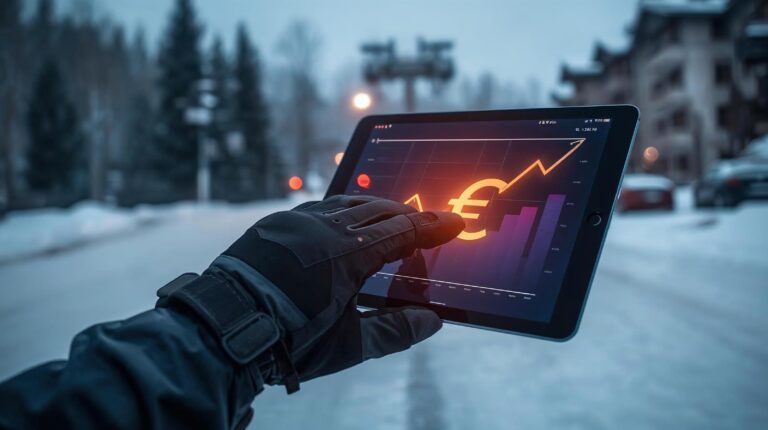
By early 2025 the prices of quality properties in Bansko they are again chasing levels of 1100–1200 euros/sq m. Inflation after 2022 also played its role, causing people to "concrete" their savings in assets under Pirin.
Statistical overview: Price movement (€/sq m)
| Year | Average price (€) | Market condition |
|---|---|---|
| 2005 | ~700 | Beginning of the construction boom |
| 2008 | 1350 (PIK) | Speculative bubble |
| 2011 | 500 | Sharp crash (-60%) |
| 2015 | 380 (BOTTOM) | Oversupply |
| 2020 | 480 | Start of recovery |
| 2023 | 850 | Inflationary pressure |
| 2025 | 1100+ | Mature, stable market |
Why isn't today's growth a bubble?
Many skeptics ask: „"Isn't a new balloon inflating?"“. The analysis shows that the current situation is fundamentally different for three main reasons:
- Actual usage: Today, properties are bought for living or long-term rental, not for quick resale the next day.
- Construction deficit: There is currently no indiscriminate construction. Moratoriums and the lack of regulated plots around the ski area limit the supply.
- Informed buyer: People already make a distinction between a "hotel-type" complex and a residential building.
The critical factor: Maintenance fee
This is the most important aspect that determines the price and liquidity. On the Bansko market today you can see a paradox – two identical apartments with a price difference of 30,000 euros.
High fee (12-15€/sq m)
Typically in complexes with pools and spas. These properties are cheaper to buy, but harder to sell and carry an ongoing expense.
Low fee (symbolic)
Residential buildings in the urban area. These are the “golden hens.” They command a high price because the costs of ownership are minimal.
Forecast for 2025-2030: Where are we going?
The trend is towards stabilization. The era of "no money" properties is irrevocably over. It is expected that:
- Price increase of "urban" properties: Housing with low taxes and good insulation will become increasingly expensive.
- Renaissance of the old part: Investors will focus on renovating authentic houses in the center.
- Increased rental market: As more and more "nomads" enter, rental yields will become more attractive than the asset's appreciation itself.
Are you planning an investment in Bansko?
The train is not abandoned, but it is now moving at a higher speed. Careful analysis of fees and location is the key to success in 2025.