


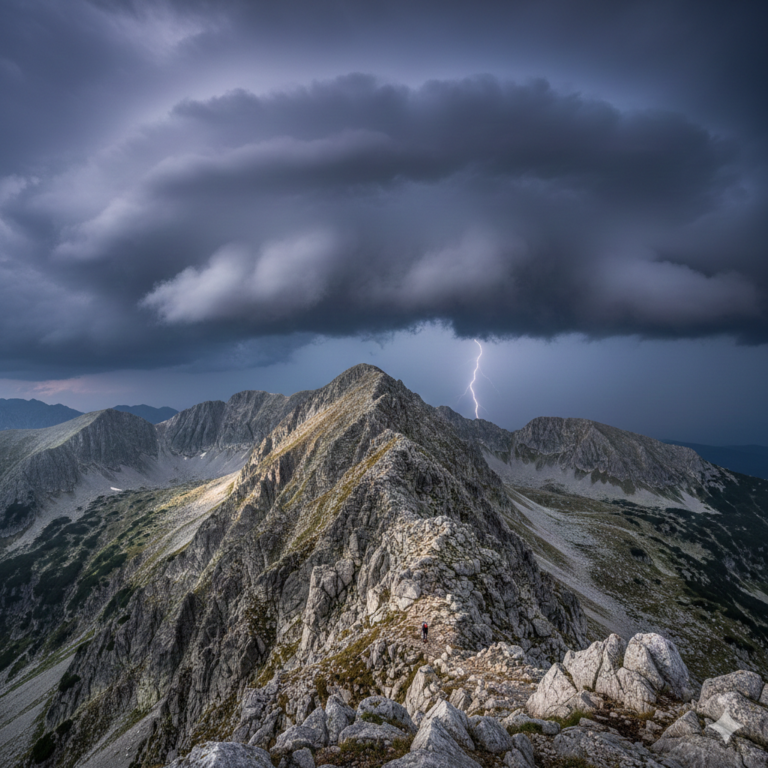
Storm season: Why is Pirin special?
The period from May to the end of July is the most dynamic. Due to the specific relief of Pirin – narrow karst edges and high granite peaks – thermodynamic processes are extremely intense. The heating of the rock masses leads to the rapid rise of air masses, which is the main ingredient for the formation of powerful cumulonimbus clouds.
The „Early Departure“ Rule: The Key to Survival
To avoid the dangerous ones summer storms in Pirin, your strategy should start as early as 05:00 or 06:00 in the morning. The standard scenario in the mountains follows a strict logic:
- 07:00 – 10:00: Crystal clear skies and excellent visibility.
- 11:00: Appearance of the first "innocent" white cumulus clouds.
- 1:00 PM – 2:00 PM: The clouds are getting bigger and darker at their base.
- After 2:30 PM: A storm breaks out with lightning, strong winds and often hail.
Your goal is to start descending from the high peaks (such as The horse) or the peaks (Vihren, Todorka, Polezhan) and be in the forest belt or near a hut.
Signs of imminent danger
Recognizing the signs that nature gives us can save a life. Pay attention to the following two factors:
1. Cumulonimbus clouds
If you notice a cloud that develops vertically like a huge tower, and its top begins to blur and resemble an anvil, this is a sure sign of an approaching storm. This "anvil" is an indicator that the cloud has reached the stratosphere and is ready to "unload.".
2. Static electricity
This is the final stage of warning. If you feel a characteristic buzzing in the air, hear a „crackling“ sound from the metal parts of the backpack, or your hair starts to stand on end – you are in the immediate strike zone. You only have seconds to get into a safe position.
Thunderstorm response protocol
If a storm catches you outdoors, follow these steps without exception:
| Action | Why is it important? |
|---|---|
| Leave the ridge | Ridges are the most exposed points for lightning. |
| Metal insulation | Leave poles and backpacks with frames 20-30m away from you. |
| Correct posture | Squat with your feet together to avoid "foot strain.". |
| Turn off the phone. | Reduces the risk of directing an electromagnetic pulse. |
The "Horse" Danger„
The karst ridge "Koncheto" is emblematic of Pirin, but during the summer storms in Pirin it becomes an "electric chair." The metal rope that serves as a safety is a perfect conductor. If lightning strikes one end of the edge, the charge flows through the entire rope.
Critical warning:
Never touch the metal rope of the Horse if you hear thunder, even if it seems far away. Distance in the mountains is deceptive!
Frequently Asked Questions (FAQ)
Is it safe in a cave or under a canopy?
This is a dangerous myth. Shallow caves and rock crevices are traps. Lightning travels along the surface of the rock. If you stand at the entrance, the current can jump through your body, seeking a shorter path to the ground. Only stay in a cave if you can get at least 3-4 meters inside and are away from the walls.
How to calculate the distance to the storm?
Sound travels at about 340 m/s. Use the formula:
Seconds between lightning and thunder / 3 = Distance in kilometers.
If the difference is less than 10 seconds (about 3 km), you are already in the danger zone and you must take safety measures immediately.
Do the lifts work in bad weather?
No. The cable car and chairlifts in the area of Bansko (Banderitsa, Bezbog) stop automatically in wind speeds above 15-18 m/sec or in the presence of lightning within a radius of 10-15 km. Do not count on the last lift if a storm is approaching.
The article is prepared for prevention and awareness purposes. Before every hike in Pirin, check the forecast on Meteoblue or specialized mountaineering sites.


 English (UK)