

Macroeconomic framework and real estate market
During the period under review, the economic climate in Bulgaria demonstrated sustainable growth. In this context, the economy of Bansko went through a phase of “healthy adjustment”, moving away from the speculative model that dominated at the beginning of the century.
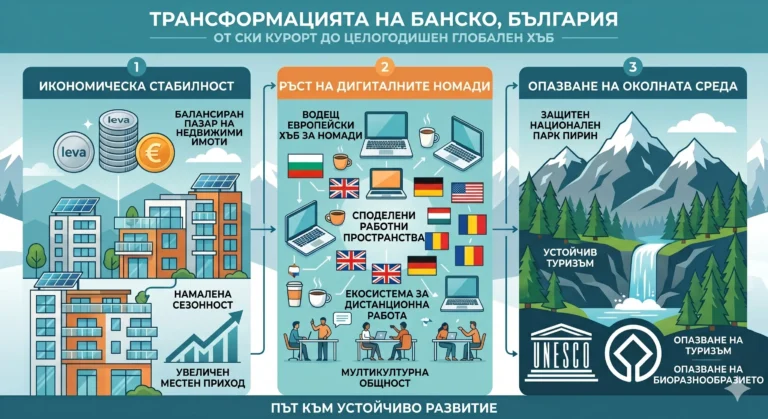
Stabilization of property prices
Market analysis shows that a long-awaited balance between supply and demand was achieved in 2019. While prices in Sofia were chasing record levels, the market in Bansko stabilized in the range of 650 to 850 euros per square meter for apartments in good condition.
| Property Type | Price Range (€/sq m) | Market Dynamics |
|---|---|---|
| Studios (Secondary Market) | €350 – €550 | High volume of transactions (Cash buyers) |
| Middle class (Good location) | €650 – €850 | Balanced market |
| Premium / Ski-in Ski-out | €850 – €1,200 | Limited Supply |
The change in the buyer profile was noticeable – British and Russian speculators were replaced by Bulgarian families looking for a holiday home and citizens from neighboring Balkan countries. This led to a more stable ownership structure.
The Rise of Digital Nomads: The New Economic Engine
If we had to name one factor that changed the concept of sustainable development of Bansko, this is the Coworking ecosystem. In 2019, the city legitimized itself as a global destination for remote work.
Evolution of Coworking Bansko
From its inception as a bold idea, by 2019 the community had reached critical mass. The statistics are stark: the city scored growth of 245% as a hub for remote work, overtaking destinations like Las Vegas and Helsinki in the rankings of Nomad List.
This phenomenon has solved the biggest problem of mountain resorts – seasonality. Digital nomads stay for an average of 1-3 months, utilizing the building stock in the “dead seasons” and generating a steady stream of revenue for local businesses.
Become part of the future of Bansko
Invest in property or develop your business in the most dynamic point in the Balkans.
Tourism infrastructure and world events
In 2019, Bansko proved its organizational capacity by hosting the Men's Alpine Skiing World Cup. The event put the Alberto Tomba slope under the spotlight and tested the infrastructure of Yulen AD to the limit.
Albert Popov's success this season has further stimulated domestic tourism. Despite the technical challenges and the queues at the starting station of the lift, Bansko has maintained its leading position in the Balkans with the most developed après-ski stage and a rich bed base.
Environmental policy and the “Pirin” case study”
The ecological aspect of the sustainable development of Bansko went through tough legal battles. The year was marked by the final decision of the Supreme Administrative Court (SAC) in January 2019, which halted changes to the Pirin National Park Management Plan.
Legal and international aspects:
- Decision of the Supreme Administrative Court: Confirmed that new construction without an environmental assessment is inadmissible in protected areas.
- Pressure from UNESCO: At the Baku session in July 2019, the World Heritage Committee remained firm in its demands for the protection of ancient pine forests.
- The new strategy: The lack of a "Second Gondola" forced the local economy to seek growth through product diversification, rather than through physical expansion of the ski area.
Conclusion: Sustainability through adaptation
The analysis of this key period shows us that the failure of plans for large-scale industrial expansion became an unexpected catalyst for better development. Bansko did not become an overdeveloped “mega-resort”, but evolved into a year-round destination combining sports, culture and modern technologies.
The road to sustainable development of Bansko Today, it is a balance between the nature of Pirin and the innovative spirit of the city's new residents. This is the model that guarantees security for investors and a high quality of life for the local community.