
However, there are specific risks in the Razlog and Bansko region. The wrong choice of configuration can turn an investment of 20,000 BGN into a serious problem if the equipment is not adapted to the harsh mountain climate and frequent temperature inversions.
The big dilemma: Split system or Monoblock?
In Western Europe, “Monoblock” type systems are widely used because they are easy to install. However, for the specific conditions in Bansko, we recommend definitely Split system.
Why is the Split system safer in the mountains?
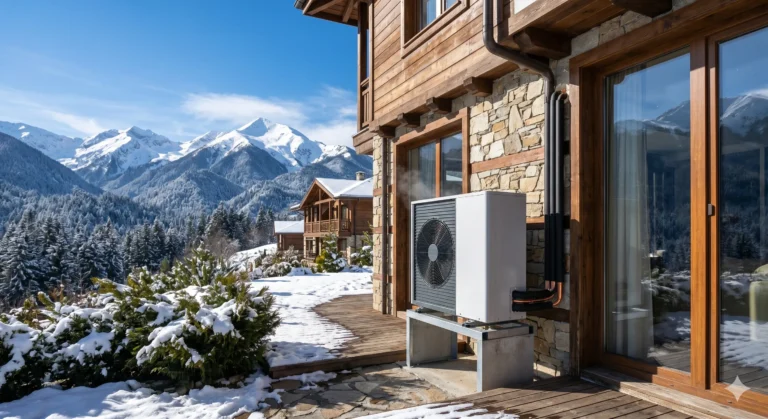
In a split system, the heat exchanger (the connection between the freon and the water) is located inside the building, in a protected location. Only freon circulates outside, which has an extremely low freezing temperature. This is critical in case of winter accidents.
The risk with Monoblock: In this type of system, the water from the heating installation goes outside to the unit itself. If the power supply in the neighborhood is interrupted for 4-5 hours at -15°C (a common occurrence during snowstorms in Bansko), the water in the outdoor unit freezes and cracks the heat exchanger. The damage is often irreparable and is not covered by the warranty.
Expert advice: If you are architecturally forced to choose a monoblock, the system must be filled with propylene glycol (antifreeze) with high concentration, not pure water.
Why is a buffer tank mandatory for a heat pump in Bansko?
In Bansko, installing a heat pump without a buffer tank is a gross technical error. Due to the high humidity in the valley, the machine often goes into defrost mode. To melt the ice on its surface, it needs rapid heat energy.
- Without buffer: The system “steals” heat directly from the radiators. The radiators cool down suddenly, and you often hear an unpleasant crackling sound in the pipes due to the temperature contraction.
- With buffer: The machine draws energy from the hot water tank (buffer), and your radiators or underfloor heating continue to operate without interruption.
Top 5 Heat Pumps for the Region (2025 Ranking)
The choice of brand is decisive for the longevity of the system. Here are the models that best cope with the Pirin cold:
| Model | Max. Temp. | Best for |
|---|---|---|
| Mitsubishi Zubadan | 60°C | Renovations and radiators |
| Daikin Altherma 3 HT | 70°C | Old houses without insulation |
| Viessmann Vitocal | 65°C | Densely built-up areas |
| Toshiba Estia | 55°C | New construction / Flooring |
| Midea Thermal | 55°C | Budget solutions |
1. Mitsubishi Electric – Zubadan (Air-Water)
The undisputed favorite in the region. The technology Flash Injection allows maintaining nominal power even at -15°C and operation down to -28°C. Ideal for systems with existing radiators.
2. Daikin Altherma 3 H HT
This is the “heavy artillery”. Designed specifically to replace solid fuel boilers. It is one of the few that reaches 70°C of water without additional heaters, making it perfect for the old cast iron radiators in the center of Bansko.
3. Viessmann Vitocal
If your property is near Pirin Street or in the Old Town, silence is a priority. Viessmann offers the lowest decibel levels on the outdoor unit, preventing conflicts with neighbors.
Final tip: Radiators or Underfloor Heating?
About the climate in Bansko underfloor heating is the “gold standard”. It operates at a low temperature (35°C), which allows your heat pump in Bansko to achieve a COP above 4.0 (for every 1kW of electricity you get 4kW of heat).
If you are planning radiators, choose three-panel (Type 33) and resize them. The goal is to achieve comfort with “cool” water, which will reduce your electricity bills by up to 30%.