

💡 Interesting fact: The Bansko Art School was one of the three largest in Bulgaria during the Bulgarian Renaissance, along with the Tryavna and Samokov Schools. Its masters were so respected that they were invited to work as far away as Vienna and Mount Athos.
History of the Bansko Art School
Before we delve into the specific crafts, it is important to understand the context. In the 18th and 19th centuries, Bansko became an economic center thanks to its enterprising merchants. Traveling to Leipzig, Vienna and Budapest, they brought not only goods but also new aesthetic ideas. Thus was born the Bansko School of Art, which combined Orthodox canonical art with elements of Western European Baroque and Renaissance.
1. Woodcarving: A prayer carved into wood
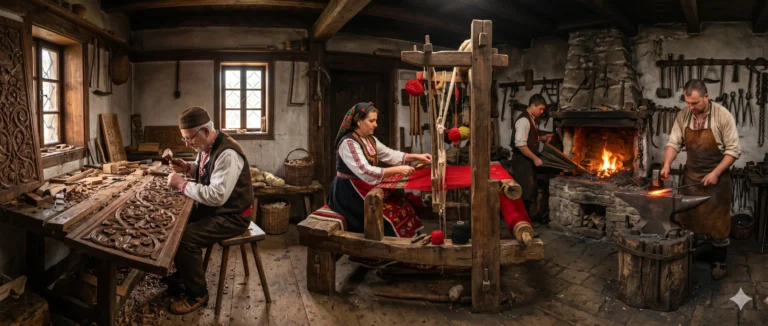
Woodcarving in Bansko is a phenomenon that goes beyond the boundaries of ordinary craft. It is a spiritual activity. When we talk about traditional crafts in Bansko, woodcarving is the first thing that comes to mind because of its monumental nature in local temples.
Philosophy of the tree
Bansko carving is not just decoration. It is characterized by complex floral motifs, intertwined with birds, dragons and mythical creatures. The wood seems to come to life, losing its weight under the fine chisel of the master. It is mainly used walnut tree because of its density and noble color, which darkens beautifully over time.
- Symbolism: Each leaf and each vine symbolizes the circle of life and the connection of man with nature.
- Technique: A “deep carving” is used, which creates a play of light and shadow, adding volume and drama.
The Masterpiece: The Iconostasis in the Holy Trinity„
The most striking example of this art is the iconostasis in the Holy Trinity Church. It is the work of masters from the famous Velyanov family. The details are so precise that they resemble fine silk lace, not solid wood.
2. Weaving: The colors of Pirin in the home
If woodcarving was the domain of men, then weaving was the song of the Bansko woman. In the harsh Pirin winters, the loom was the heart of every house. It is one of the most enduring traditional crafts in Bansko, which has remained almost unchanged to this day in authentic taverns and homes.
The Magic of "Scarlet" Red
The predominant color in local fabrics is deep red (scarlet). It symbolizes blood, life, and brings protective power to the home. Bansko women used natural dyes from plants and insects to achieve this unique shade, which does not fade for decades.
Rugs and carpets: Bathrobes (thick wool blankets with long pile) were the main salvation on icy nights. Their making requires enormous physical effort and skill in selecting the wool, which comes directly from the herds grazing in the alpine meadows of Pirin.
| Craft | Main Material | Symbolism |
|---|---|---|
| Woodcarving | Walnut, Fir | Spirituality and eternity |
| Weaving | Wool, Hemp | Home comfort and protection |
| Blacksmithing | Iron | Security and strength |
3. The Blacksmith: The Iron Will of the City
Bansko has always been a fortress. As a rich trading center, the city had to defend itself. Here, blacksmithing developed not only for the sake of agriculture, but also as a means of security. The metal fittings of the typical Bansko houses are a true engineering and artistic achievement.
Fortress houses and metal ornaments
Walk around the old town and look at the doors. They are massive, forged with heavy iron. Huge reamers and complex locks – this is the legacy of the old blacksmiths. Even in the rough metal, Banska Bystrica sought beauty. The door handles are often in the shape of snakes (guardian of the home) or lion heads.
Where to see traditional crafts in Bansko today?
To experience the magic live, we recommend visiting the following locations:
- Velyanova's house: A unique cultural monument where woodcarving and murals merge into one.
- Ethnographic Museum "Radonova House": Here you will find a complete collection of authentic fabrics, costumes and instruments.
- Permanent iconic exhibition: It is located in the building of the former convent and shows the peaks of the Bansko Art School.
- Pirin Street: In its upper part, small workshops still operate where you can buy handmade souvenirs made of wood or metal.
Expert advice for tourists:
If you visit Bansko during the "Festival of Traditions" (during the summer months), you will have the opportunity to try your hand at a loom or pick up a chisel under the guidance of local craftsmen. This is the best way to understand why these traditional crafts in Bansko have survived through the centuries.
Bansko is not seen. Bansko is felt through the touch of old wood, the warmth of the carpet and the clang of iron. Visit it and discover its history!